
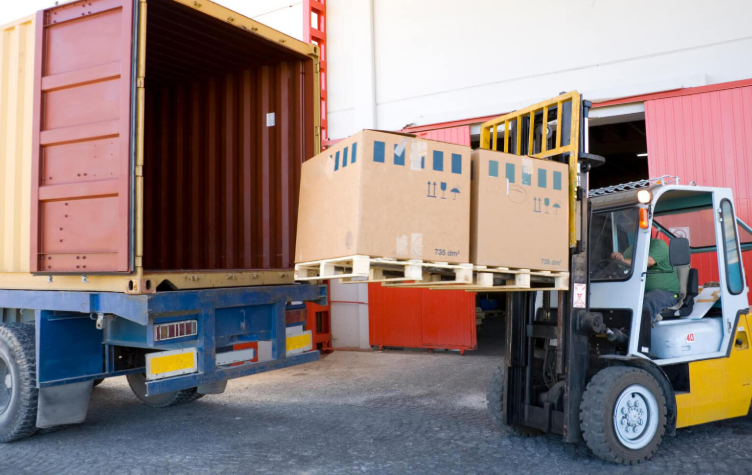
Calculating shipment CBM is simple.
Choosing the right shipping container is not.
A basic CBM calculation tells us the theoretical volume of a shipment, but it does not tell us exactly how cartons will fit inside a container.
In actual apparel shipping, I prefer to start by looking at the carton dimensions, not only the total CBM.
Why?
Because containers are not filled with liquid. They are loaded with physical cartons that have fixed lengths, widths, and heights.
Two shipments can have exactly the same total CBM and still require different loading arrangements—or even different container sizes.
That is why practical container planning should consider:
- Carton dimensions
- Carton quantity
- Total CBM
- Number of different carton sizes
- Container internal dimensions
- Door clearance
- Loading orientation
- Loading sequence
- Residual space
- Cargo weight
- Carton condition
- Finished-garment protection
The objective is not simply to calculate volume.
The objective is to choose a practical container and load it efficiently without damaging the cartons or the garments inside them.
What Is CBM?
CBM stands for cubic meter.
It is a measurement of volume commonly used in international freight and container planning.
For a carton measured in centimeters:
Length × Width × Height ÷ 1,000,000 = CBM per carton
For example, a carton measuring:
60 cm × 40 cm × 40 cm
has a volume of:
0.096 CBM
If the shipment contains 500 cartons:
0.096 × 500 = 48 CBM
The total theoretical shipment volume is therefore:
48 CBM
This is an essential number.
But it is only the beginning of the container-planning process.
Start With Carton Dimensions, Not Only Total CBM
When planning a container shipment, one of the first things I want to know is the size of the cartons.
A shipment may contain one standard carton size or several different carton sizes depending on:
- Style
- Size assortment
- Packing method
- Product category
- Customer requirements
- Order quantity
This matters because the physical dimensions of the cartons determine how many cartons can be arranged across the container width, along its length, and through its available height.
A simple comparison such as:
Shipment CBM < Container CBM
does not prove that every carton will fit efficiently.
The carton geometry matters.
Why Nominal Container CBM Can Be Misleading
Container specifications provide a useful reference for internal cubic capacity.
It is tempting to look at those numbers and assume that a shipment with a lower CBM will automatically fit.
But theoretical cubic capacity and practical carton-loading capacity are different concepts.
Imagine a shelf that has enough total volume for ten boxes.
If the shelf dimensions and box dimensions do not align well, you may only be able to place eight or nine boxes on it without damaging them.
A container presents the same basic problem on a larger scale.
Unused space may remain:
- Along the side walls
- Between carton rows
- At the end of the load
- Above certain carton groups
- Between different carton sizes
That space still counts as part of the container’s internal volume.
But it may not be usable for the cartons you need to load.
Nominal CBM is capacity. Practical loading is geometry.
Compare the Common Container Options
For many apparel shipments, the initial comparison is among:
20′ GP — 20-foot General Purpose
40′ GP — 40-foot General Purpose
40′ HC — 40-foot High Cube
The larger container obviously provides more theoretical volume.
But the objective should not automatically be to choose the largest option.
A good planning question is:
Which container can accommodate the shipment safely and practically without purchasing unnecessary space?
That requires looking beyond total CBM.
Do Not Try to Fill Every Cubic Meter
Maximum theoretical utilization is not necessarily the best loading plan.
This is particularly important for apparel shipments.
Finished garments are often packed into corrugated cartons. If cartons are forced into a space simply to improve utilization, they may become compressed, crushed, or deformed.
That can affect the garments inside.
Excessive carton pressure may contribute to:
- Garment wrinkles
- Creasing
- Distorted folding
- Damaged packaging
- Poor presentation at destination
- Additional pressing or steaming work
- Potential quality claims
The objective of container loading should therefore not be:
Fill every possible cubic meter.
A better objective is:
Achieve efficient container utilization while protecting the cartons and the finished garments inside them.
A small amount of unused space can be less expensive than damage to finished merchandise.
Keep Cartons in Their Normal Loading Condition
Whenever possible, cartons should be loaded in their normal condition.
Turning, forcing, squeezing, or placing cartons in an unsuitable orientation simply to use a small remaining space can create unnecessary risk.
There are situations where carton orientation can safely be changed.
But this should depend on:
- Product characteristics
- Packing method
- Carton strength
- Handling requirements
- Markings such as THIS SIDE UP
- Internal garment arrangement
It should not be done automatically just because a mathematical model shows unused space.
For practical planning, I prefer to maintain the normal carton condition first and then evaluate what usable space remains.
Load the Larger Cartons First
When several carton sizes need to share one container, I generally prefer to begin the planning process with the larger cartons.
The logic is practical.
Large cartons are more difficult to fit into irregular residual spaces.
Smaller cartons provide more flexibility later.
A basic planning sequence can therefore be:
Larger Cartons → Main Loading Area → Check Remaining Space → Smaller Cartons → Recheck Residual Space
This is not an absolute mathematical rule for every shipment.
Different carton combinations can produce different optimal arrangements.
But starting with the larger cartons is a useful practical method for understanding the major space requirement before trying to optimize the remaining areas.
Loading Sequence Can Change Container Utilization
Suppose a container carries three groups of cartons:
Shipment A — Large cartons
Shipment B — Medium cartons
Shipment C — Small cartons
Loading A first may create one residual-space pattern.
Loading C first may create another.
The total CBM of A + B + C has not changed.
But the shape and location of the unused space can change significantly.
This means:
Same CBM + Different Loading Sequence = Different Practical Result
For mixed-carton shipments, loading sequence should therefore be considered during planning rather than decided only when the container doors are opened.
Draw a Container Map Before Loading
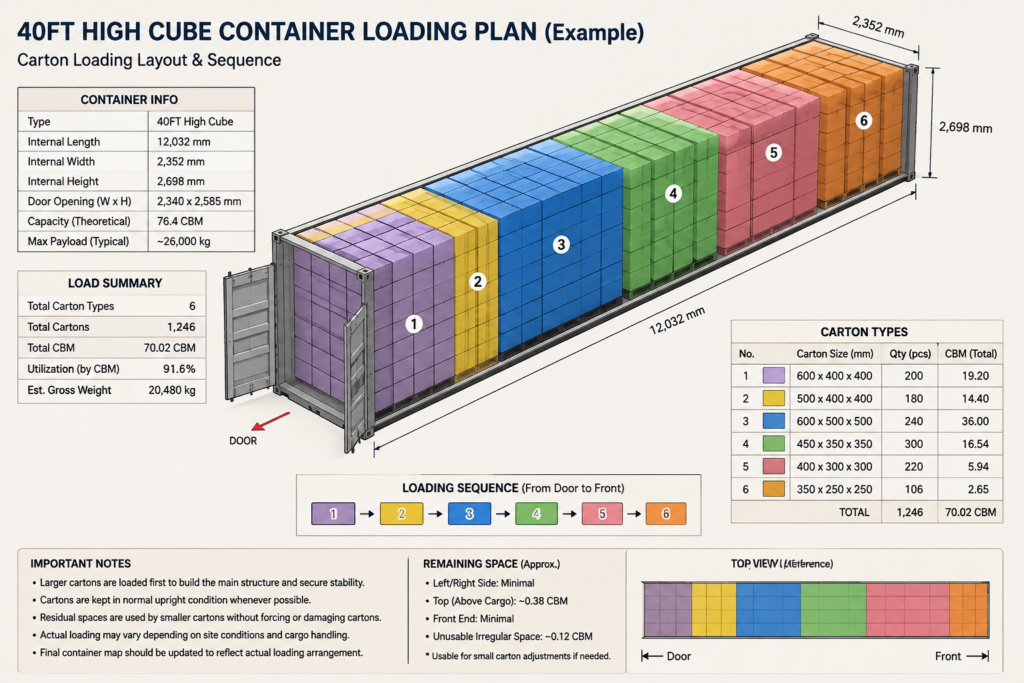
Before actual loading, I prefer to prepare a container map.
The purpose is to visualize how the cartons are expected to occupy the container before the loading team starts moving physical boxes.
A practical container map may identify:
- Container type
- Carton dimensions
- Carton groups
- Style or PO
- Carton quantities
- Loading sequence
- Approximate loading position
- Number of rows
- Number of layers
- Remaining space
The map does not need to be a sophisticated engineering drawing.
What matters is that the loading team can understand the intended arrangement.
Planning the load on paper—or with a digital estimator—is much easier than discovering a poor arrangement after hundreds of cartons have already been loaded.
The Container Map Should Follow the Actual Load
A container map should not disappear once loading begins.
Actual loading conditions may require adjustments.
A carton group may occupy slightly more space than expected.
A loading sequence may change.
A different carton orientation may be used.
The final map should therefore reflect how the container was actually loaded, not merely how it was originally planned.
This turns the container map from a planning sketch into a useful shipment record.
Put the Final Container Map Inside the Container Door
After loading is completed and the final arrangement has been confirmed, I recommend placing a copy of the final container map inside the container near the door where the receiving or unloading team can easily find it.
This provides practical value at destination.
When the container is opened, the unloading team can immediately understand:
- What cargo is inside
- Where different carton groups are positioned
- Where styles or POs change
- Which shipment group is located deeper in the container
- How the load was organized
The same document that helped the shipping team plan the loading can therefore help the receiving team understand the unloading.
The information flow becomes:
Loading Plan → Actual Loading → Final Container Map → Destination Unloading
That is much more useful than treating the container map as a document that only belongs to the loading side.
The map should be positioned so that it is visible and retrievable without interfering with cargo securement, door operation, seals, or safe unloading procedures.
Residual CBM and Usable Space Are Not the Same
One of the most important concepts in container planning is the difference between:
Remaining CBM
and
Usable Remaining Space
A calculation may show that 4 CBM remains inside the container.
But that 4 CBM may be divided into several narrow or shallow spaces.
If the next carton requires a larger continuous rectangular space, it may not fit.
Therefore:
4 CBM remaining does not necessarily mean 4 CBM of additional cartons can be loaded.
This is exactly why carton dimensions and a visual loading plan matter.
Check the Container Door, Not Only the Interior
Another easily overlooked point is the container door opening.
A carton may theoretically fit within the internal dimensions of the container but still create a problem at the entrance.
This is especially relevant for unusually large cartons or packaged products.
Before finalizing the plan, make sure the individual carton can physically pass through the applicable door opening in an acceptable orientation.
Internal capacity means little if the cargo cannot be loaded through the door.
Weight Still Matters
Apparel shipments are often strongly influenced by volume, but weight should never be ignored.
Container planning should consider both:
Volume utilization
and
Payload
A dense product may reach a weight limitation before the container reaches its cubic capacity.
Gross weight per carton can therefore be useful when evaluating the shipment.
In addition, the applicable carrier, equipment, port, road, rail, and local regulatory restrictions should be confirmed before final booking.
Why I Have Often Asked the Forwarder to Confirm the Booking
Finding the most efficient container arrangement can be surprisingly difficult.
The CBM formula itself takes only seconds.
The difficult part is translating that number into an actual loading plan.
Carton dimensions, multiple carton sizes, residual spaces, weight, container availability, and operational requirements all influence the final decision.
For that reason, in actual shipment planning I have often asked the freight forwarder to help confirm the appropriate booking.
That is not a weakness in the planning process.
A freight forwarder has direct knowledge of available equipment, carrier conditions, routing, and current operational requirements.
The factory or shipper should still understand its own shipment.
Ideally, the conversation with the forwarder should begin with useful information:
Carton Dimensions + Carton Quantities + Total CBM + Gross Weight + Proposed Container + Loading Considerations
The better the information provided, the more productive the booking discussion can be.
For more on managing apparel shipping terms, delivery methods, and warehouse delivery, see Apparel Shipping & Logistics: Managing FOB, LDP/DDP, and Warehouse Delivery.
Use a Calculator to Improve the Planning Conversation
A container calculator should not be presented as a replacement for the freight forwarder or carrier.
Its value is different.
It can help the factory, vendor, production team, or shipper understand the shipment before asking someone else to make the booking decision.
A useful planning tool can answer questions such as:
- What is the total shipment CBM?
- How much CBM does each carton group represent?
- Is a 20′ GP obviously too small?
- Should a 40′ GP or 40′ HC be evaluated?
- Do the carton dimensions create inefficient space?
- Could loading sequence improve utilization?
- How much residual space may remain?
- Could another carton group potentially use that space?
- Is weight becoming a limiting factor?
This makes the final conversation with the logistics provider more informed.
For more on connecting production schedules, lead times, and delivery requirements, see Apparel Production Planning & Lead Time: From PO to Warehouse Delivery.
Try the Container CBM & Loading Sequence Estimator
To make this planning process easier, Apparel Production Lab developed the Container CBM & Loading Sequence Estimator.
The Tool allows you to enter carton dimensions, quantities, and optional carton weight, then compare the shipment against common container options.
It is designed to help evaluate:
- CBM per carton
- Total shipment CBM
- Total carton quantity
- Estimated cargo weight
- 20′ GP / 40′ GP / 40′ HC options
- Carton fit
- Loading sequence
- Approximate carton utilization
- Residual space
The visualization is intended to support the same basic thinking used when preparing a container map: understand how physical cartons may occupy the available space rather than looking only at one total CBM number.
A Calculator Is Still an Estimate
No calculator can perfectly reproduce every actual container-loading condition.
Real loading can be affected by:
- Container manufacturing variation
- Carton dimensional tolerance
- Carton deformation
- Pallets
- Dunnage
- Bracing
- Cargo securement
- Weight distribution
- Carton stacking strength
- Handling requirements
- Loading equipment
- Operational access
- Carrier requirements
- Local regulations
For this reason, calculator results should be used for planning and comparison, not as a guaranteed loading instruction.
When the shipment is close to container capacity, has unusual cartons, uses pallets, is heavy, or involves special handling, the final plan should be confirmed with the responsible freight forwarder or carrier.
Final Takeaway
Calculating CBM is easy.
Good container planning requires more judgment.
Start with the carton dimensions and quantities.
Calculate the total CBM.
Compare appropriate container sizes.
Then consider how the cartons will physically fit, which cartons should be loaded first, what residual spaces will remain, whether the cartons can stay in their normal condition, and whether the proposed loading method protects the finished garments inside.
When several carton sizes are involved, preparing a container map before loading can make the operation easier to understand and control.
And once loading is complete, update that map to reflect the actual arrangement and keep a copy inside the container near the door so the destination team can understand the load during unloading.
Most importantly:
Do not sacrifice product protection simply to achieve a higher theoretical container-utilization percentage.
The best container plan is not necessarily the one that fills every cubic meter.
It is the one that uses the available space efficiently, protects the merchandise, supports practical loading and unloading, and gives the logistics team enough reliable information to make the final booking decision.
USE THE CONTAINER CBM CALCULATOR
Need Help With Apparel Production & Logistics Planning?
Apparel Production Lab provides practical support for apparel production planning, costing, factory execution, quality control, packing, shipment planning, and production-risk management.
If you need help connecting order quantities, carton planning, shipment schedules, container requirements, and delivery targets into a workable production and logistics plan, we can help evaluate the process around your actual order and operating requirements.