
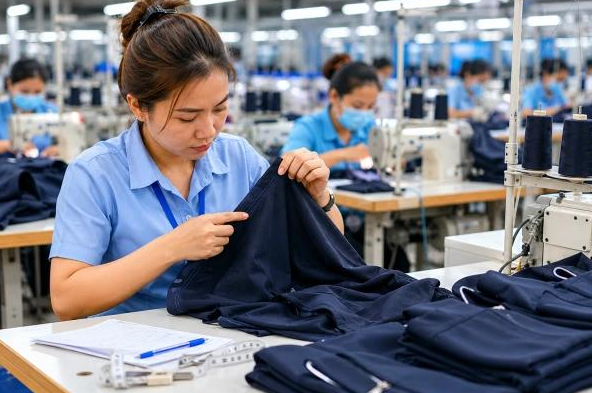
Quality control in apparel production should not begin when the garments are already finished.
By the time a serious construction, measurement, material, or workmanship problem reaches final inspection, hundreds or even thousands of garments may already have been produced with the same issue. At that point, correction becomes much more difficult, expensive, and time-consuming.
In my experience, the most important stage of garment inspection is inline inspection.
There is a simple reason for this: if the first button is fastened incorrectly, correcting everything that follows becomes much harder.
The objective of quality control should therefore be to identify a problem as close as possible to the operation where it begins, correct it against the approved standard, verify the correction, and only then allow production to continue.
Inline, end-line, and final inspection each have different responsibilities. When they work together properly, they form a quality-control system that prevents problems from moving unnecessarily toward packing and shipment.
Why Inline Inspection Matters Most
Inline inspection takes place while production is actually running.
For me, this has always been the most important quality-control stage because it provides an opportunity to correct a problem before the same mistake spreads through the production line.
A sewing line consists of many connected operations. A mistake at one operation may not remain isolated. It can affect later operations and eventually become a finished-garment problem.
This is why an inline inspector should not simply wait for completed garments at the end of the line.
The inspector needs to observe the production process at important operations throughout the line and determine whether each operation is being performed according to the approved product standard.
During-production inspection is also recognized more broadly as an important opportunity to detect deviations while manufacturing is still underway rather than waiting until pre-shipment inspection.
My Inline Inspection Priority
When checking production, I have generally followed this order:
1. Compare to the approved sample
2. Check construction
3. Check measurements
4. Check workmanship
The order is important.
It is easy to look at a garment and concentrate immediately on sewing appearance. But good workmanship does not make a garment correct if the garment itself is being made incorrectly.
Before evaluating how cleanly something is sewn, we need to know whether we are producing the correct garment.
1. Compare Production Against the Approved Sample
The approved sample should be one of the primary references on the production floor.
The actual production should be compared with it to determine whether the factory is producing what was approved.
The inspector should not depend only on memory, verbal instructions, or what the sewing operator believes is correct.
When there is uncertainty, return to the approved standard.
This comparison provides the starting point for checking construction, material application, measurements, workmanship, and other product details.
2. Check the Construction
Construction errors are particularly dangerous because they can be repeated continuously once the production method has been established incorrectly.
Examples may include:
- incorrect seam or assembly construction
- incorrect component attachment
- missing or additional operations
- incorrect positioning
- construction that differs from the approved sample or technical specification
A cleanly sewn garment can still be unacceptable if its construction is wrong.
For this reason, construction needs to be checked during production rather than waiting until finished garments reach final inspection.
3. Check Measurements
Measurements should also be checked during the production process.
The inspector should compare the garment against the approved measurement sheet and applicable tolerances.
Measurement problems may come from several sources, including cutting, sewing construction, operator handling, machine settings, fabric behavior, or finishing.
If an off-measurement condition begins appearing repeatedly, continuing production without identifying the cause can turn a correctable production issue into a large quantity problem.
Fabric and garment shrinkage can also contribute to measurement variation during production. For more on controlling shrinkage from fabric testing through bulk production, see Garment Shrinkage Control: From Fabric Testing to Bulk Production.
The important question is not simply:
“Is this garment off measurement?”
It is also:
“Why is it off measurement, and is the same condition continuing through production?”
4. Check Workmanship
Workmanship remains an essential part of inline inspection.
Typical problems may include poor stitching, puckering, skipped stitches, open seams, uneven sewing, incorrect tension, poor alignment, or other visible sewing defects.
However, workmanship problems should be managed according to the operation where they occur.
A problem at one sewing operation does not always require the entire production line to stop.
This distinction is important because effective quality control should protect product quality without creating unnecessary production disruption.
Not Every Problem Requires the Same Response
One of the most important responsibilities of inline quality control is deciding how serious the problem is and how much production needs to be stopped.
In my production experience, major issues such as the following required immediate production stoppage:
Different construction
If bulk production differs materially from the approved construction, continuing production only increases the quantity that may later require correction or rejection.
Off measurement
When measurements are materially outside the approved tolerance and the condition is being repeated, production should be stopped until the cause is identified and corrected.
Wrong fabrication or material
If the wrong fabric, component, or material specification is being used, production should not continue.
Fabric quality problems should ideally be identified before the material reaches the sewing line. For more on controlling fabric quality before cutting, see Fabric Inspection and the 4-Point System: How to Control Fabric Quality Before Cutting.
These are not simply individual workmanship defects. They can affect the fundamental correctness of the product.
The response should therefore be:
STOP → IDENTIFY THE CAUSE → CORRECT → VERIFY → RESUME
Workmanship Problems Can Often Be Controlled at the Operation
Workmanship defects require a different approach.
When a workmanship problem is isolated to a particular sewing operation, I have generally preferred to stop the affected operation rather than automatically stop the entire line.
The process is:
Stop the affected operation → Correct the problem → Verify the correction → Resume the operation
At the same time, garments that may already have passed through that operation should be identified and checked when necessary.
This allows the factory to correct the problem at its source without creating unnecessary disruption throughout unrelated parts of the line.
The purpose of inline inspection is therefore not simply to find defects.
It is to decide how quickly and how far production must be controlled before the problem spreads.
Production Should Not Resume Until the Correction Is Verified
Correcting a problem is only half of the process.
Before production resumes, the correction should be checked against the original approved standards.
My normal verification process has been:
1. Compare again with the original or approved sample
2. Recheck the Tech Pack and Measurement Sheet
3. Confirm that the correction meets the approved requirement
4. Resume production
This is an important discipline.
Production should not restart simply because someone says, “The problem has been fixed.”
The corrected product should be verified against the same documents and samples that originally defined what the factory was supposed to produce.
A useful operating principle is:
Stop the problem at the operation where it starts, correct it against the approved standard, verify the correction, and only then allow production to continue.
The Role of End-Line Inspection
End-line inspection has a different purpose.
If inline inspection is controlling the manufacturing process while production is moving, end-line inspection acts as a quality gate before finished garments move toward final inspection.
I have generally used end-line inspection for three main purposes.
First, identify garments requiring repair and make sure they go through a proper repair process.
Second, check for problems that may have escaped inline inspection.
No inspection system is perfect. Even with good inline control, an issue may pass through the production line.
End-line inspection provides another opportunity to catch it.
Third, determine whether the finished garments have reached a quality level that is ready for final inspection.
This last point is especially important.
Final Inspection Should Not Become the Factory’s Repair Department
Final inspection should not be the first place where routine production defects are discovered.
If large quantities of repairable workmanship problems are still reaching final inspection, there is probably a weakness somewhere earlier in the quality-control process.
End-line inspection should separate products requiring repair, return them through the proper correction process, and confirm the repaired garments before they move forward.
In other words:
Inline controls the process.
End-line controls what comes out of the process.
Only after those controls have done their job should the production lot be prepared for final inspection.
The Role of Final Inspection
Final inspection has another responsibility.
Its purpose is to evaluate whether the completed production lot meets the required quality standard and is ready to move toward shipment.
Final random inspections commonly use statistical sampling procedures such as ANSI/ASQ Z1.4 or ISO 2859-1 and an agreed AQL requirement. SGS, for example, describes final random inspection at 100% production completion with at least 80% packed and ready for dispatch.
In my own production management experience, final inspection was normally scheduled when approximately 85% of the order had been packed, depending on the customer’s inspection requirements.
That 85% figure should be understood as a practical operating threshold I used—not as a universal rule. Buyer requirements and inspection protocols should always take priority.
The important principle is that enough of the order must be completed and packed for the inspector to obtain a meaningful random sample representative of the shipment.
AQL Should Be Used as a Sampling and Acceptance System
Final inspection is normally conducted according to the customer’s required AQL and inspection procedure.
The inspector selects the required sample from the production lot and evaluates the garments according to the agreed quality criteria and defect classifications.
One important point is that AQL should not be interpreted simply as “the percentage of defective garments allowed in the shipment.”
It is part of a statistical sampling and lot-acceptance system. The applicable sample size and acceptance/rejection numbers depend on the lot size, inspection level, sampling plan, and selected AQL. International inspection providers use ANSI/ASQ Z1.4 / ISO 2859-1-based sampling for this purpose.
The customer’s specific quality manual, defect classifications, inspection level, and acceptance requirements should therefore be confirmed before production and followed during final inspection.
What Happens When Final Inspection Finds a Problem?
A failed or problematic final inspection does not always lead to the same decision.
The next step depends on the nature of the problem.
If the problem is correctable, the affected production can go through the required repair or corrective process.
After correction, the lot should be prepared for re-inspection rather than assuming that the original failure has automatically been resolved.
The correction needs to be verified.
When the Problem Cannot Be Corrected
Some problems cannot be solved through normal repair or rework.
A serious construction issue, incorrect material, irreversible finishing problem, or another fundamental product deviation may fall into this category.
In such cases, my approach has been:
HOLD → INFORM CUSTOMER → RECEIVE CUSTOMER DECISION → COMMUNICATE THE DECISION → TAKE ACTION
This is an important management distinction.
Once a serious non-correctable problem affects customer requirements, the factory or internal QC team should not independently redefine what is acceptable.
The customer needs accurate information about the problem so that the appropriate commercial and shipment decision can be made.
Until that decision is received, the affected production should remain on hold.
Inline, End-Line, and Final Inspection Are Not Three Versions of the Same Inspection
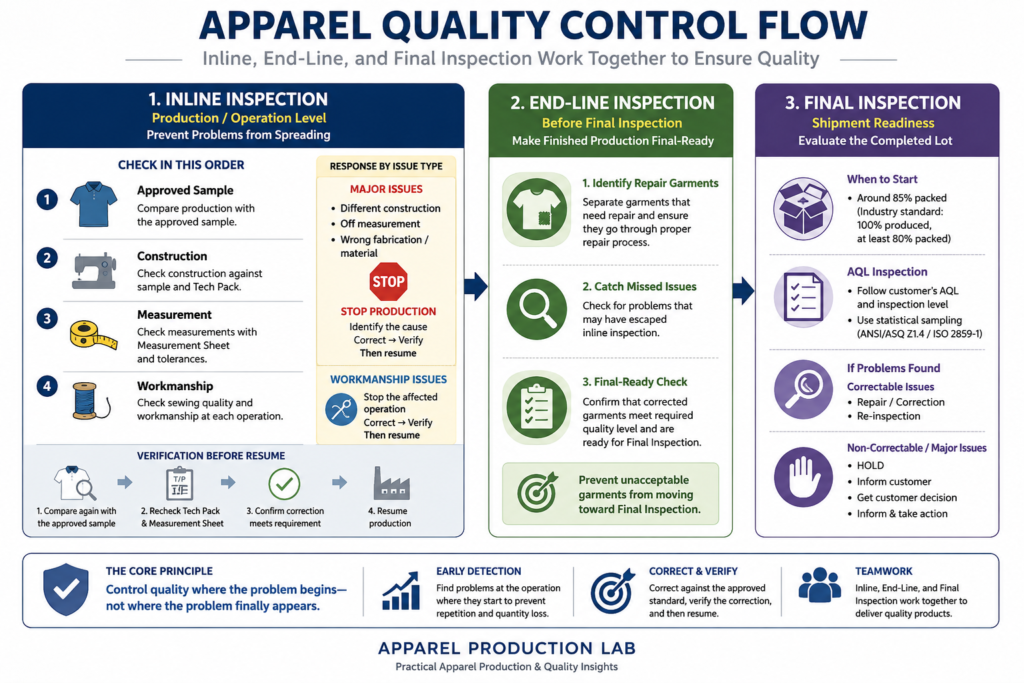
Each stage has a different job.
Inline Inspection — Prevent the problem from spreading
Inspect production at the operation level, compare against the approved sample and technical requirements, identify the source of problems, and correct them while production is running.
End-Line Inspection — Make finished production final-ready
Identify repair garments, catch issues that may have escaped inline control, verify corrections, and prevent unacceptable garments from moving toward final inspection.
Final Inspection — Evaluate shipment readiness
Use the required sampling and AQL procedure to evaluate the completed production lot and determine whether it meets the customer’s quality requirements before shipment.
When these three stages are treated as one connected system, quality problems can be controlled much earlier and more effectively.
Quality Should Be Controlled Where the Problem Begins
The biggest mistake in apparel quality control is relying too heavily on final inspection.
Final inspection is important, but it happens very late in the production cycle.
If the first serious quality decision is made at final inspection, the factory may already have produced, finished, and packed a large quantity of defective merchandise.
At that stage, even a correctable problem can mean extensive rework, additional inspection cost, packing disruption, shipment delay, or air-freight risk.
Good quality management therefore moves attention upstream.
Find the problem at the operation where it begins.
Determine whether it requires a full stop or a partial operation stop.
Correct it.
Return to the approved sample, Tech Pack, and Measurement Sheet.
Verify the correction.
Then allow production to continue.
That is much more effective than trying to inspect quality into a garment after production is already finished.
Final Takeaway
In apparel manufacturing, inspection should not be viewed only as a method for finding defective garments.
It should be a production-control system.
Inline inspection prevents problems from spreading through the sewing line.
End-line inspection makes sure repairable garments are properly corrected and that finished production is ready for final inspection.
Final inspection uses the required sampling and acceptance criteria to determine whether the completed production lot is ready to move toward shipment.
Of these three stages, I consider inline inspection the most important because it gives the production team the earliest practical opportunity to stop a repeated problem before it becomes a large-scale quality issue.
The principle is simple:
Control quality where the problem begins—not where the problem finally appears.
Need Help With Apparel Production & Quality Control?
Apparel Production Lab provides practical support for apparel production planning, factory execution, quality control, production-risk management, and shipment readiness.
If you need help developing an inspection process, controlling recurring production problems, evaluating factory quality performance, or connecting inline, end-line, and final inspection into a workable quality-control system, we can help evaluate the process around your actual product and production requirements.