

In apparel manufacturing, production lead time should not be viewed simply as the number of days required to cut and sew a garment.
The production process begins when an order is confirmed and continues through material development and approvals, fabric and trim production, transportation to the garment factory, garment manufacturing, inspection, shipment, and ultimately delivery to the customer’s warehouse.
This is why effective production planning requires more than a factory sewing schedule. It requires a complete Time and Action calendar — commonly called a T&A — that connects every critical activity to the required delivery date.
What Does Production Lead Time Really Mean?
For practical apparel production management, production lead time can be viewed as the total time required to move an order from confirmed PO to the agreed delivery point.
That process may include:
PO Confirmation → Material Development & Approval → Fabric & Trim Production → Material Transportation / Drop-Ship → Factory In-House → Pre-Production → Garment Manufacturing → Inspection & Packing → Shipment → Customer Warehouse In-House
The exact calendar varies depending on the product, sourcing structure, country of origin, material source, transportation method, commercial terms, and customer delivery requirements.
The important point is that production is not limited to sewing.
Fabric, trims, labels, packaging, and other components also have to be developed, approved, manufactured, and delivered before garment production can proceed.
Why a T&A Calendar Is Essential
A T&A calendar converts the required delivery date into a series of measurable production milestones.
Instead of asking only, “When will sewing start?” production teams should know:
- When must material POs be issued?
- When must colors and materials be approved?
- When must fit approval be completed?
- When must bulk fabric and trims be ready?
- When must materials leave the source country?
- When must they arrive at the garment factory?
- When must PP approval be completed?
- When can cutting and sewing begin?
- When should TOP samples be reviewed?
- When must final inspection be completed?
- When must the goods ship?
- When must they arrive at the customer’s warehouse?
A good T&A therefore works as a production roadmap, not merely a list of dates.
1. Start With the Required Delivery Date
Production planning should begin with the required customer delivery date and work backward.
Depending on the order terms, the critical date might be an ex-factory date, FOB date, delivery date, or warehouse in-house date.
This distinction matters.
If the customer requires an LDP or DDP delivery, additional time after international shipment must be included for transportation, customs clearance, inland delivery, and other destination activities.
The garment manufacturing process may be the same, but the total calendar required to reach the customer’s warehouse is longer.
Therefore, everyone involved should clearly understand which delivery date the T&A is designed to achieve.
2. Material Development and Approvals
One of the biggest mistakes in production planning is treating material lead time as separate from production lead time.
In reality, fabric and trims are part of production.
Before bulk materials can be completed, the process may require activities such as:
- Color standards
- Lab dips or color submissions
- Fabric quality approval
- Trim development
- Fit sample materials
- Fit sample approval
- Bulk fabric submission
- Bulk fabric approval
- Trim approval
- PP sample materials
These activities are connected.
For example, bulk fabric production may depend on color approval, while PP samples may depend on approved or representative production materials.
The T&A must therefore consider not only how long each activity takes, but also which activity must be completed before the next one can begin.
For more information about material selection and sourcing, read Fabric Sourcing for Apparel Production: How to Choose the Right Materials.
3. Material Production Lead Time
Once materials are approved, fabric and trims still need time to be manufactured.
Lead time can vary significantly depending on:
- Fabric type
- Yarn availability
- Dyeing or printing requirements
- Special finishes
- Custom trims
- MOQ
- Color quantity
- Mill capacity
- Season
- Country of production
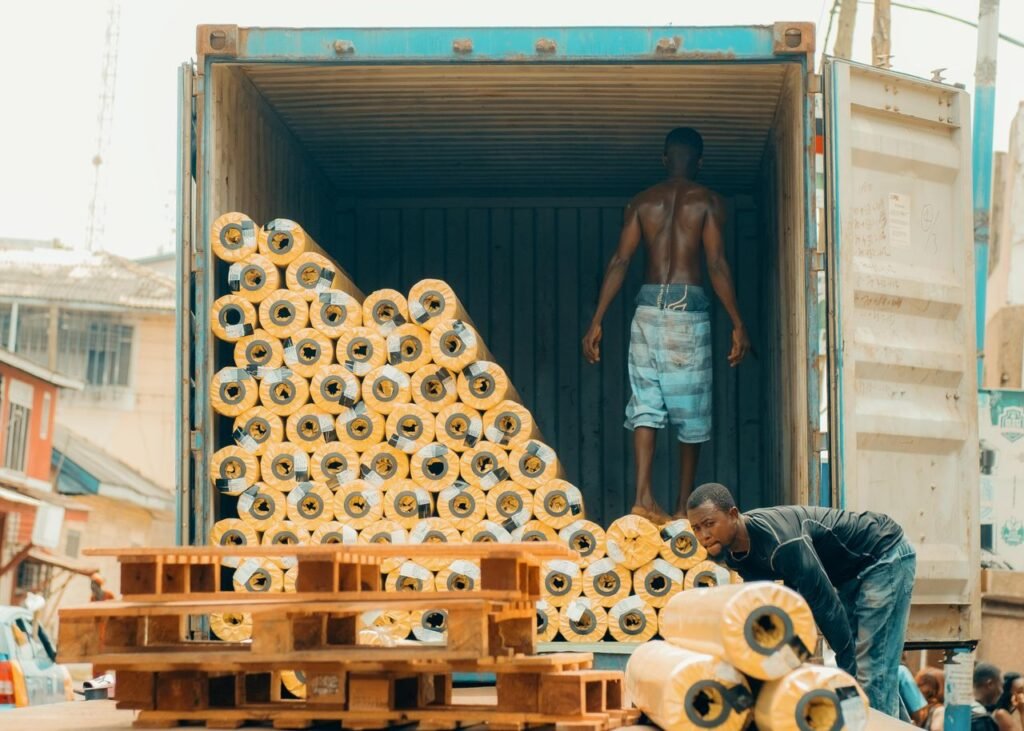
A material that requires 40 or 50 days cannot be treated as though it were available immediately after the PO is issued.
This is why material lead time should be established early in production planning.
4. Material Source and Drop-Ship Time
Where the materials are produced can have a major effect on the production calendar.
If the fabric mill, trim supplier, and garment factory are located in the same country or region, transportation time may be relatively short.
But many global apparel supply chains are more complicated.
For example, fabric may be produced in one country while garment manufacturing takes place in another.
In that situation, finished materials must be transported — or drop-shipped — from the material source to the garment factory.
The T&A therefore needs to include:
Material ETD → Transit Time → Customs/Receiving → Material In-Factory Date
This period can become a critical part of the production lead time.
A factory cannot begin bulk production simply because the fabric mill has finished producing the material. The material must actually arrive at the garment factory and be available for production.
5. Pre-Production Readiness
Once the required materials are available, the order moves toward final production preparation.
Typical milestones may include:
- PP sample submission
- PP sample approval
- Bulk thread or trim approval
- Fabric in-factory confirmation
- Pre-production meeting
- Final production instructions
The purpose of the pre-production stage is to make sure that the factory, merchandising team, quality team, and other responsible parties are aligned before bulk manufacturing begins.
The T&A should not treat these activities as optional administrative steps. Delayed approvals at this stage can directly affect sewing start and shipment.
For a deeper look at sample stages, read Garment Sampling Process: From First Sample to Production Approval.
6. Garment Manufacturing Lead Time
Only after the necessary materials, approvals, and production preparation are in place does the order enter bulk garment manufacturing.
Depending on the product, this may include:
Cutting → Sewing → Washing or Special Processing → Finishing → Inspection → Packing
The required time depends on factors such as order quantity, garment complexity, factory capacity, line allocation, efficiency, special processes, and quality requirements.
This is the part many people think of when they hear “production lead time.”
But in reality, it is only one section of the complete production calendar.
7. TOP Samples and Production Monitoring
Once bulk production begins, the production team still needs to verify that actual production is following the approved standard.
TOP — Top of Production — samples provide an opportunity to evaluate garments produced under actual bulk manufacturing conditions.
At the same time, production progress should be monitored against the T&A.
A schedule that looked achievable when the order was placed can change because of material delays, approval delays, production problems, capacity issues, or quality corrections.
The T&A therefore needs to be a working management tool, not a document created once and forgotten.
8. Final Inspection, Packing and Shipment
Garments are not finished from a production-planning perspective simply because sewing is complete.
Time must also be allowed for:
- Finishing
- Final quality checks
- Final inspection
- Packing
- Shipping samples
- Carton preparation
- Documentation
- Cargo handover
- Export procedures
A delay at the end of production can be just as damaging as a delay at the beginning.
If a shipment misses its scheduled vessel or cargo cutoff, a relatively small factory delay can become a much larger delivery delay.
9. FOB vs. LDP/DDP Lead Time
FOB and landed or delivered orders should not be planned with exactly the same final timeline.
For an FOB order, the supplier’s production calendar typically works toward the agreed FOB shipment obligation.
For an LDP or DDP order, the planning calendar must continue beyond international shipment toward the required destination delivery.
Depending on the arrangement, this may involve additional time for:
International Transit → Customs Clearance → Destination Handling → Inland Transportation → Customer Warehouse In-House
This does not necessarily change the time required to manufacture the garment itself.
What changes is the amount of time required after the goods leave the production country before the customer actually receives them.
10. Manage Dependencies, Not Just Dates
This may be the most important principle in apparel production planning.
A T&A should not be managed as a collection of independent deadlines.
The dates are connected.
If color approval is late, bulk fabric production may start late.
If bulk fabric is late, material ETD may move.
If material ETD moves, factory in-house moves.
If material in-house moves, the PP meeting and sewing start may move.
And if sewing starts late, TOP review, final inspection, shipment, and warehouse delivery can all be affected.
In other words:
One delayed action can move the entire critical path.
Strong production management means identifying these dependencies early and taking corrective action before the final delivery date is already at risk.
Build the T&A Backward — Manage It Forward
A practical way to think about production planning is:
Build the calendar backward from the required delivery date, then manage the order forward from PO confirmation.
Working backward establishes the latest acceptable dates for each critical milestone.
Managing forward allows the production team to compare actual progress with those planned dates and identify delays while there is still time to respond.
This is where a well-designed T&A becomes much more than an Excel spreadsheet.
It becomes the central production management tool connecting sourcing, merchandising, suppliers, factories, quality teams, logistics, and the customer’s delivery requirement.
Why Production Planning Matters
Many late deliveries do not begin with a problem on the sewing line.
They begin much earlier — with late approvals, delayed material POs, slow fabric production, missed material shipments, incomplete PP approvals, or poor coordination between different production locations.
Effective production planning makes those risks visible before they become shipment problems.
A strong T&A helps teams understand:
What must happen → Who is responsible → When it must happen → What depends on it → What happens if it is late
That visibility is one of the foundations of effective apparel production management.
Need Help With Apparel Production Planning?
Apparel Production Lab provides practical consulting for apparel production planning, sourcing, factory coordination, costing, and production management.
Whether you are developing a T&A calendar, dealing with material delays, coordinating production across multiple countries, or trying to protect a critical delivery date, we can help identify dependencies, production risks, and practical ways to improve the production plan.