
Choosing an apparel factory should involve much more than comparing prices, production capacity, or audit reports.
A factory may be large, well equipped, and competitively priced, but that does not necessarily mean it is the right factory for a specific product, order quantity, quality standard, or delivery requirement.
A practical factory evaluation combines two things: what you observe on the production floor and what you confirm through the factory’s management and production systems.
The objective is not simply to determine whether a factory is “good” or “bad.”
The real question is:
Does this factory have the right capability, capacity, management, and production system for this specific product and order?
Factory Evaluation Begins Before the Checklist
Most factory visits begin with a brief introduction or meeting with factory management, followed by a walk-through of the production facility and then a more detailed discussion about the business or specific orders.
The factory walk-through is particularly important because it allows you to see how the operation actually functions.
Before reviewing capacity reports, machinery lists, audit records, or costing, however, there are several things an experienced production professional may notice almost immediately after entering the production floor.
What I Notice First When I Walk Into a Factory
Organization — Not Just Cleanliness
The first thing I notice is how the factory is organized.
This is not simply a question of whether the floor has been cleaned for a visitor.
Materials, tools, work-in-process, production documents, equipment, and other items needed for daily operations should have logical locations and be reasonably easy for workers to identify and access.
A factory where people constantly need to search for materials, tools, or production information may indicate deeper issues with production control and management.
Good organization helps support efficient product flow, accountability, and consistent production.
The Sound and Rhythm of Production
The second thing I notice is the sound of the factory.
After spending enough time in manufacturing environments, you begin to recognize that a production floor operating smoothly often has a certain rhythm.
Machines are running consistently. Work is moving. Operators are working. Interruptions do not dominate the production environment.
The sound of a factory alone cannot determine whether it is well managed, but it can provide an early operational signal.
If the production floor feels unusually interrupted or disorganized, it gives you a reason to look more closely at workflow, bottlenecks, machine maintenance, line management, and production efficiency.
Worker Focus
The third observation is how workers behave while production is running.
When visitors walk through the factory, do workers repeatedly stop what they are doing to watch them? Or do most operators remain naturally focused on their work?
This should never be used by itself to judge workers or a factory. Cultural differences, the type of visit, and the circumstances of the day can all influence behavior.
But together with other observations, worker focus can provide clues about production discipline, supervision, workflow, and whether the factory is operating in its normal production rhythm.
These first impressions do not replace a formal factory evaluation.
They tell you where to look more closely.
Follow the Product Flow Through the Factory
A useful factory walk-through should follow the same basic path that the product follows through manufacturing.
A typical flow is:
Raw Material Warehouse & Incoming Inspection → Cutting → Sewing → Inspection & Packing → Finished Goods Warehouse → Shipping Area
Following this sequence makes it easier to understand how materials and garments are controlled from the moment they enter the factory until finished goods leave for shipment.
1. Raw Material Warehouse and Incoming Inspection
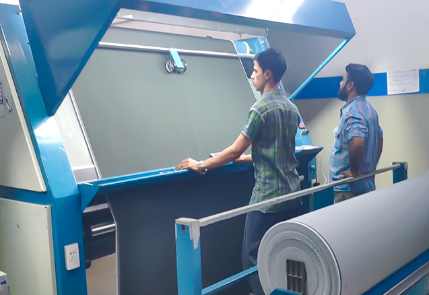
The evaluation should begin where production materials enter the factory.
Look at how fabric, trims, labels, packaging materials, and other components are received, identified, stored, and issued to production.
An important question is whether incoming materials are inspected before being released for manufacturing.
For fabric, this may involve checking quality, color, width, quantity, defects, or other required specifications. Trims and components should also be checked against approved standards where appropriate.
Pay attention to how accepted, rejected, pending, or questionable materials are identified and separated.
A factory cannot consistently produce a good garment if uncontrolled or incorrect materials are allowed into production.
For more information about material sourcing, read Fabric Sourcing for Apparel Production: How to Choose the Right Materials.
2. Cutting Department
The cutting department is where expensive fabric begins its transformation into garment components.
Observe how fabric is handled, relaxed when required, spread, marked, cut, bundled, numbered, and transferred to sewing.
Depending on the product and factory, important considerations may include:
- Fabric handling and identification
- Marker control
- Spreading
- Cutting accuracy
- Shade control
- Bundle identification
- Cut-panel inspection
- Work-in-process control
Mistakes created during cutting can affect many garments at once, so control at this stage is critical.
3. Sewing Floor
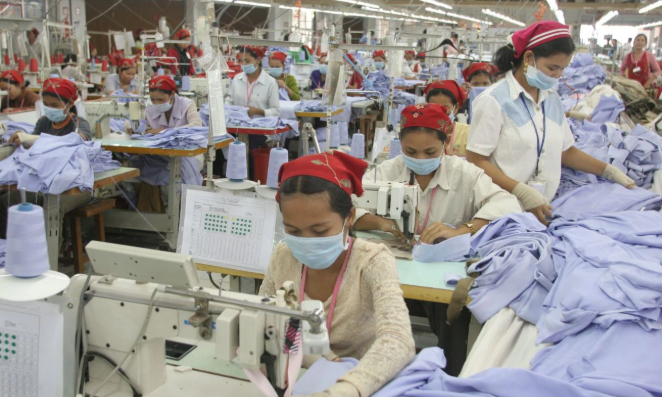
The sewing floor provides one of the clearest views of how the factory actually operates.
Do not look only at the number of sewing machines.
Look at the flow of production.
Observe whether work moves logically from one operation to another, whether excessive WIP is accumulating between operations, whether operators appear to be waiting for work, and whether obvious bottlenecks are developing.
Also consider whether the factory has the appropriate machinery and technical capability for the product being produced.
A factory that performs well on basic knit products may not necessarily have the same capability in tailored garments, outerwear, activewear, or technically complicated products.
Product specialization matters.
4. Quality Control During Production
Quality control should not exist only at the end of the sewing line.
Look for how the factory identifies and corrects problems while production is still running.
Depending on the operation, this may include inline inspection, measurement checks, workmanship review, end-line inspection, defect tracking, and corrective action.
The important question is not simply:
“Does the factory have QC inspectors?”
It is:
“What happens when they find a problem?”
A strong quality system should identify recurring issues, communicate them to production, correct the cause, and prevent the same problem from continuing through large quantities.
5. Inspection, Finishing and Packing
After sewing, garments may move through finishing, pressing, measurement checks, final inspection, folding, labeling, and packing.
Observe whether finished garments are protected from contamination or damage and whether rejected or repair garments are clearly separated from approved goods.
Packing requirements should also be controlled carefully.
Incorrect labels, size stickers, barcodes, folding, assortments, polybags, or carton markings can create serious problems even when the garment itself has been manufactured correctly.
6. Finished Goods Warehouse
The finished-goods warehouse is another useful indicator of factory management.
Finished cartons should be identifiable and organized so that orders, styles, colors, sizes, and shipment quantities can be controlled accurately.
Look at how completed goods are stored and protected while waiting for shipment.
A well-run factory should be able to identify what has been completed, what has passed inspection, what is pending, and what is ready to ship.
7. Shipping Area
The factory walk should continue through the shipping area.
This completes the physical product flow:
Incoming Materials → Production → Finished Goods → Shipment
At this stage, look at how cartons are controlled, staged, counted, documented, and handed over for shipment.
For brands working with strict delivery calendars, shipping control is part of production management—not an activity that begins after production is finished.
For a broader explanation of production timing, read Apparel Production Planning & Lead Time: From PO to Warehouse Delivery.
What to Evaluate Beyond the Factory Floor
The walk-through provides valuable information, but visual observations alone are not enough.
After seeing the factory, the next step is to connect those observations with the factory’s actual business and management capability.
Product Capability and Specialization
Ask what the factory actually produces well.
Review current production and, where appropriate, previous products that demonstrate relevant experience.
Consider:
- Product categories
- Construction complexity
- Fabric types
- Special machinery
- Technical capability
- Sample room capability
- Pattern and fitting support
- Finishing processes
The question is not whether the factory can technically sew a product.
The question is whether it can produce that product consistently, efficiently, and at the required quality level.
Capacity and Line Availability
A factory may state that it can produce hundreds of thousands of garments per month.
That number by itself tells you very little about whether your order will ship on time.
You need to understand:
- Current bookings
- Available production lines
- Planned line allocation
- Order quantity
- Expected efficiency
- Product complexity
- Required production period
- Seasonal capacity constraints
Factory capacity and available capacity are not the same thing.
A large factory that is fully booked may present more delivery risk than a smaller factory with the right capability and properly allocated capacity.
Management and Communication
Good equipment cannot compensate for weak management.
Evaluate the people responsible for merchandising, production planning, technical development, quality, sourcing, and factory management.
Consider how clearly they understand the product and whether they respond to questions with specific information rather than vague assurances.
When a problem occurs—and in apparel production, problems eventually occur—the quality of communication and decision-making becomes extremely important.
Subcontracting
Ask which processes are performed inside the factory and which are subcontracted.
Printing, embroidery, washing, special finishing, and other processes may legitimately be performed by specialized outside facilities.
However, it is important to understand where production actually takes place and how subcontractors are controlled.
One particularly important question is whether garment sewing itself may be transferred to another factory without the customer’s knowledge or approval.
Uncontrolled subcontracting can create risks involving quality, capacity, delivery, traceability, and compliance.
Compliance and Working Conditions
Compliance requirements vary by customer, market, product, and country.
Review the certifications, audits, safety requirements, working conditions, and other standards relevant to the intended business.
However, passing an audit should not be confused with demonstrating manufacturing capability.
A factory can meet compliance requirements and still be the wrong production partner for a particular product.
Compliance is essential where required, but it is one part of factory evaluation—not the entire evaluation.
Costing and Commercial Capability
After understanding the factory’s operational capability, evaluate whether its costing and commercial terms make sense for the intended business.
Consider:
- Cost structure
- MOQ
- Payment terms
- Material sourcing
- Production quantities
- FOB or delivered terms
- Lead time
- Shipping requirements
The cheapest quotation should not automatically determine the factory decision.
For a deeper discussion, read Garment Costing: What Determines the Cost of Apparel Production?
Factory Visit vs. Factory Audit
A factory visit, factory evaluation, and formal factory audit are related, but they are not necessarily the same thing.
An audit generally evaluates the facility against defined requirements, standards, or checklists.
A practical factory evaluation asks a different question:
Can this factory successfully execute my specific product and order?
Audit reports and certifications provide valuable information, but they cannot completely replace seeing how materials, workers, machines, quality systems, and management interact during actual production.
The strongest evaluation combines objective information with experienced observation.
The Best Factory Is the Right Factory
The best apparel factory is not necessarily the largest factory, the newest factory, or the factory offering the lowest price.
It is the factory with the appropriate:
Product Capability + Capacity + Technical Skill + Quality System + Management + Commercial Structure
for the specific product and order.
A successful factory evaluation therefore follows the product flow—from incoming materials through finished-goods shipment—and then connects what was observed on the production floor with the factory’s management capability and the requirements of the business.
That is how a factory visit becomes a production decision rather than simply a tour.
Need Help Evaluating an Apparel Factory?
Apparel Production Lab provides practical consulting for factory evaluation, global sourcing, production management, quality control, and apparel manufacturing.
Whether you are evaluating a new factory, comparing potential suppliers, reviewing production capability, or preparing to place an order, we can help identify operational risks and determine whether a factory is the right fit for your product and production requirements.