

Garment costing is often presented as a simple calculation.
Fabric cost plus trims, sewing, overhead, logistics, and profit eventually produce a selling price.
Mathematically, that may be true.
But in actual apparel production, the difficult part is not adding the numbers together. The difficult part is determining which numbers are realistic before they are entered into the cost sheet.
Delivery requirements, order quantity, fabric MOQ, factory CMPT, payment terms, shipping terms, production risk, and target profit can all change the final result.
For that reason, I do not view garment costing as only a mathematical exercise.
The calculation may be done in a cost sheet, but the numbers that go into that sheet should come from production knowledge, negotiation, logistics, and commercial judgment.
Start With Delivery, Not With Fabric Price
When I receive a new style for costing, one of the first things I check is the required delivery.
Why look at delivery before calculating fabric and sewing costs?
Because the required garment delivery date determines when actual production must take place.
That timing can affect many of the assumptions behind the cost.
A very tight delivery requirement may affect fabric sourcing options, available factory capacity, production planning, logistics, and even whether a particular sourcing strategy is realistic.
A price calculated without considering when the garment must actually be produced can therefore be misleading.
Costing should reflect the production conditions that will actually exist when the order must be produced—not only today’s prices and assumptions.
Order Quantity Can Change the Entire Cost Structure
After reviewing delivery, I check the order quantity.
Delivery and order quantity are two of the most important facts in garment costing because together they influence how the order can be produced, what it will cost, and whether the business can be profitable.
Order quantity can affect:
- Fabric purchasing conditions
- Fabric MOQ
- Trim MOQ
- Factory CMPT
- Production efficiency
- Factory capacity allocation
- Freight efficiency
- FCL versus LCL decisions
- Unit logistics cost
- Final profitability
A larger order does not automatically mean that every cost will be lower, and a smaller order does not simply mean multiplying the same unit cost by fewer pieces.
The production conditions themselves may change.
Order quantity is not just a number used to calculate total sales. It can change the entire cost structure of the order.
Fabric Cost Is More Than Fabric Price
Fabric is normally one of the largest components of garment cost.
The basic calculation may begin with fabric price and consumption or yield, but the commercial reality can be more complicated.
I normally consider the fabric price together with the MOQ and the actual order requirement.
If the required fabric quantity does not meet the mill’s normal MOQ, I do not automatically accept an MOQ surcharge and add it to the garment price.
My first approach is usually to negotiate with the fabric supplier and try to eliminate or minimize the surcharge.
This is an important part of costing.
Good costing is not only about calculating costs. It is also about managing costs before they become fixed.
However, there is an important distinction between a commercial MOQ problem and a production minimum.
If the mill can produce the fabric but wants an additional charge because the quantity is below its preferred MOQ, there may be room for negotiation.
But some fabrics simply cannot be produced below a certain practical quantity.
In that situation, the problem cannot be solved only by negotiating a surcharge.
Alternative fabric or mill options may need to be considered, or the issue may need to be discussed directly with the customer.
Raw Materials Must Be Costed as a Complete Package
Fabric is only one part of the material cost.
Depending on the garment, the cost sheet may also include items such as:
- Main fabric
- Contrast or secondary fabric
- Labels
- Zippers
- Buttons
- Tags
- Packaging materials
- Other trims and accessories
Each component should be based on realistic price and consumption assumptions.
A small difference in an individual trim may appear insignificant, but across a large order—or across multiple trims—small errors can accumulate into a meaningful cost difference.
The objective is not simply to fill every line of the cost sheet.
It is to make sure each line represents a cost that can realistically support production.
CMPT Should Be Evaluated, Not Simply Accepted
Another major component of garment cost is factory CMPT.
When a factory provides a CMPT quotation, I do not automatically enter that number into the final cost.
Based on experience, I normally have an approximate CMPT expectation after reviewing the garment, its construction, sewing requirements, and overall production difficulty.
I then compare my expected CMPT with the factory’s quotation.
From there, the final CMPT can be negotiated while considering factors such as:
- Garment construction
- Sewing difficulty
- Required operations
- Order quantity
- Delivery requirement
- Production conditions
- Factory capability and efficiency
A factory quotation should therefore be treated as an important input—but not necessarily the final answer.
A factory quotation is a starting point for costing, not necessarily the final cost.
Production experience is particularly valuable here because two garments that appear similar can require very different levels of sewing work.
Without understanding how the garment will actually be produced, it is difficult to judge whether the quoted CMPT is reasonable.
The Three Major Cost Areas
In practical garment costing, I tend to think of three major cost areas:
1. Raw Materials
2. CMPT
3. Logistics
Overhead and profit must eventually be added to determine the final commercial price, but these three areas form much of the operational cost structure behind the garment.
Each creates a different type of risk.
Raw materials can change because of price, consumption, MOQ, or sourcing conditions.
Logistics can change according to shipping terms, freight conditions, duty, destination costs, and shipment method.
CMPT has another dimension that is sometimes overlooked.
It is not only about how much the factory charges.
The CMPT payment term can influence whether the finished goods are actually released for shipment.
CMPT Payment Terms Can Become a Shipment Risk
This is one of the areas where overseas production experience becomes especially important.
When production takes place overseas, it is not always possible to visit the factory whenever a problem occurs. Communication can sometimes be difficult, and the commercial expectations of the factory and the ordering side may not always be the same.
CMPT payment arrangements therefore need to be understood clearly when the order is placed.
In my experience, factory payment arrangements commonly involve either an L/C (Letter of Credit) structure or T/T (Telegraphic Transfer).
With an L/C arrangement, many of the detailed payment conditions are established when the order and banking documents are arranged. This can reduce certain types of ambiguity if the terms are properly established.
T/T arrangements can require more active commercial management.
Factories generally prefer to collect their CMPT as early and securely as possible.
A factory may prefer a structure such as:
Final Inspection → CMPT Payment → Ex-Factory / Shipment
In other words, the factory receives payment before releasing the finished goods.
The ordering side, however, may prefer credit terms such as:
FOB / Shipment → 30 Days or More → CMPT Payment
This difference in preference can become a serious issue near shipment.
A Signed Payment Term Does Not Eliminate Operational Risk
Suppose an agreement specifies payment 30 days after FOB.
On paper, the term appears clear.
But overseas production does not operate only on paper.
If the current order is approaching shipment and there is no confirmed follow-up order, the factory may become concerned about collecting its CMPT.
Even when another order has been confirmed, the factory may still become concerned if the raw materials for the next production have not arrived and there is no visible continuation of work.
Under those circumstances, a factory may request CMPT payment before releasing the current finished goods—even when the original agreement provided for payment after FOB.
That can create a critical shipment problem.
The goods may be finished.
Final inspection may have passed.
The vessel schedule may be approaching.
But the shipment can still be placed on hold because of a commercial dispute over payment timing.
This does not mean that a factory’s demand automatically overrides the signed agreement.
It means that a written payment term by itself does not remove the operational risk of a shipment dispute.
That risk needs to be managed long before the goods reach the shipping date.
Factory Relationships Are Part of Cost Control
Many CMPT payment problems become more serious when there is little trust between the factory and the ordering side.
This is one reason factory selection should never be based only on the lowest quoted price.
If orders are continually moved among many factories simply to obtain the lowest CMPT, the short-term price may look attractive.
But the long-term commercial relationship becomes weaker.
My preference is to select the number of factories that are genuinely necessary for each product category and develop reliable working relationships with them.
Once a factory relationship begins, both sides need visibility and credibility.
Where appropriate, sharing realistic information about upcoming orders or business conditions can help the factory understand the expected continuity of production.
Payment discipline is especially important during the first several orders.
If an agreed payment date is repeatedly changed or missed early in the relationship, it becomes much more difficult to ask the factory for flexibility later.
Trust is built before the difficult order arrives—not during the dispute.
And from a costing perspective, this matters.
A few cents saved in CMPT can become very expensive if a weak factory relationship eventually puts a shipment at risk.
Define the Commercial Conditions Before Production
Good relationships are important, but they should not replace clear agreements.
When an order is confirmed, the commercial terms should be written as clearly as possible.
Payment method, payment timing, shipment release conditions, and other reasonably foreseeable situations should be discussed and documented before production reaches a critical stage.
The objective is not to create an unnecessarily complicated agreement.
It is to reduce the areas where the two parties may later claim that they understood the arrangement differently.
In international production, ambiguous language can become expensive very quickly.
Good commercial relationships require both trust and clear documentation.
FOB and LDP Start From the Same Garment
Shipping terms also have a direct impact on garment costing.
When I calculate both FOB and LDP prices, I generally begin with the same underlying garment cost structure.
The difference is what must be added to deliver the goods under the required commercial arrangement.
For LDP costing, additional expenses can include:
- Duty
- Ocean or other freight
- Customs-related expenses
- Handling charges
- Port or terminal-related charges
- Inland transportation
- Other local/import costs
Therefore, the simplified relationship can be viewed as:
FOB-Based Garment Cost
plus
Duty + Freight + Local / Import Costs
equals the additional cost structure required for an LDP price.
The exact items will depend on the shipment, destination, and commercial arrangement.
The important point is that logistics should be calculated from the actual shipping term rather than estimated as a generic percentage.
Logistics Can Change the Unit Cost
Order quantity becomes important again when logistics are calculated.
A shipment that moves efficiently as a full container can have a very different unit logistics cost from a smaller LCL shipment.
Carton volume, CBM, freight, destination charges, and other local expenses may all affect the final landed cost.
This is why logistics should not be treated as an afterthought after the garment price has already been decided.
For LDP business in particular, inaccurate logistics assumptions can reduce or eliminate an expected profit margin even when the factory production cost was calculated correctly.
Overhead and Profit Complete the Commercial Cost
Once the production and logistics costs have been established, overhead and profit must be considered.
But I do not believe one fixed profit percentage should automatically be applied to every order.
The appropriate target margin can depend on:
- Buyer
- Order quantity
- Competitive situation
- Production complexity
- Expected risk
- Payment terms
- Shipping terms
- Business relationship
- Overall commercial opportunity
A stable repeat order from an established customer may justify a different commercial decision from a difficult one-time order with higher production and payment risk.
Similarly, a highly competitive program may require a different margin strategy from a specialized product with fewer qualified suppliers.
Profit margin should reflect the business conditions and risk of the specific order—not simply a standard percentage stored in a spreadsheet.
Costing Is Also Negotiation
One of the biggest mistakes in garment costing is assuming that all input numbers are fixed.
Often they are not.
Fabric MOQ surcharge may be negotiable.
CMPT may be negotiable.
Some sourcing options may change after reviewing order quantity.
Freight strategy may change.
Even the final margin may need to reflect the commercial importance and risk of the order.
The same cost discipline must continue after the initial quotation because material, production, and logistics costs can change as the order moves toward bulk production.
Therefore, costing is not just:
Collect Numbers → Add Numbers → Quote Buyer
A more realistic process is:
Understand the Order
→ Estimate the Costs
→ Challenge the Assumptions
→ Negotiate Where Appropriate
→ Evaluate the Risks
→ Calculate the Final Cost
→ Decide the Commercial Price
This is where production and sourcing experience becomes especially valuable.
A Practical Garment Costing Flow
My general approach can be summarized as:
Delivery Requirement
↓
Order Quantity
↓
Fabric Price, Consumption & MOQ
↓
Trims & Accessories
↓
Expected CMPT vs. Factory Quotation
↓
CMPT Negotiation & Payment Terms
↓
FOB / LDP Shipping Requirements
↓
Duty, Freight & Local Costs When Applicable
↓
Overhead
↓
Target Profit Margin
↓
Final Garment Price
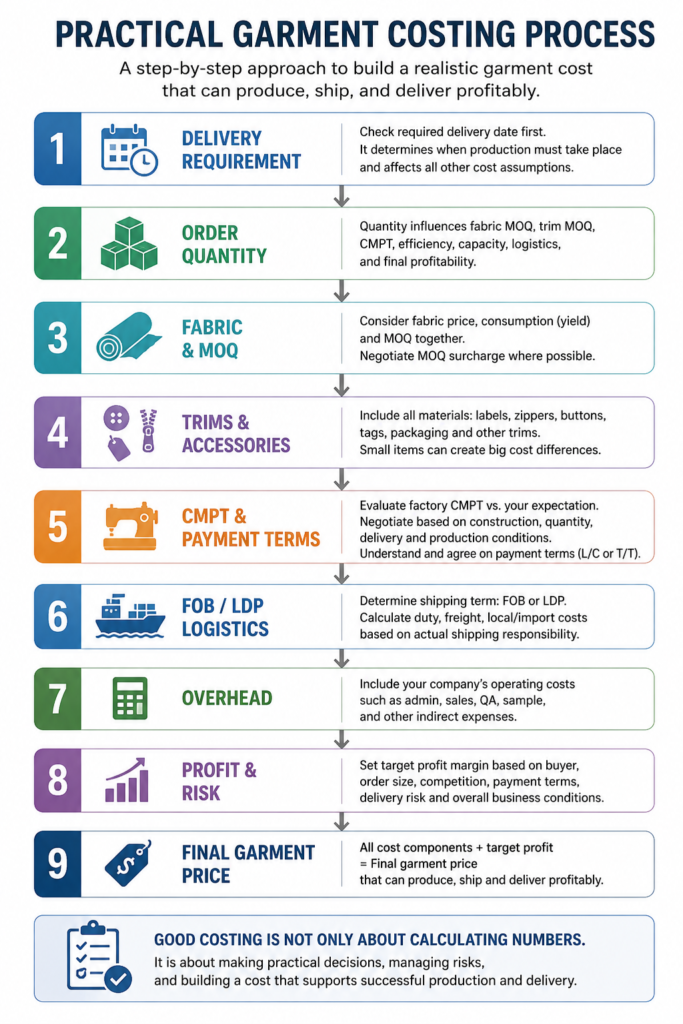
But this should not be treated as a rigid formula.
The factors influence one another.
A change in order quantity may affect fabric cost and CMPT.
A delivery change may affect factory selection or freight.
A payment term may change commercial risk.
A logistics change may alter the profitability of an LDP order.
Costing therefore needs to remain connected to the actual order until the commercial decision is finalized.
The Cost Sheet Is a Decision Tool
A well-designed cost sheet is extremely useful.
It organizes fabric, trims, CMPT, logistics, overhead, and profit into a structure that allows different scenarios to be compared.
But a spreadsheet cannot determine whether a mill’s MOQ surcharge should be accepted.
It cannot determine whether a factory’s CMPT quotation is reasonable.
It cannot judge whether a 30-day payment term could become a shipment risk with a particular factory.
And it cannot decide what profit margin is appropriate for the commercial circumstances of the order.
Those decisions come from experience and judgment.
The cost sheet performs the calculation. The production professional determines whether the assumptions behind that calculation make sense.
Garment Costing Calculator
A well-built garment cost should reflect more than fabric and sewing costs. Use our practical calculator to estimate FOB and LDP costs, including fabric, trims, CMPT, overhead, profit, duty, freight, and local/import costs.
Final Takeaway
Garment costing is much more than adding fabric, trims, sewing, freight, overhead, and profit.
A practical costing process begins with the delivery requirement and order quantity, because those two facts can influence almost every decision that follows.
Fabric price must be considered together with consumption, MOQ, and the possibility of negotiation.
Factory CMPT should be compared against an experienced production estimate rather than accepted automatically.
Just as importantly, CMPT payment terms must be managed carefully because a commercial disagreement at the end of production can put an otherwise completed shipment at risk.
FOB and LDP costing must reflect the actual logistics responsibilities of the order, including duty, freight, and local/import costs where applicable.
Finally, overhead and profit must be evaluated according to the actual buyer, order, competition, payment conditions, and production risk.
Good garment costing is not about finding the lowest possible number. It is about building a realistic cost that can actually produce, ship, and complete the order profitably.
If you need practical support with apparel costing, factory negotiation, sourcing, production planning, or FOB/LDP cost analysis, Apparel Production Lab provides consulting based on real-world apparel manufacturing and sourcing experience.