
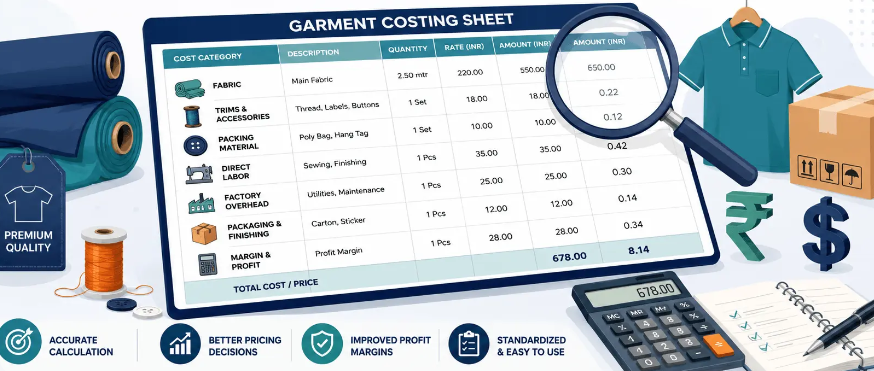
Apparel costing does not end when a quotation is approved.
Between initial development and bulk production, product specifications may change, actual fabric consumption may differ from estimates, manufacturing requirements may become more complex, or shipping costs may change.
The result is often a difference between the original quoted cost and the actual production cost.
But a cost increase should not automatically lead to a price increase for the customer.
The first question should be:
Why did the cost increase?
A practical cost-control process is:
QUOTED COST → COST CHANGE → IDENTIFY CAUSE → DETERMINE RESPONSIBILITY → FIND OPTIONS → MINIMIZE IMPACT → DISCUSS IF REQUIRED → APPROVE → UPDATE
Good cost control is not simply about preventing costs from increasing.
It is about understanding why costs change and making the right commercial decision before the change becomes an uncontrolled loss.
Cost Control Begins With Root Cause
When production cost increases, it is tempting to immediately ask:
Who should pay for it?
That question comes too early.
First determine what changed and why.
For example, a higher fabric cost may result from increased consumption.
But why did consumption increase?
A higher CM may result from additional sewing operations.
But who requested those operations?
Higher freight cost may result from air shipment.
But why was air freight required?
The same cost increase can have very different commercial implications depending on its cause.
Therefore:
Before asking who should absorb a cost increase, first determine what caused it.
1. Compare Quoted Cost With Actual Production Cost
The original quotation is normally based on information available during development.
Depending on the product, this may include estimated:
- Fabric consumption
- Fabric price
- Trim cost
- CM or CMPT
- Wash / finishing
- Packing
- Testing
- Freight or logistics
- Other applicable production costs
As development progresses, some of these assumptions may change.
The purpose of cost control is to identify those changes early rather than discovering the total difference after production is completed.
A useful comparison is:
QUOTED COST ↔ CURRENT / ACTUAL PRODUCTION COST
When a difference appears, identify the specific cost component responsible.
2. Fabric Consumption Is a Common Source of Cost Change
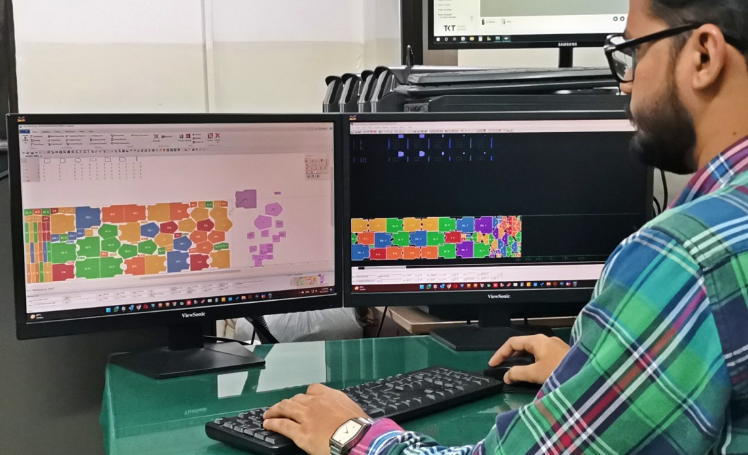
Fabric is often one of the largest cost components in apparel production, so even a relatively small change in consumption can affect garment cost.
But increased consumption does not automatically justify a higher selling price.
The first question is:
Why did consumption increase?
There may be several possible causes.
The initial consumption may have been estimated incorrectly.
Actual marker efficiency may differ from the development estimate.
The pattern may have changed during fitting.
Garment measurements may have increased.
Construction or design details may have changed.
Fabric width or usable width may differ.
Matching requirements may increase consumption.
Each cause needs a different commercial response.
Material cost also depends on how fabric and trims are developed, approved, produced, and managed. For more information, read Apparel Fabric & Trim Management: From Approval to Production.
3. Separate Estimation Error From Product Change
This distinction is particularly important.
Suppose the original fabric consumption was underestimated because of an internal costing error.
The actual bulk marker later shows higher consumption.
That is very different from a situation where the customer requested a longer body length or larger measurement during fitting, which increased the garment’s material requirement.
In the first situation:
Initial Estimation Error → Consumption Increase
In the second:
Customer-Requested Product Change → Consumption Increase
The numerical result may be the same.
The responsibility is not.
This is why production teams should document important product changes during development and understand their cost impact before bulk production.
4. Customer-Requested Changes Should Be Connected to Cost Impact
A customer may request a change for perfectly valid product reasons.
The issue is not whether the customer should be allowed to make the change.
The issue is whether the commercial impact of that change is understood.
For example:
Fit Change
→ Pattern Change
→ Higher Consumption
→ Higher Material Cost
or:
Construction Change
→ Additional Operation
→ Higher CM
When a customer-requested change creates a meaningful cost increase, the relationship between the change and the additional cost should be clearly explained.
The discussion becomes much easier when the customer can see:
What changed → Why cost changed → How much it changed
rather than receiving only a revised price.
5. Review Consumption Before Accepting the Increase
Even when consumption increases for a legitimate reason, the production team should still ask whether the increase can be minimized.
Possible areas to review may include:
- Marker efficiency
- Pattern placement
- Fabric usable width
- Size ratio
- Matching requirements
- Cutting method
- Fabric utilization
- Other product-specific opportunities
The objective is not to force consumption below a technically realistic level.
It is to confirm that the revised consumption represents an efficient and realistic production requirement.
A cost increase should be verified before it is accepted.
6. CM and CMPT Can Change During Development
Manufacturing cost may also change between initial quotation and bulk production.
Depending on the costing system, this may appear as CM, CMPT, or another manufacturing-cost structure.
Possible causes may include:
- Additional sewing operations
- More difficult construction
- Special machines
- Attachments
- Additional finishing
- More complex handling
- Additional quality requirements
- Lower-than-expected productivity
- Packing changes
- Other production requirements
Again, the first step is not to accept or reject the increase.
The first step is to determine:
What changed?
7. A Factory Cost Increase Should Be Explained
Suppose a factory requests a higher CM after the order has been confirmed.
The production team should compare the original product and production assumptions with the current requirements.
If the customer added a construction detail that requires additional operations, a higher manufacturing cost may have a clear explanation.
If nothing significant changed and the increase results from an original factory costing mistake or internal productivity issue, the commercial situation is different.
This leads to another important principle:
A higher production cost does not automatically justify a higher customer price. Responsibility depends on the cause of the increase.
8. Shipping Cost Changes Need the Same Analysis
Freight cost can also change during an order.
But again, the amount of the increase is only part of the story.
Consider two situations:
Factory Delay → Missed Planned Shipment → Air Freight Required
and:
Customer Requests Earlier Delivery → Air Freight Required
Both may create additional freight cost.
But the cause and commercial responsibility are different.
Other freight changes may result from market rates, shipment volume, routing, mode changes, split shipments, destination requirements, or other external conditions.
Therefore, when freight cost increases, ask:
What changed in the logistics plan, why did it change, and who or what caused the change?
For more information about shipment planning, read Apparel Shipping & Logistics: Managing FOB, LDP/DDP, and Warehouse Delivery.
9. Determine Responsibility Before Discussing Price
Once the cause is understood, the next step is to determine where responsibility reasonably belongs.
A practical way to think about cost changes is to separate them into three broad categories.
Producer / Factory-Side Cause
Examples may include:
- Original costing error
- Incorrect consumption estimate
- Internal productivity issue
- Avoidable production mistake
- Supplier or factory error
When the increase originates on the production side, the producer should first make a reasonable effort to solve or minimize the issue before passing additional cost to the customer.
Customer-Driven Change
Examples may include:
- Fit changes
- Measurement changes
- Design changes
- Construction changes
- Material changes
- Packing changes
- Earlier delivery request
When a customer-requested change creates a measurable additional cost, the commercial impact should be identified and discussed.
External or Uncontrolled Change
Some changes may result from circumstances outside the direct control of either party.
Depending on the order, these may involve significant freight-market changes, duties or tariffs, regulatory changes, or other external conditions.
The appropriate response depends on the agreement, timing, magnitude, and available alternatives.
Not every cost increase should be absorbed, and not every cost increase should be passed to the customer.
10. Find Options Before Passing on the Cost
After identifying the cause and responsibility, look for ways to eliminate or reduce the increase.
For example, if consumption increased:
Can marker efficiency be improved?
If CM increased:
Can the production method be improved without changing the approved product?
If freight increased:
Is another sailing, consolidation plan, split shipment, or shipping option available?
The exact alternatives depend on the situation.
The important principle is:
Do not decide who pays before checking whether the additional cost can first be reduced.
This is particularly important when the increase was not caused by a customer-requested change.
If the cost increase was not caused by a customer-requested change, the production side should first make a reasonable effort to solve or minimize it before passing the additional cost to the customer.
11. Evaluate the Impact of Each Option
The lowest-cost solution is not automatically the best solution.
A cost-saving option may affect:
- Quality
- Appearance
- Fit
- Performance
- Lead time
- Production efficiency
- Delivery
- Customer requirements
For example, changing a construction method may reduce CM but alter garment appearance.
Changing a material may reduce cost but affect quality or approval status.
Choosing a slower freight option may reduce logistics cost but miss the required delivery date.
Therefore, each option should be evaluated across:
COST → QUALITY → PRODUCT → LEAD TIME → DELIVERY → RISK
The objective is to find the best overall production solution—not simply the lowest number.
12. Customer Communication Should Include More Than the Increase
When customer discussion is required, do not communicate only:
“The cost increased.”
Provide enough information for a commercial decision.
A useful structure is:
CAUSE → COST IMPACT → AVAILABLE OPTIONS → EFFECT OF EACH OPTION → RECOMMENDATION
For example, where applicable:
Option A — Maintain the current requirement → additional cost, no product change
Option B — Alternative production method → lower additional cost, with defined impact
Option C — Different timing or logistics solution → cost reduction, but delivery impact
The exact options depend on the situation.
What matters is that the customer understands the consequences of the decision.
Do not bring the customer only a cost increase. Bring the cause, the impact, the available options, and a recommendation.
13. Customer Approval Should Be Obtained When Required
If a cost solution changes an approved product, production process, material, delivery, or other customer-controlled requirement, approval should be obtained before implementation where required.
The production team should clearly document:
- What is changing
- Why it is changing
- Cost impact
- Product impact
- Lead-time impact
- Delivery impact
- Customer decision
This protects both the production team and the customer from misunderstandings later in the order.
14. Update the Cost After the Decision
Once a decision is made, the costing should be updated.
Do not leave the original quotation as the only cost reference while production proceeds under different assumptions.
The updated cost should reflect the agreed production condition.
Depending on the organization, this may require updates to:
- Cost sheet
- PO
- Supplier agreement
- Customer price
- Internal margin
- Freight estimate
- Other commercial records
The exact documentation process will vary.
The important point is that the commercial record should match the actual production decision.
15. Cost Changes Should Be Tracked During Development
One of the easiest ways to lose margin is to treat many small development changes as individually insignificant.
A small consumption increase.
One additional operation.
A slightly more expensive trim.
An added packing requirement.
Additional testing.
A freight change.
Individually, each may appear manageable.
Together, they can materially change the order margin.
Therefore, cost should be reviewed at key development and production checkpoints rather than only at initial quotation and final accounting.
A useful principle is:
Small changes should be tracked before they become one large unexplained variance.
For more information about monitoring production against plan and taking corrective action, read Apparel Production Management: How to Control Production from Cutting to Shipment.
16. Cost Control and Change Control Are Closely Connected
Many production cost increases begin as product changes.
This is why cost control should be connected with development communication.
When a meaningful change occurs, ask:
Does this change affect consumption?
Does it affect material cost?
Does it affect CM/CMPT?
Does it add testing or finishing?
Does it affect packing?
Does it affect lead time or freight?
This does not mean every small development comment requires a price revision.
It means the production team should understand the commercial effect before the order moves too far forward.
17. Cost Control Should Protect Both Sides
There are two unhealthy extremes in cost management.
One is passing every small increase to the customer without first understanding or minimizing it.
The other is absorbing every increase internally until the producer’s margin disappears.
Neither creates a sustainable production relationship.
Good cost control should protect the customer’s agreed price where reasonably possible while also protecting the producer from uncontrolled losses.
Good cost control protects both the customer’s price and the producer’s margin.
That requires transparency, accurate root-cause analysis, and timely communication.
18. Do Not Wait Until Production Is Finished
A cost variance discovered after shipment leaves very few options.
By then, fabric has been consumed, CM has been paid or incurred, packing is complete, and freight decisions may already have been made.
The earlier a cost change is identified, the more alternatives are usually available.
This is similar to quality and production-risk management:
Early identification creates options. Late identification creates consequences.
For more information about managing production risks before they become larger problems, read Apparel Production Delays: Common Causes, Risks, and How to Minimize Them.
Cost Control Is a Decision Process
Effective apparel cost control is not simply a negotiation over price.
It is a structured decision process:
IDENTIFY → VERIFY CAUSE → DETERMINE RESPONSIBILITY → FIND OPTIONS → MEASURE IMPACT → DISCUSS → APPROVE → UPDATE
The same cost increase can require a completely different decision depending on what caused it.
A consumption increase caused by an internal estimation error is different from one caused by a customer-requested fit change.
Higher air freight caused by a factory delay is different from higher air freight caused by a customer-requested earlier delivery.
Higher CM caused by added construction is different from higher CM caused by an original costing error.
That is why the first question should never simply be:
“Who will pay?”
The first question should be:
“Why did the cost change?”
Once that is understood, responsibility, alternatives, and the appropriate commercial decision become much clearer.
Need Help With Apparel Cost Control?
Apparel Production Lab provides practical consulting for apparel costing, product development, sourcing, production planning, supplier management, and production control.
Whether you need help evaluating consumption changes, reviewing CM or CMPT increases, identifying production-cost variances, or understanding how product and delivery changes affect margin, we can help develop a practical cost-control approach for your production requirements.