
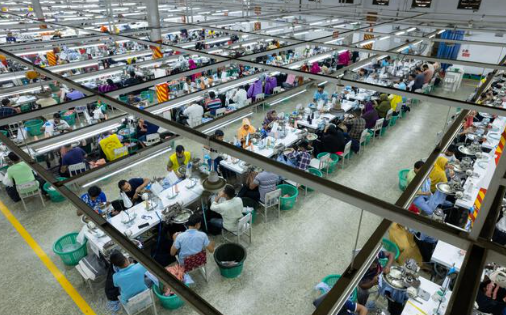
Sewing line efficiency is one of the most frequently discussed performance measures in apparel manufacturing.
But a high efficiency percentage does not automatically mean that a sewing line is being managed well.
A sewing line is a connected production system. Every operation depends on the flow of work from the operation before it and affects the operation that follows.
For this reason, good sewing-line management begins long before the first garment enters the line.
The garment construction should be analyzed, sewing operations should be identified, realistic production targets should be established, and the right number of operators and machines should be planned.
Once production begins, that plan must then be continuously adjusted according to what is actually happening on the sewing floor.
The objective is not simply to produce as many pieces as possible.
It is to create a stable production flow that delivers the required quantity, at the required quality, within the planned production time and cost.
Start With a Detailed Sewing Operation Analysis
Before setting a sewing-line target, the factory needs to understand what must actually happen to construct the garment.
The garment should be broken down into individual sewing operations.
Depending on the product, these may include operations such as joining panels, attaching collars, setting sleeves, closing side seams, hemming, attaching labels, making buttonholes, sewing buttons, topstitching, and many others.
Each operation has its own:
- Work content
- Machine requirement
- Skill requirement
- Cycle time
- Quality requirement
- Relationship with the next operation
Without understanding these operations, it is difficult to establish a realistic production target or determine how many operators the line actually needs.
A sewing target should therefore not begin with the question:
“How many pieces do we want this line to produce?”
It should begin with:
“What work is required to produce one garment, and what resources are needed to complete that work within the available production time?”
Set the Production Target Before Setting the Line
The production target should connect the order quantity with the available production schedule.
If an order must produce a certain number of garments within a defined number of sewing days, the factory needs to determine the daily output required to stay on schedule.
That target then becomes an important input for line planning.
A target that is too low may not support the required delivery date.
A target that is unrealistically high may lead to excessive manpower, overtime, quality problems, or unstable production.
The target therefore needs to reflect:
- Order quantity
- Available sewing days
- Garment complexity
- Standard production time
- Available machines
- Operator capability
- Expected line efficiency
- Quality requirements
- Factory working hours
The objective is to establish a target that is commercially necessary and operationally achievable.
For more on connecting order requirements with factory capacity and production schedules, see Apparel Production Planning & Lead Time: From PO to Warehouse Delivery.
Manpower Should Be Planned Around the Work
Once the operation breakdown and production target are understood, manpower can be planned.
A common mistake is to assume that adding more sewing operators will automatically increase output.
Sometimes it will.
Sometimes it will simply increase labor cost and WIP.
If one operation requires more capacity while another already has excess capacity, adding operators without understanding the imbalance may make the line less efficient rather than more efficient.
The right question is not:
“How many operators can we put on this line?”
It is:
“How many operators are required at each part of the process to achieve the target without creating unnecessary waiting or excess WIP?”
Manpower should follow the production requirement—not the other way around.
What Is Sewing Line Balancing?
Line balancing is the process of distributing work and production capacity across sewing operations so that garments can move through the line with minimal unnecessary interruption.
A perfectly balanced line does not mean that every operator produces exactly the same number of pieces at every moment.
What matters is the overall flow.
A balanced sewing line is a line where work flows continuously without creating unnecessary waiting or excessive WIP between operations.
If one operation is too slow, work may accumulate in front of it.
If one operation produces much faster than the next operation can process, excess WIP may also accumulate.
At another point in the line, operators may be waiting because insufficient work is reaching them.
These conditions are signals that the line needs attention.
WIP Is a Signal, Not Just Inventory
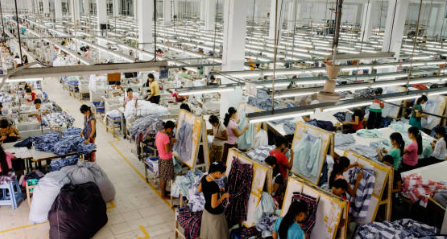
Work in process—or WIP—is the unfinished production moving between operations.
Some WIP is necessary to keep a sewing line operating.
Too much WIP, however, can hide production problems.
A growing pile of work in front of an operation may indicate:
- Insufficient manpower
- Incorrect manpower allocation
- A difficult operation
- Low operator skill
- Machine problems
- Poor feeding from previous operations
- Quality problems
- Excessive repair or rework
- An unrealistic production target
Likewise, an operator repeatedly waiting for work may indicate that an upstream operation cannot supply enough pieces.
The important point is that WIP should not simply be counted.
It should be read as information about the condition of the line.
A Bottleneck Is a Symptom, Not a Diagnosis
When work begins to accumulate at one operation, it is tempting to identify that operation as the problem and immediately add another operator.
That may solve the problem—but only if insufficient capacity is actually the cause.
A bottleneck is a symptom, not a diagnosis.
Before adding manpower, the production team should determine why the bottleneck exists.
The cause may be related to manpower.
It may be related to the machine.
It may be related to operator skill.
It may be related to quality and rework.
Or it may be a combination of several factors.
Fast diagnosis matters because every hour that a major bottleneck remains unresolved can affect the output of the entire line.
Check Manpower Before Adding Manpower
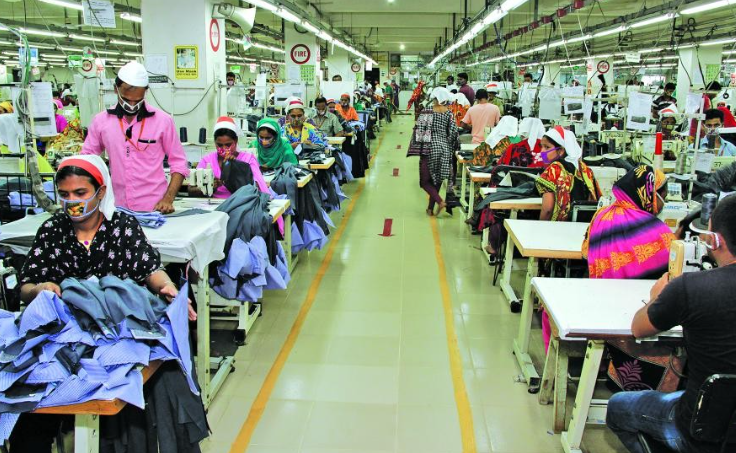
One of the first areas to review is manpower allocation.
Is the operation genuinely understaffed?
Is another nearby operation overstaffed?
Can an operator be temporarily reassigned?
Can the work be divided differently?
Is the operator receiving more pieces than planned because an upstream operation has excess capacity?
Line balancing should therefore be dynamic.
The manpower plan established before production is a starting point—not a rule that can never be changed.
As actual production conditions become visible, supervisors need the flexibility to add, remove, or reallocate capacity where necessary.
Machine Condition Can Create a Production Bottleneck
Not every output problem is caused by the operator.
A sewing machine that is poorly adjusted can reduce production speed and create defects even when the operator is highly skilled.
Machine-related checks may include areas such as:
- Thread tension
- Presser-foot pressure
- Feed setting
- Needle condition
- Stitch formation
- Machine timing
- Attachments and folders
- General machine condition
The exact settings depend on the machine, operation, fabric, thread, and garment construction.
The important management principle is that a machine should be evaluated as part of the production process.
If an operator is repeatedly stopping to correct stitching, adjust material feeding, repair thread breaks, or handle machine-related defects, simply asking that operator to work faster will not solve the problem.
Operator Skill Must Match the Operation
Different sewing operations require different levels and types of skill.
An operator who performs very efficiently on one operation may struggle on another.
This is why operator capability should be considered when balancing the line.
The objective is not only to fill every sewing machine with a person.
It is to match the right operator with the right operation as effectively as possible.
When a skill mismatch creates a bottleneck, possible responses may include:
- Reassigning the operation
- Providing additional training
- Splitting the operation
- Adding temporary support
- Changing the work method
- Reviewing the machine or attachment
Operator performance should therefore be evaluated in the context of the operation being performed.
Rework Can Create a Hidden Bottleneck
One of the easiest bottlenecks to misdiagnose is the one created by repair or rework.
The original production plan assumes that a garment component will move forward after an operation is completed.
But defective pieces may be rejected during inspection and sent back to an earlier operation for repair.
Those pieces then re-enter the production flow.
The operator is no longer processing only the planned forward production.
The operator is processing:
Normal Production + Repair/Rework
This increases the actual workload at that operation.
As repair pieces continue to return, WIP may begin to accumulate.
From a distance, the situation may look like a simple manpower shortage.
It may not be.
A bottleneck can be created by rework. When defective pieces repeatedly return to the same operation for repair, the actual workload becomes higher than the planned production flow.
Adding another operator may temporarily reduce the queue, but it does not eliminate the quality problem that created the additional work.
Follow the Cause of Rework, Not Just the Quantity
When repair volume becomes significant, production management should investigate why the defect is occurring.
The cause may involve:
- Operator technique
- Machine setting
- Incorrect seam construction
- Material handling
- Poor attachment or folder setup
- Inconsistent feeding
- Incorrect instruction
- Fabric behavior
- Upstream quality problems
The objective should be to reduce the number of pieces that need to return for repair in the first place.
Otherwise, the factory is using additional labor and production time to manufacture the same garment more than once.
This is why quality performance and sewing efficiency cannot be managed independently.
Poor first-pass quality consumes capacity.
For more on controlling garment quality throughout production, see Apparel Quality Inspection: From Cut Pieces to Final AQL Inspection.
Output and Efficiency Are Not the Same Thing
A sewing line can produce a high number of garments and still operate inefficiently.
For example, output may increase because additional operators were added or overtime was extended.
The number of finished pieces goes up—but so does the amount of labor required to produce them.
Conversely, a line with fewer operators may produce a lower gross output but use its available working time more effectively.
This is why production output and sewing-line efficiency should not be treated as the same measurement.
Output tells management how many pieces were produced.
Efficiency helps management understand how effectively available labor time was converted into standard production work.
Both are important.
Neither tells the complete story by itself.
Understanding Sewing Line Efficiency
A commonly used sewing-line efficiency calculation compares the standard minutes earned by actual production with the total labor minutes available.
In simplified form:
Line Efficiency (%) = (Actual Output × Garment SAM or SMV) ÷ (Number of Operators × Working Minutes) × 100
For example, if a line produces 800 garments and the standard time is 10 minutes per garment:
Standard Minutes Earned = 800 × 10 = 8,000 minutes
If 20 operators each worked 480 minutes:
Available Labor Minutes = 20 × 480 = 9,600 minutes
The resulting line efficiency would be approximately:
8,000 ÷ 9,600 × 100 = 83.3%
The calculation is useful because it connects output with the labor time used to produce that output.
But the percentage should be interpreted carefully.
A High Efficiency Number Does Not Tell the Whole Story
A sewing line should not be judged by one percentage alone.
Suppose a line reports strong efficiency but is also producing excessive defects.
Or perhaps the line reaches its target only through repeated overtime.
Maybe WIP is building up between operations.
Maybe repair quantities are increasing.
Maybe the line achieves a strong daily number but is consuming more labor than the costing assumption allows.
These conditions matter.
A healthy sewing line should be evaluated through several connected indicators, such as:
- Actual output
- Target achievement
- Line efficiency
- WIP
- First-pass quality
- Repair/rework
- Manpower
- Overtime
- Machine downtime
- Production days remaining
- Cost performance
The objective is not to maximize one KPI while damaging another.
Manage the Line in Real Time
Line balancing is not something that should be completed once in the morning and ignored for the rest of the day.
Production conditions change.
An operator may slow down.
A machine may begin creating problems.
Repair may increase.
An upstream operation may produce too much.
Another operation may run short of work.
A supervisor needs to recognize these changes quickly.
Good sewing-floor management therefore depends on frequent observation and timely adjustment.
When an operation needs more capacity, support should be provided.
When an operation has unnecessary excess capacity, resources may need to be moved.
When WIP grows, the reason should be investigated.
When output falls, management should look for the cause rather than simply increasing pressure on the line.
The faster the real cause is identified, the smaller the production loss is likely to become.
Daily Output Must Connect to the Production Calendar
A sewing line does not operate in isolation from the order schedule.
Daily production performance should always be compared with the remaining order quantity and available production days.
For example, if the order requires 20,000 pieces and the factory has 20 effective sewing days, the production plan must support an average output consistent with that requirement.
If actual production remains below plan for several days, the problem becomes larger than a daily efficiency issue.
The factory may need:
- Additional production days
- Overtime
- Additional manpower
- Another sewing line
- Production-plan adjustment
- Delivery-plan adjustment
All of these can affect cost and capacity.
This is why daily line management should connect directly with the overall production calendar.
For a broader view of managing garment production from the factory floor through shipment, see Apparel Production Management: How to Control Production from Cutting to Shipment.
Sewing Efficiency Is Connected to Factory BEP
Production efficiency also has a financial dimension.
A factory has operating costs that continue whether a sewing line reaches its planned output or not.
These may include labor, supervision, utilities, building costs, equipment, maintenance, administration, and other factory overhead.
The factory therefore needs sufficient productive output and revenue to cover its operating cost.
This is where sewing performance connects with the factory’s break-even point, or BEP.
If production requires significantly more days or labor hours than planned, the factory absorbs additional operating cost.
If too much manpower is used to achieve the required output, labor productivity declines.
If poor quality creates excessive repair, productive capacity is consumed without creating additional saleable garments.
And if line efficiency remains below the level assumed in costing and capacity planning, the profitability of the order can deteriorate.
Sewing efficiency is therefore not only a production-floor KPI.
It is directly connected to labor utilization, production capacity, delivery performance, cost, and factory profitability.
Do Not Chase Output at Any Cost
When an order falls behind schedule, the natural response is to push for more output.
Sometimes additional capacity is necessary.
But increasing output without understanding the cost can create another problem.
Adding operators, increasing overtime, opening additional lines, or repeatedly repairing defective garments may help recover quantity while simultaneously increasing production cost.
The better question is not simply:
“How can we produce more pieces today?”
It is:
“How can we achieve the required output with the right manpower, stable quality, controlled WIP, and acceptable cost?”
That is a much more useful production-management question.
What Good Sewing Line Management Looks Like
An effectively managed sewing line does not necessarily look busy everywhere.
It looks controlled.
Work moves continuously.
WIP remains manageable.
Operators are assigned according to the actual work requirement.
Machines are maintained and adjusted for the operation.
Quality problems are identified before repair volume becomes excessive.
Bottlenecks are investigated rather than simply patched with additional manpower.
Daily output is compared with the production plan.
And efficiency is evaluated together with quality, labor utilization, delivery, and cost.
Most importantly, management responds to what is happening on the floor rather than relying only on what was planned before production started.
Final Takeaway
Sewing line efficiency begins with preparation.
The garment operations need to be analyzed, the production target needs to be realistic, and manpower and machines need to be planned around the actual work.
Once production starts, line balancing becomes a continuous management process.
WIP needs to be monitored.
Bottlenecks need to be diagnosed.
Machine conditions need to be checked.
Operator capability needs to match the operation.
And repair flow needs to be separated from normal production flow so that quality problems are not mistaken for simple capacity shortages.
Output and efficiency should also be understood as different measurements.
A high output does not automatically mean good efficiency, and a high efficiency percentage does not automatically mean a healthy production line.
The real objective is to achieve the required garment quantity within the planned production days using the appropriate labor and machine capacity while maintaining quality and controlling cost.
When those elements work together, sewing-line efficiency becomes more than a factory KPI.
It becomes a practical measure of how effectively the factory converts time, labor, machines, and production capacity into profitable garment output.
Need Help With Sewing Efficiency & Production Management?
Apparel Production Lab provides practical consulting for sewing-line planning, production management, capacity analysis, garment costing, quality control, and factory performance improvement.
Whether you need help reviewing line efficiency, identifying production bottlenecks, improving manpower allocation, reducing rework, or connecting production targets with factory capacity and cost, we can help develop a practical approach around your product and production requirements.