
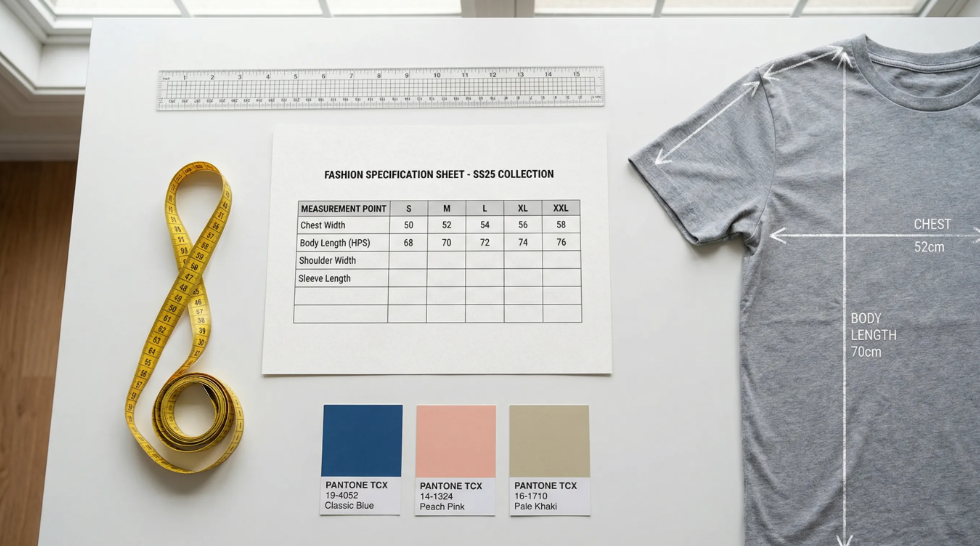
Fit approval is one of the most important stages between garment development and bulk production.
But fit approval is not simply about making a sample, receiving comments, revising it, and getting an approval.
A fit comment can affect much more than one measurement.
It may change garment construction, pattern shape, overall silhouette, balance, material consumption, manufacturing method, and eventually production cost or lead time.
For this reason, fit comments should not be treated as isolated instructions.
They should be evaluated as changes to the garment as a whole.
A practical process is:
FIT COMMENTS → CONSTRUCTION → MEASUREMENTS → SILHOUETTE / BALANCE → PATTERN → SAMPLE → REVIEW → CONFIRMATION → FINAL PRODUCTION STANDARD
The real objective is not simply to get the fit sample approved.
It is to make sure the approved fit becomes the correct production standard.
Start With the Construction
When new fit comments are received, one of the first questions should be:
Has the garment construction changed?
This should be reviewed before looking only at individual measurement changes.
A construction change may affect:
- Pattern shape
- Sewing operations
- Seam allowance
- Finishing method
- Machinery or attachments
- Material consumption
- CM or CMPT
- Garment appearance
- Production efficiency
A comment that appears small on paper can create a larger production impact if it changes how the garment is constructed.
Therefore, understand the construction impact before revising the pattern.
1. Review the Measurement Changes
After checking construction, review the measurement changes.
The purpose is not simply to enter new numbers into the specification.
Ask:
Which measurements changed?
Why were they changed?
Which other measurements may be affected?
Can the requested measurement be achieved without affecting garment balance?
Garment measurements are interconnected.
Changing one area can affect another.
For example, changing body length, shoulder width, armhole shape, rise, sweep, or another key measurement may require adjustments elsewhere to maintain the intended fit and appearance.
Therefore:
A measurement change should be evaluated as part of the garment—not as an isolated number.
2. Review Silhouette and Garment Balance
After construction and measurements, evaluate the overall silhouette and balance.
A garment can technically meet individual measurements and still look wrong when worn.
The production team should consider whether the requested changes affect:
- Overall proportion
- Front-to-back balance
- Body shape
- Sleeve balance
- Shoulder position
- Hemline
- Ease
- Drape
- Intended silhouette
The exact considerations depend on the garment.
This is why fit evaluation requires both measurement control and visual judgment.
Passing the spec does not automatically mean the garment fits correctly.
3. Revise the Pattern After Understanding the Full Impact
Once the construction, measurement, and balance implications are understood, the pattern can be revised.
A useful sequence is:
CONSTRUCTION CHANGE
→ MEASUREMENT CHANGE
→ SILHOUETTE / BALANCE IMPACT
→ PATTERN REVISION
This helps reduce the risk of repeatedly changing the pattern one measurement at a time without understanding the overall garment.
The revised pattern should reflect the intended fit—not merely a collection of corrected numbers.
4. Buyer Comments Should Be Followed, but Not Blindly
Customer fit comments define the requested direction.
However, the production team also has a responsibility to identify foreseeable technical problems.
Suppose a buyer requests a change that can be made, but the pattern team believes it may create another measurement problem or negatively affect garment balance.
There are two poor responses.
The first is to ignore the concern and proceed without saying anything.
The second is to silently change the buyer’s instruction because the production team believes another solution is better.
Neither is ideal.
The better approach is to make the issue visible and allow the customer to make an informed decision.
5. Show the Requested Direction and a Recommended Alternative
When practical, one effective approach is to prepare:
Sample A — Buyer-Requested Direction
and
Sample B — Production Team’s Recommended Alternative
The first sample shows the actual result of the requested comment.
The second shows an alternative developed after reviewing the technical concern.
Both can then be submitted with an explanation:
What was requested → What we observed → What may be affected → What we recommend
This changes the conversation from:
“We disagree with the fit comment.”
to:
“Here is the requested result, here is the issue we identified, and here is an alternative for comparison.”
That is much more useful communication.
When a fit comment may create another fit or balance problem, do not silently change the customer’s instruction. Show the requested direction, show the recommended alternative, explain the difference, and let the customer make an informed decision.
6. Two Full Samples Are Not Always Necessary
The objective is not to make two complete garments every time there is a technical concern.
Depending on the issue, the comparison may be demonstrated through:
- Full samples
- Partial samples
- Mock-ups
- Pattern comparisons
- Measurement comparisons
- Photos
- Marked-up sketches
- Other clear technical references
The appropriate method depends on the complexity of the decision.
The principle is:
Provide the clearest practical comparison needed for the customer to make the decision.
For more information about using samples throughout development and approval, read Garment Sampling Process: From First Sample to Production Approval.
7. Explain the Consequences, Not Only the Difference
When proposing an alternative, explain why it matters.
A fit or pattern change may affect:
FIT → APPEARANCE → CONSTRUCTION → CONSUMPTION → CM → LEAD TIME
Not every change affects all of these areas.
But if a meaningful impact exists, the customer should know before confirming the direction.
For example, if a requested fit change increases fabric consumption, the production team should identify the impact rather than discovering it later during costing or bulk marker preparation.
Similarly, if a construction change adds an operation, its manufacturing impact should be understood.
This connects fit management with cost control.
For more information about managing cost changes caused by development and production changes, read Apparel Cost Control: Managing Cost Changes from Development to Production.
8. Customer Confirmation Determines the Final Direction
After the buyer reviews the requested sample, proposed alternative, and explanation, the final direction should be confirmed.
This distinction matters:
Production Recommendation ≠ Customer Approval
The production team can identify a technical risk and recommend a better solution.
But where the requirement is customer-controlled, the final decision should be confirmed by the customer.
Once confirmed, the decision should be incorporated into the appropriate technical documents.
9. Fit Approval Is Not the End of the Process
Receiving:
FIT APPROVED
is an important milestone.
But it should not be treated as the end of fit management.
The approved result must now be translated into the final production references.
Depending on the product and customer, these may include:
- Final measurement specification
- Final corrected pattern
- Final fit comments
- Final tech pack
- Approved sample
- Other relevant approval documents
If the sample is approved but the pattern or specification still reflects an earlier revision, production remains at risk.
Approval must be transferred into the documents that control production.
10. Update All Related Documents
After final fit approval, check that the approved changes are reflected consistently.
For example:
APPROVED SAMPLE
↔ FINAL FIT COMMENTS
↔ FINAL MEASUREMENT SPEC
↔ FINAL PATTERN
↔ FINAL TECH PACK
These references should tell the same story.
This connects directly with tech pack revision control.
Development may create many revisions, but production should not be forced to decide which one is current.
Development creates revisions. Production needs one clear final reference.
For more information about technical-document control, read Apparel Tech Pack: What a Factory Needs Before Production.
11. Build a Final Production Reference Package
One practical method is to consolidate the final approved information into a PO Folder, or equivalent production reference package.
The name may vary by company.
The important point is its function.
The package brings together the information and physical references needed to prepare and control the order.
Depending on the product and customer, a PO Folder may include:
- Purchase Order
- Final tech pack
- Final fit comments
- Final measurement specification
- Final approved pattern
- Approved sample reference
- Bulk fabric sample
- Bulk trim samples
- Color and artwork approvals
- Label and packing information
- Routing guide
- Final inspection guide
- Testing or other applicable requirements
- Other order-specific approved references
Not every order requires exactly the same documents.
The purpose is to create a controlled package that represents what the factory is actually expected to produce and how the order is expected to be handled.
12. Bulk Fabric and Trim References Matter
The PO Folder should not contain only development paperwork.
Where applicable, actual bulk fabric and trim references should also be included.
This allows the team to compare:
APPROVED MATERIAL ↔ ACTUAL BULK MATERIAL
for areas such as:
- Quality
- Color
- Handfeel
- Construction
- Size
- Finish
- Appearance
- Other applicable characteristics
This is important because an approved garment cannot be reproduced correctly if the actual bulk materials do not match the approved standard.
For more information, read Apparel Fabric & Trim Management: From Approval to Production.
13. Include Routing and Final Inspection Requirements
Production readiness also extends beyond making the garment.
The factory needs to understand how the completed order will be inspected, packed, routed, and prepared for shipment.
A routing guide may contain customer-specific logistics and shipment requirements.
A final inspection guide may define the applicable inspection procedures or customer expectations.
These requirements should not first appear when the goods are already packed.
They should be understood before production completion so that the factory can prepare accordingly.
14. Use the PO Folder as the Basis for the PP Meeting
The final production reference package becomes especially valuable during the pre-production meeting.
Instead of discussing production from memory or from scattered emails, the team can review the actual approved references together.
A practical comparison may include:
FINAL TECH PACK
↔ APPROVED SAMPLE
↔ FINAL PATTERN
↔ BULK FABRIC
↔ BULK TRIMS
↔ PRODUCTION METHOD
↔ QUALITY REQUIREMENTS
↔ PACKING / ROUTING REQUIREMENTS
This creates a common production reference before bulk begins.
For more information about this process, read Apparel Pre-Production Meeting: How to Prepare for Bulk Production.
15. Fit Approval and Production Readiness Are Different
This distinction deserves to be explicit.
FIT APPROVAL ≠ PRODUCTION READINESS
Fit approval confirms that the garment’s fit direction has been accepted.
Production readiness requires more.
The approved fit must be reflected in the pattern and technical documents.
Bulk materials must be confirmed.
Construction requirements must be clear.
Quality requirements must be understood.
Routing and packing requirements must be available where applicable.
The factory team must be aligned.
Only then can the approved development result become a reliable production standard.
16. Avoid Production From Scattered Approvals
One common risk in apparel development is having approvals spread across different emails, sample comments, spreadsheets, tech-pack versions, and messages.
The information may technically exist.
But if the factory has to reconstruct the final product by searching through the development history, mistakes become more likely.
This is why final consolidation matters.
Development history explains how the product got there.
The final production package explains what to make now.
Both are useful.
They serve different purposes.
17. Fit Management Is Also Change Management
Fit development is essentially a controlled series of product changes.
Each round may alter:
- Construction
- Measurements
- Pattern
- Silhouette
- Materials
- Cost
- Production method
Therefore, each comment should be evaluated not only for whether it can be executed, but also for what else it affects.
This is especially important as the order approaches bulk production.
A late fit change can have a much larger impact than the same change made during early development.
The closer production gets, the more important controlled confirmation becomes.
18. The Goal Is a Reproducible Garment
A beautiful approved sample is not enough if the factory cannot consistently reproduce it in bulk.
That is ultimately the purpose of fit management.
The final approved garment needs to become a clear, measurable, repeatable production standard.
The process therefore moves from:
FIT COMMENT
→ TECHNICAL REVIEW
→ PATTERN REVISION
→ SAMPLE
→ CUSTOMER DECISION
→ APPROVAL
→ DOCUMENT UPDATE
→ FINAL PRODUCTION PACKAGE
→ PP MEETING
→ BULK PRODUCTION
Good fit management does not simply ask:
“Did the buyer approve the sample?”
It also asks:
“Can the factory now reproduce what the buyer approved?”
That is the difference between sample approval and production readiness.
Fit Approval Should Lead to Production Control
Fit comments are part of product development, but their final purpose is production.
A requested measurement change may affect balance.
A construction change may affect manufacturing.
A pattern change may affect consumption.
A customer comment may require an alternative technical solution.
The production team’s responsibility is to understand those relationships, communicate foreseeable problems, provide practical alternatives where necessary, and obtain clear confirmation.
After approval, the final result should be consolidated into one controlled production reference.
Fit approval is not simply getting a sample approved. It is making sure the approved fit becomes the correct production standard.
Need Help With Garment Fit & Production Readiness?
Apparel Production Lab provides practical consulting for garment development, fit review, sampling, tech pack management, sourcing, pre-production planning, quality control, and apparel manufacturing.
Whether you need help reviewing fit comments, coordinating factory corrections, evaluating technical alternatives, or preparing an approved style for bulk production, we can help develop a practical process for your product and production requirements.