
Vietnam–U.S. Ocean Freight Rates: November 2026 Carrier Comparison and Costing Implications
November 2026 freight quotations show selective increases on the Vietnam–Los Angeles trade lane, with significant differences across carriers and service options.
November 2026 Freight Market Snapshot
Ocean freight remains an important variable in apparel landed cost calculations, particularly for U.S. importers sourcing garments from Vietnam.
A November 1, 2026 freight-forwarder quotation received by Apparel Production Lab provides a useful comparison of carrier-specific ocean freight rates from Vietnam to Los Angeles and Long Beach.
The quotation covers eight full-container-load (FCL) carrier services and three less-than-container-load (LCL) options.
Compared with the same forwarder’s October 2026 quotation, several carrier rates increased, while others remained unchanged.
The key finding is that freight costs did not move uniformly across carriers.
These observations reflect individual freight-forwarder quotations, not a comprehensive market freight index.
1. November 2026 FCL Freight Rate Comparison
The following rates were quoted for shipments from Haiphong and, where specified, Ho Chi Minh City to Los Angeles or Long Beach.
| Carrier / Service | 20’DC | 40’DC | 40’HC | 45’D/HC |
|---|---|---|---|---|
| ONE | $6,815 | $8,468 | $8,468 | $8,968 |
| HMM | $6,845 | $8,550 | $8,550 | $9,050 |
| COSCO/OOCL | $6,868 | $8,575 | $8,575 | $10,755 |
| ZIM | $8,568 | $10,685 | $10,685 | $13,535 |
| Wan Hai | $5,575 | $6,968 | $6,968 | Not quoted |
| Maersk | $5,568 | $6,868 | $6,868 | $8,125 |
| Matson MAX | $9,568 | $11,898 | $13,149 | $14,845 |
| Matson CLX | $10,198 | $12,698 | $14,245 | $15,925 |
Source: Victory International, November 1, 2026. USD per container. Rates valid through November 14, 2026. Origin and destination port coverage differs by service; Matson port details were not specified in the source rate table.
These figures demonstrate the importance of comparing service options rather than selecting a carrier based solely on its published or quoted freight rate.
The lowest container price may not represent the lowest overall shipping cost once transit time, equipment availability, inland transportation, local charges, and delivery requirements are considered.
2. October vs. November: Which Carriers Increased Rates?
Comparing the October and November quotations reveals several noteworthy changes.
| Carrier | October 40’HC | November 40’HC | Change |
|---|---|---|---|
| ONE | $8,468 | $8,468 | 0.0% |
| HMM | $8,550 | $8,550 | 0.0% |
| COSCO/OOCL | $8,575 | $8,575 | 0.0% |
| ZIM | $9,425 | $10,685 | +13.4% |
| Wan Hai | $6,668 | $6,968 | +4.5% |
| Maersk | $6,768 | $6,868 | +1.5% |
| Matson MAX | $13,149 | $13,149 | 0.0% |
| Matson CLX | $14,245 | $14,245 | 0.0% |
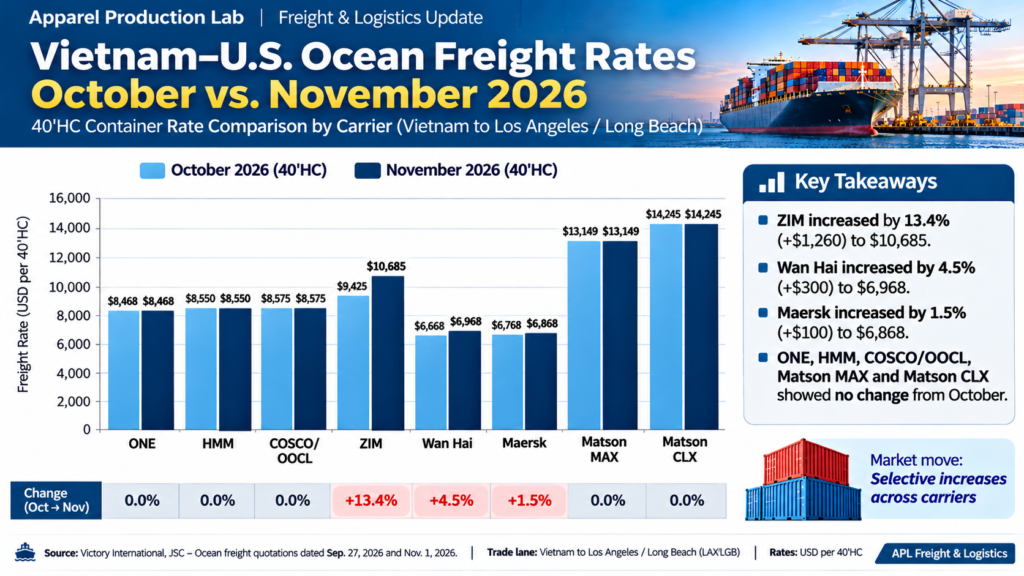
ZIM recorded the largest quoted increase among these services, rising by $1,260 per 40’HC container.
Wan Hai increased by $300, while Maersk increased by $100.
The other five listed services showed no change in their quoted 40’HC rates.
This pattern suggests that carrier-specific pricing decisions, rather than a uniform increase across all services, were the main distinguishing feature of these two quotation sets.
However, the quotations alone do not establish why individual carriers adjusted their rates.
For broader market context, the Freightos Baltic Index (FBX) provides container freight rate benchmarks that can be reviewed alongside individual forwarder quotations.
3. LCL Freight Rates: An Important Consideration for Smaller Apparel Shipments
For smaller apparel shipments that do not require a full container, LCL freight remains an alternative.
The November quotation provides the following rates.
| Carrier | Ocean Freight / CBM | DDC / CBM |
|---|---|---|
| ONE | $85.00 | $28.10 |
| ZIM | $95.00 | $28.10 |
| Matson | $205.00 | $28.10 |
Compared with October, ONE increased its quoted ocean freight rate from $78 to $85 per CBM, approximately 9.0%.
ZIM remained at $95 per CBM.
The November Matson LCL quotation of $205 per CBM has no corresponding October figure in the supplied quotation, so a month-over-month comparison is not available.
Importers should also consider minimum chargeable volume, cargo handling, destination charges, customs clearance, and final delivery costs.
A low ocean freight rate per CBM does not necessarily produce the lowest delivered cost for a small shipment.
4. How Freight Rate Changes Affect Apparel Landed Cost
The practical impact of freight increases depends on the number of garments loaded into a container.
For example, consider the $1,260 increase in ZIM’s quoted 40’HC freight rate.
If a container carries 20,000 garments:
Additional Freight Cost per Garment = $1,260 ÷ 20,000 = $0.063
That represents an additional 6.3 cents per garment.
If the container carries only 12,000 garments, the same increase produces an additional cost of $0.105 per garment.
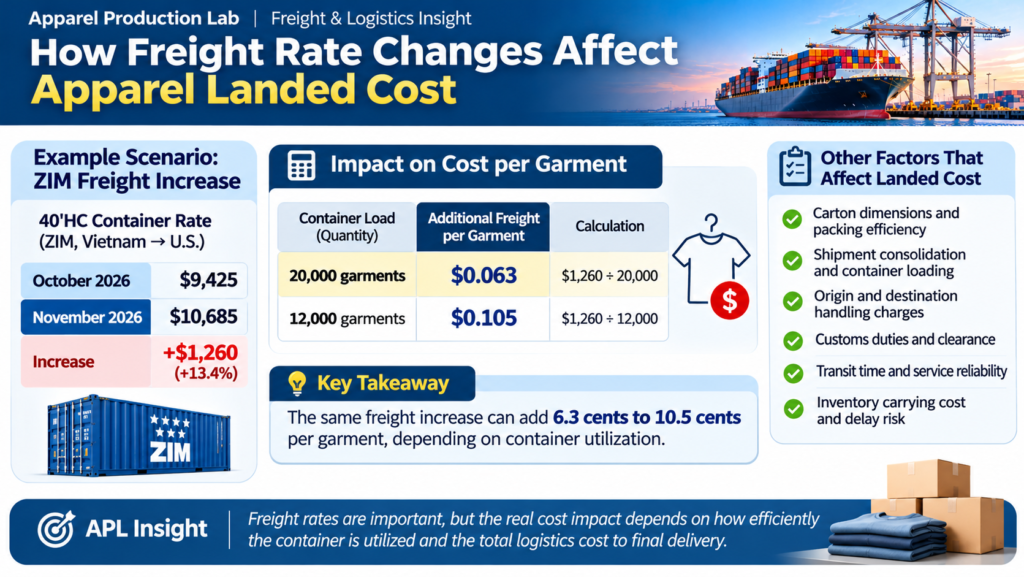
This illustrates why container utilization is a critical part of garment landed cost management.
The effect of freight increases is not determined by the container rate alone.
Carton dimensions, packing efficiency, garment type, shipment consolidation, and container loading performance can materially change the cost per unit.
These are illustrative calculations based on the quoted rate difference, not actual shipment results.
5. Freight Rate vs. Total Logistics Cost
A freight quotation should not be evaluated independently of service performance.
For apparel buyers and production managers, the relevant cost is the total expense required to deliver goods to the intended destination within the required time.
Important factors include:
- Ocean freight and applicable surcharges.
- Origin and destination handling charges.
- Customs clearance and duties.
- Inland trucking and warehouse delivery.
- Transit time and schedule reliability.
- Demurrage, detention, and storage exposure.
- Inventory carrying costs and delivery-delay risks.
A higher freight rate may be commercially justified if a service provides a meaningful and verified improvement in transit time or reliability.
Conversely, paying a premium without a corresponding operational benefit can unnecessarily increase landed cost.
Buyers should compare confirmed sailing schedules and service conditions before choosing between standard and premium options.
For additional information on U.S. ocean transportation regulations and shipping practices, consult the Federal Maritime Commission (FMC).
6. Practical Recommendations for Apparel Importers
Compare multiple carrier quotations
Do not assume that all carriers are moving in the same direction. The November quotation shows meaningful differences in both price levels and monthly adjustments.
Recalculate landed costs when freight rates change
Update garment costing models when new freight quotations become available, especially for shipments with narrow margins.
Improve container utilization
Review carton dimensions, packing methods, shipment consolidation, and loading plans to reduce freight cost per garment.
Confirm quotation validity
The November rates discussed here were valid through November 14, 2026.
Freight quotations can change, and booking availability may differ from quoted conditions.
Evaluate lead time alongside price
A lower ocean freight rate should be balanced against actual sailing schedules, transit time, and the buyer’s delivery requirements.
APL Perspective: Freight Data Should Support Better Sourcing Decisions
The November 2026 Vietnam–U.S. freight quotation illustrates why apparel importers should maintain historical freight records by carrier, route, equipment type, and quotation date.
A structured freight rate history can help identify cost changes, support supplier negotiations, and improve landed cost forecasting.
However, a single forwarder’s quotation should not be treated as a definitive representation of the entire ocean freight market.
For sourcing professionals, the most valuable approach is to combine freight quotations with actual shipment costs, carrier performance, and container utilization data.
Explore the Apparel Production Lab Freight Rate Tracker for historical carrier quotations and monthly freight comparisons.
Need assistance evaluating apparel landed costs or sourcing decisions? Contact Apparel Production Lab to discuss your requirements.
Source and Data Notes
Primary source: Victory International, JSC, private ocean freight quotations dated September 27, 2026 (October rates) and November 1, 2026 (November rates).
Trade lane: Vietnam to Los Angeles / Long Beach, subject to the origin and destination coverage specified for each carrier.
Quotation validity: October 14, 2026, and November 14, 2026, respectively.
All figures are quoted rates in USD. They are provided for historical reference and should be reconfirmed before booking.
Percentage changes are calculated from the quoted values and rounded to one decimal place.