
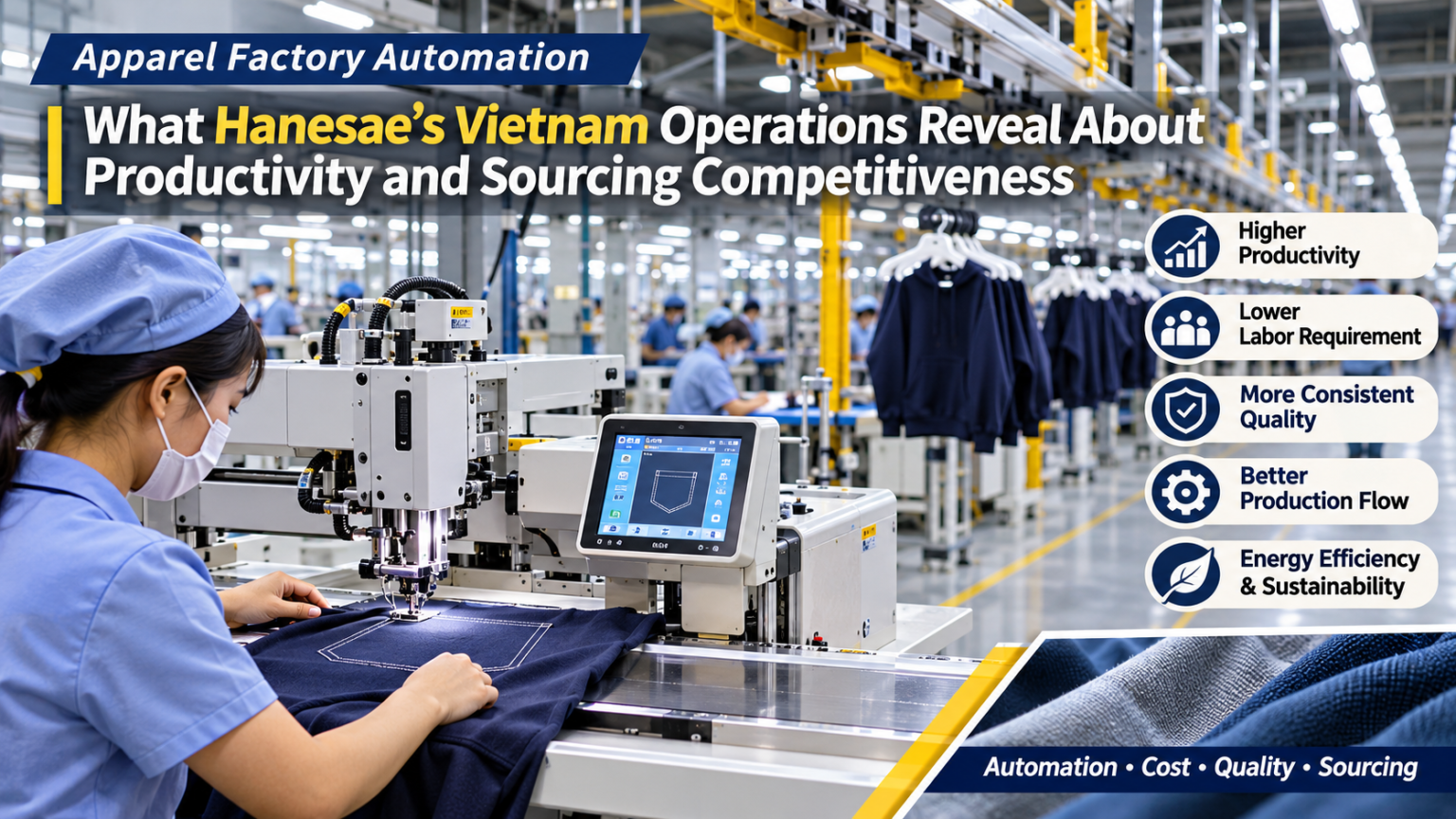
Apparel Factory Automation: What Hanesae’s Vietnam Operations Reveal About Productivity and Sourcing Competitiveness
How automated sewing, material handling, and vertical integration are changing the economics of apparel manufacturing.
Introduction: A New Competitive Model for Apparel Manufacturing
For decades, global apparel sourcing decisions have been heavily influenced by labor costs, production capacity, and preferential trade arrangements. However, a recent example from Vietnam demonstrates why these traditional measures are no longer sufficient to evaluate a garment manufacturer’s competitiveness.
South Korean apparel manufacturer Hansae Co., Ltd. has introduced automated sewing equipment, overhead hanger systems, automated material handling, and digital identification technologies at its Vietnam manufacturing operations.
According to a November 1, 2026 report by The Korea Economic Daily, these investments have produced substantial productivity improvements in selected sewing operations.
The significance extends beyond one company’s performance.
For apparel buyers, sourcing managers, and factory operators, the case raises an important question:
Will the next generation of competitive apparel suppliers be defined more by production efficiency than by low hourly wages?
1. The Vietnam Factory Case: Productivity Improvements in Practice
Hansae is a major Korean apparel manufacturer supplying international brands and retailers. According to the published report, the company produces approximately 400 million garments annually, with around 300 million destined for the United States.
Its Vietnam TG manufacturing operation reportedly operates 72 production lines across five buildings.
The company has invested in automated pattern sewing, overhead hanger systems, automated guided vehicles (AGVs), and radio-frequency identification (RFID) technologies.
The reported improvements are significant.
| Production operation | Before automation | After automation | Approximate increase |
|---|---|---|---|
| Hoodie front-pocket sewing | 34 pieces/hour | 61 pieces/hour | 79% |
| Jacket half-moon pattern sewing | 89 pieces/hour | 225 pieces/hour | 153% |
| Overall line productivity | Baseline | Reportedly 2.5 times baseline | 150% |
Source: The Korea Economic Daily, November 1, 2026. These figures represent reported operations and should not be interpreted as universal productivity gains for all apparel factories.
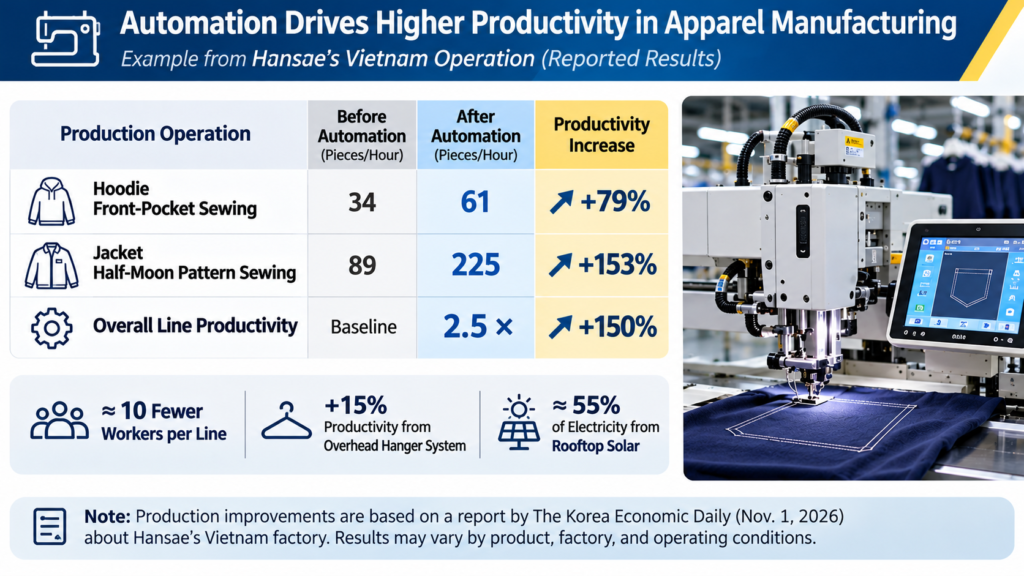
The factory also reported reducing staffing requirements by approximately ten workers per production line following automation investments.
These results illustrate how targeted automation can transform specific labor-intensive operations without eliminating the need for skilled production personnel.
2. Automated Pattern Sewing: Reducing Skill Dependency
Traditional garment sewing depends heavily on operator skill, particularly when producing curved seams, decorative patterns, pockets, and complex reinforcement stitching.
In conventional operations, these processes often require experienced sewing operators to maintain consistent quality and output.
Automated pattern sewing machines change the operating model.
Once a sewing program is established, the operator positions the fabric or garment component, and the machine executes a predefined stitching pattern.
Potential advantages include:
- More consistent stitching and dimensional accuracy.
- Reduced dependence on highly experienced operators for repetitive patterns.
- Faster training for new production employees.
- Lower variation between operators and shifts.
- Improved predictability of standard operation times.
However, automation does not eliminate technical preparation.
Pattern programming, fixture development, machine maintenance, fabric positioning, and quality verification remain essential.
The most effective factories combine automated equipment with well-trained operators and disciplined production engineering.
APL Perspective: The value of automation should be measured not only by pieces per hour but also by first-pass quality, rework reduction, operator utilization, and equipment availability.
3. Overhead Hanger Systems: Eliminating Non-Value-Added Movement
One of the most overlooked sources of inefficiency in garment manufacturing is the movement of work-in-process (WIP) between sewing operations.
In traditional bundle systems, operators or helpers manually transfer partially completed garments between workstations.
This creates several operational challenges:
- Unnecessary walking and handling.
- Excessive WIP accumulation.
- Uneven feeding of sewing operations.
- Delays in identifying production bottlenecks.
- Limited visibility into individual operation performance.
An automated overhead hanger system moves garment components between operators through a controlled transportation network.
At Hansae’s Vietnam facility, the report indicates that this system increased productivity by at least 15% by reducing unnecessary movement.
For production managers, the larger opportunity is not simply faster transportation.
It is the ability to improve production flow.
When properly implemented, an overhead system can support better line balancing, WIP control, bottleneck identification, and production tracking.
Nevertheless, an automated transportation system cannot compensate for poor line engineering.
If operation sequencing, workstation capacity, or production balancing is incorrect, automation may simply move bottlenecks faster.
4. The Real Costing Question: Does Automation Reduce Garment FOB Cost?
Higher production output does not automatically translate into lower garment FOB prices.
For sourcing and costing professionals, the critical issue is how automation affects total manufacturing cost per garment.
A simplified conversion-cost model can be expressed as:
Conversion Cost per Garment = Total Relevant Factory Conversion Cost ÷ Good Garments Produced
Relevant costs may include direct labor, indirect production labor, equipment depreciation, maintenance, electricity, factory overhead, and quality-related losses.
Consider a hypothetical example:
| Metric | Conventional operation | Automated operation |
|---|---|---|
| Good garments per hour | 100 | 150 |
| Relevant hourly conversion cost | $120 | $150 |
| Conversion cost per garment | $1.20 | $1.00 |
Illustrative APL calculation, not Hansae factory data.
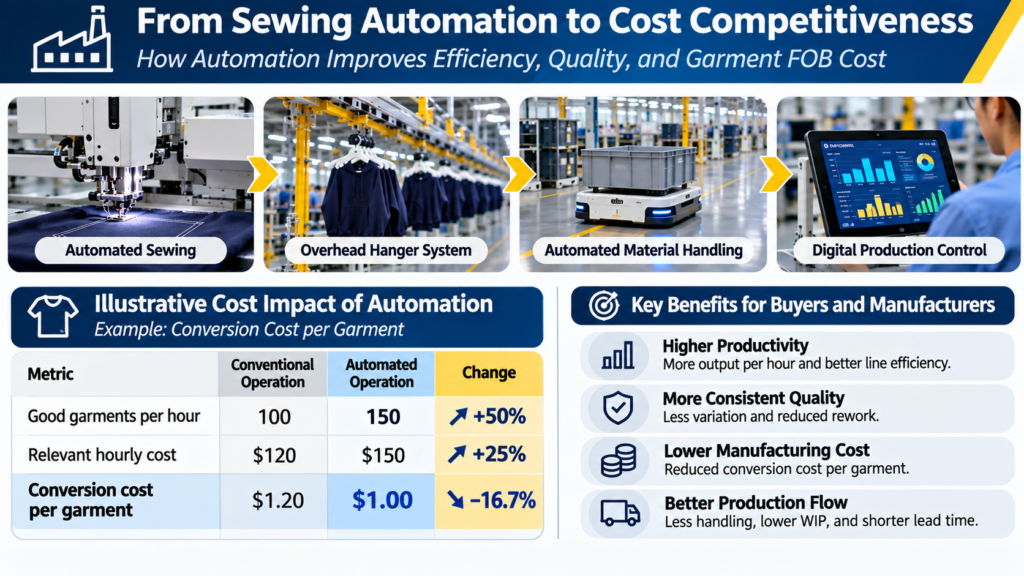
Although hourly operating cost increases by 25%, good output increases by 50%.
As a result, conversion cost per garment decreases by approximately 16.7%.
However, this result depends on production volume, equipment utilization, downtime, maintenance expense, and the actual proportion of labor replaced or redeployed.
For low-volume orders with frequent style changes, specialized automation may provide less benefit because programming, setup, and changeover time consume a larger share of available production hours.
This is why buyers should evaluate factory automation in relation to their specific product categories, order quantities, and production complexity.
5. Automation and Quality: Productivity Must Be Measured Against Good Output
An operation producing more pieces per hour is not necessarily more productive if defects and rework increase.
Apparel manufacturing performance should be evaluated using good output rather than gross output alone.
For example, a sewing operation producing 200 pieces per hour with a 10% defect rate generates fewer first-pass acceptable pieces than its gross output suggests.
An alternative operation producing 190 pieces per hour with a 2% defect rate may deliver more usable production with less disruption.
This distinction is especially important for automated operations involving fabric positioning, alignment, stitching accuracy, and component handling.
Key performance indicators should include:
- First-pass yield (FPY).
- Defects per hundred units (DHU).
- Rework hours.
- Machine availability.
- Actual output against standard allowed minutes.
- On-time completion of production orders.
Automation investments should strengthen both productivity and process consistency.
Otherwise, improvements in sewing speed may be offset by higher inspection, repair, and handling costs.
6. Energy Efficiency Is Becoming Part of Factory Competitiveness
The Korea Economic Daily also reported that Hansae installed rooftop solar power systems at its Vietnam operation, replacing approximately 55% of the facility’s electricity consumption and generating substantial annual cost savings.
This introduces another important dimension of manufacturing competitiveness.
Energy management affects factory operating expenses, exposure to electricity-price changes, and environmental performance.
For international apparel buyers, energy efficiency may also become increasingly relevant to supplier assessment and sustainability reporting.
However, environmental claims should be evaluated using documented energy consumption, generation records, and credible accounting methods.
A solar installation is a positive operational development, but it does not independently establish that an entire garment production process is environmentally sustainable.
7. Vertical Integration: From Sewing Efficiency to Supply Chain Control
Hansae’s manufacturing strategy extends beyond sewing automation.
The company has also pursued upstream capabilities in textiles and materials, including investments and acquisitions connected with fabric development and production.
The November 2026 report describes plans for integrated manufacturing capabilities in Guatemala, covering stages from yarn and fabric production through garment manufacturing and export.
This strategy reflects a broader industry trend toward controlling more elements of the apparel supply chain.
Vertical integration may provide advantages in:
Material development: Faster coordination between fabric engineering and garment development.
Lead-time management: Reduced dependency on multiple independent production and transportation schedules.
Quality consistency: Better control over material specifications and process requirements.
Cost visibility: Improved understanding of upstream and downstream manufacturing costs.
Product diversification: Greater capability to support technical fabrics, activewear, denim, and other specialized product categories.
Yet vertical integration also introduces challenges.
Capital requirements, operating complexity, capacity utilization, and the need to maintain competitiveness at every production stage can create financial and managerial risks.
The existence of integrated facilities does not guarantee lower costs.
Their performance must be evaluated against external sourcing alternatives.
8. Vietnam and Central America: Different Competitive Advantages
Hansae’s Vietnam and Guatemala investments also demonstrate that sourcing diversification is not simply a matter of shifting orders from one country to another.
Vietnam offers established apparel manufacturing capabilities, experienced production networks, and significant export capacity.
Central American locations may offer geographic advantages for serving the United States, including shorter transportation distances and opportunities under preferential trade arrangements.
However, preferential tariff treatment is not automatic.
Eligibility depends on the applicable trade agreement, product classification, rules of origin, and other legal requirements.
For example, CAFTA-DR benefits generally require qualifying products to satisfy specific origin rules, which can be particularly important for yarn, fabric, and garment production planning.
Therefore, sourcing decisions should consider both operational competitiveness and the actual landed cost of qualifying products.
A vertically integrated supplier may be better positioned to manage certain origin requirements, but buyers must verify compliance rather than assume eligibility.
9. Five Questions Buyers Should Ask Automated Apparel Factories
The Hansae case provides a useful framework for evaluating manufacturing partners.
1. Which operations are automated?
Ask suppliers to identify the exact processes supported by automated equipment.
A factory with automated pocket sewing is not necessarily automated across its entire production operation.
2. What are the verified productivity improvements?
Request comparable before-and-after figures, including output, staffing, operating hours, and defect rates.
3. How does automation affect the quoted price?
Evaluate whether improvements in labor efficiency and production flow are reflected in the CMPT or garment FOB costing structure.
4. Can the system accommodate frequent style changes?
Assess programming time, machine flexibility, minimum efficient order quantities, and setup requirements.
5. Does the factory have a reliable maintenance and engineering team?
Automation requires technical support, spare parts, preventive maintenance, and production engineering expertise.
A sophisticated machine without reliable support can become a costly bottleneck.
10. What Apparel Manufacturers Should Learn
For factory owners and production managers, the most practical lesson is to identify the processes that constrain output or create unnecessary costs.
Not every operation requires expensive automation.
A disciplined improvement program may begin with:
- Measuring actual output and standard operation times.
- Identifying bottlenecks and excessive material movement.
- Reviewing defect and rework data.
- Selecting operations with repetitive, stable production requirements.
- Testing equipment or workflow improvements before full-scale investment.
- Calculating payback using realistic utilization and maintenance assumptions.
In many factories, improvements in line balancing, workplace organization, operator training, and production scheduling should come before major capital investment.
Automation should be part of a manufacturing improvement strategy—not a substitute for one.
Conclusion: The Future of Apparel Sourcing Is About Productivity, Not Just Wages
Hansae’s Vietnam operations illustrate an important shift in apparel manufacturing.
A factory’s competitiveness increasingly depends on how effectively it combines labor, technology, production engineering, material flow, quality management, and supply chain coordination.
Low wages remain relevant, but they cannot fully explain manufacturing performance.
For buyers, the critical question is no longer simply:
Which country offers the lowest sewing labor rate?
It is:
Which supplier can consistently deliver the required quality, lead time, flexibility, and total cost?
That is the standard against which modern apparel sourcing decisions should be measured.
APL Practical Takeaway
Apparel factory automation should be evaluated through measurable production performance, not equipment ownership alone.
For manufacturers, the priority is sustainable improvement in good output, conversion cost, and production reliability.
For buyers, the priority is understanding how those improvements translate into actual sourcing value.
Explore Apparel Production Lab’s resources on global sourcing, production management, garment costing, and factory performance evaluation.
Source and Editorial Note
This article is an independent operational and sourcing analysis based in part on reporting by The Korea Economic Daily, published November 1, 2026, concerning Hansae’s Vietnam manufacturing operations.
Reported company performance figures are attributed to that publication. Costing examples and operational interpretations are original APL analysis. Results may differ substantially across factories, products, equipment configurations, and production volumes.
Original reporting: The Korea Economic Daily, November 1, 2026.
Additional reporting on Hansae’s Vietnam factory automation is available from Chosun English.