
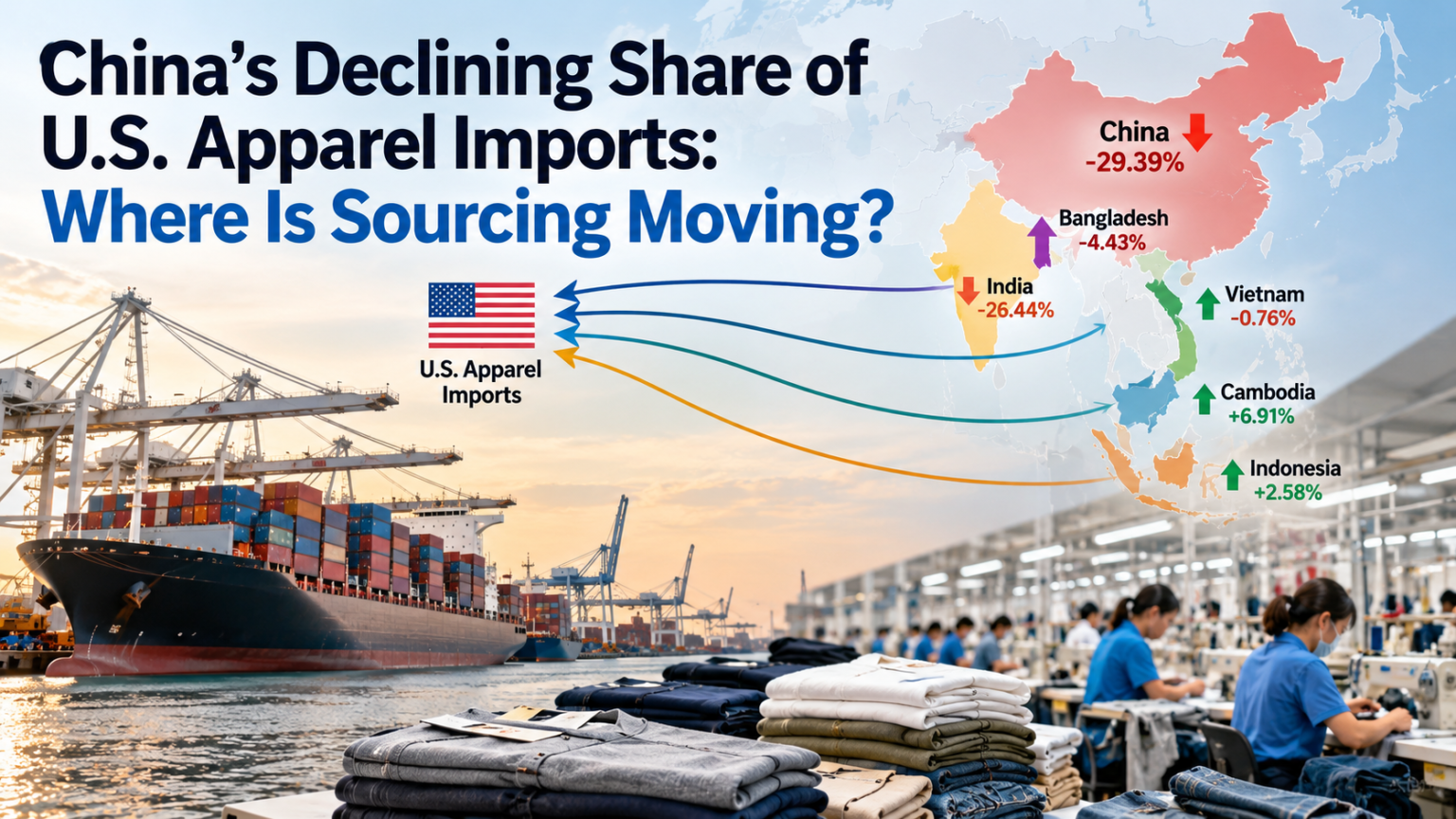
China’s Declining Share of U.S. Apparel Imports: Where Is Sourcing Moving?
Market Update: October 19, 2026
China’s declining share of U.S. apparel imports is reshaping global sourcing strategies. However, the shift is more complicated than simply transferring garment orders from China to another low-cost manufacturing country.
Recent U.S. import data shows that China’s apparel shipments have fallen substantially, while Vietnam, Bangladesh, Cambodia, and Indonesia are competing for a changing share of the American market.
For apparel buyers and production teams, the important question is not only where sourcing is moving, but which manufacturing locations can deliver the right combination of cost, capacity, quality, compliance, and reliability.
What the Latest U.S. Apparel Import Data Shows
According to U.S. Office of Textiles and Apparel (OTEXA) data reported for January–August 2026, total U.S. apparel imports reached approximately $49.08 billion, representing a 7.42% decline from the same period in 2025.
Import volumes declined 8.98%, while the average import unit value increased 1.71%.
China experienced a significantly sharper contraction than the overall market, with its apparel shipments to the United States declining 29.39% in value and 21.61% in volume.
The difference suggests that China’s declining role reflects more than weaker overall U.S. apparel demand. Changes in sourcing strategies, trade uncertainty, and supplier diversification are also important considerations.
However, declining imports from China should not automatically be interpreted as equivalent growth in another manufacturing country.
Which Apparel Sourcing Countries Are Gaining Ground?
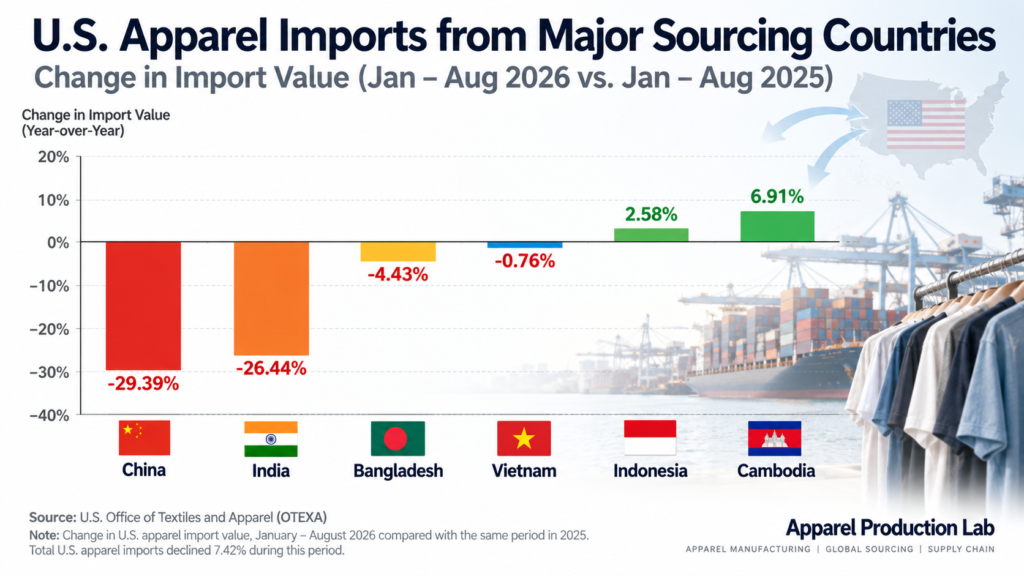
The January–August 2026 data shows different performance patterns among major Asian apparel suppliers.
| Sourcing country | U.S. apparel import value change, YoY |
|---|---|
| China | −29.39% |
| India | −26.44% |
| Bangladesh | −4.43% |
| Vietnam | −0.76% |
| Indonesia | +2.58% |
| Cambodia | +6.91% |
Source: OTEXA-based January–August 2026 data reported in October 2026. Changes compare import values with the same period in 2025.
Vietnam: A Major Sourcing Base with Established Capabilities
Vietnam remains one of the most important apparel manufacturing countries serving the U.S. market.
Its established export infrastructure, experienced garment factories, and connections to regional textile supply chains make it a practical option for many apparel programs.
Although Vietnam’s U.S.-bound apparel export value declined slightly during January–August 2026, its relative performance was considerably stronger than China’s.
For buyers, Vietnam’s attractiveness depends on product category, factory specialization, fabric sourcing arrangements, and available production capacity.
Bangladesh: Competitive Garment Manufacturing with Material-Sourcing Considerations
Bangladesh remains a major apparel sourcing destination, particularly for high-volume garment programs.
Its competitive manufacturing base is important for products such as knitwear, basic apparel, and other labor-intensive categories.
However, many factories depend on imported fabrics and materials. Buyers should therefore evaluate the complete supply chain rather than garment assembly capacity alone.
Fabric development, material approval, import lead times, and production readiness can determine whether a factory’s quoted delivery schedule is achievable.
Cambodia and Indonesia: Positive Growth in a Contracting Market
Cambodia and Indonesia recorded positive apparel export value growth to the United States during January–August 2026.
Cambodia increased 6.91%, while Indonesia grew 2.58%.
Their positive performance is notable because overall U.S. apparel imports declined during the same period.
Nevertheless, growth at the country level does not guarantee that every factory has suitable capacity, product expertise, or commercially competitive pricing.
Buyers still need factory-level evaluation before allocating orders.
India: A Large Manufacturing Base Facing Near-Term Pressure
India offers substantial textile and apparel manufacturing capabilities, including cotton-based products, woven garments, knitwear, and integrated textile production.
However, its U.S.-bound apparel export value declined 26.44% during January–August 2026.
This demonstrates why sourcing decisions should not rely only on a country’s long-term manufacturing potential.
Current commercial conditions, trade measures, material costs, and delivery performance must also be considered.
Why Apparel Sourcing Is Becoming More Diversified
The 2026 Fashion Industry Benchmarking Study from the United States Fashion Industry Association (USFIA) highlights the growing importance of sourcing diversification.
The objective is increasingly to reduce concentration risk rather than replace one dominant sourcing country with another.
For a closer look at regional sourcing alternatives, read our article, Nearshoring Is Not Just About Distance and Duty.
For apparel companies, a diversified sourcing structure can provide several operational advantages:
- Reduced dependence on a single manufacturing country
- Greater flexibility when trade conditions change
- Alternative production capacity during factory disruptions
- More options for different garment categories
- Improved resilience when logistics or material supply becomes uncertain
However, diversification also introduces management challenges.
Working with additional factories across several countries requires consistent technical specifications, quality standards, production reporting, compliance procedures, and shipment coordination.
A larger supplier network is not automatically a more efficient supplier network.
China Still Has Important Competitive Advantages
China’s declining share of U.S. apparel imports does not mean its manufacturing capabilities have disappeared.
China continues to offer significant advantages in textile production, material availability, manufacturing integration, technical development, and production flexibility.
For certain garments, particularly those requiring specialized fabrics, complicated trims, or rapid material development, China’s integrated supply chain can remain highly competitive.
A factory in another country may offer a lower garment-making cost but require imported fabrics, additional transportation, or longer development time.
This can change the overall commercial comparison.
Buyers should therefore distinguish between reducing China exposure and eliminating China from their sourcing strategy.
The appropriate decision depends on the product, the required delivery date, and the total landed cost.
Why Lower FOB Prices Do Not Always Mean Lower Landed Costs
When shifting apparel production between countries, buyers often begin by comparing garment FOB prices.
However, FOB price alone does not represent the complete cost of supplying a U.S. customer.
A practical landed-cost comparison should consider:
- Garment FOB price and material cost assumptions
- Applicable U.S. import duties and trade measures
- Ocean or air freight
- Destination handling and inland transportation
- Additional testing and compliance requirements
- Material development and approval costs
- Production lead time and inventory exposure
- Potential delivery delays and related commercial risks
For example, a factory may quote a lower sewing cost while depending on fabric imported from another country.
If fabric procurement adds several weeks to the production schedule, the lower manufacturing cost may not produce a better overall sourcing result.
The appropriate comparison is the cost of delivering compliant, acceptable merchandise to the required destination within the agreed delivery window.
Five Practical Checks Before Moving Apparel Production
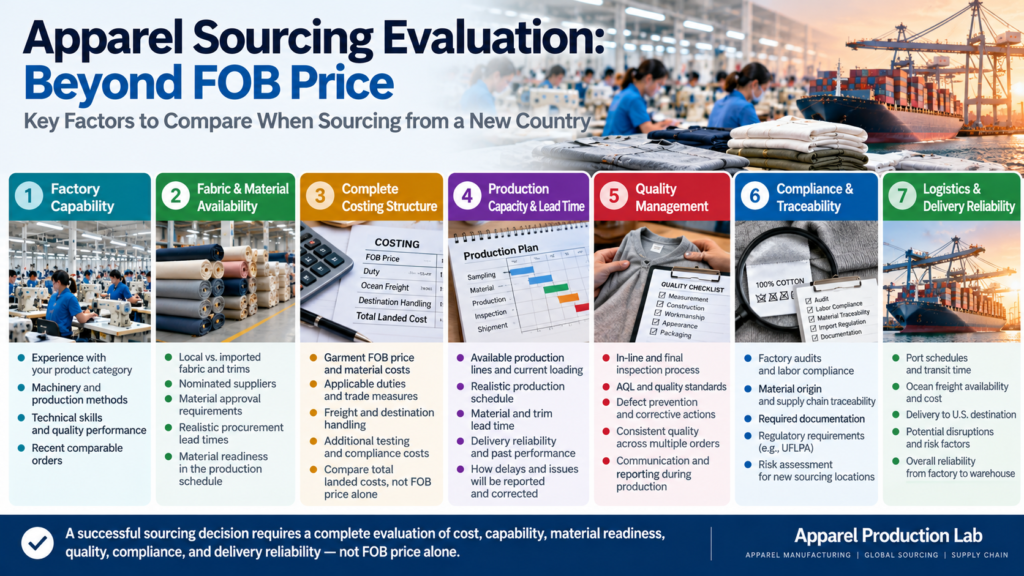
1. Verify Product-Specific Factory Capability
Confirm that the proposed factory has experience producing the actual garment category.
Review machinery, production methods, technical skills, quality performance, and recent comparable orders.
Country-level manufacturing capacity is not a substitute for factory-level capability.
2. Confirm Fabric and Material Availability
Determine whether the required fabric, trims, and packaging materials are locally available or must be imported.
Identify the nominated suppliers, material approval requirements, and realistic procurement lead times.
Material readiness should be included in the production schedule before confirming the delivery date.
3. Compare Complete Costing Structures
Request quotations based on equivalent garment specifications, order quantities, packing requirements, delivery terms, and commercial assumptions.
Separate confirmed costs from estimates.
When comparing FOB and landed-delivery quotations, ensure that the included charges are clearly identified.
4. Evaluate Production Capacity and Delivery Reliability
Review available production lines, current factory loading, planned production dates, and shipment commitments.
A factory’s quoted capacity should be supported by a realistic production plan.
Buyers should also confirm how delays, material shortages, and quality problems will be reported and corrected.
5. Review Compliance and Traceability
Verify relevant factory audits, labor compliance requirements, material traceability, and applicable import regulations.
Pay particular attention to documentation supporting the origin of materials and components.
A sourcing change should not introduce compliance risks that outweigh the expected cost benefits.
What This Means for Apparel Buyers and Production Teams
China’s declining share of U.S. apparel imports creates both opportunities and challenges.
Vietnam and Bangladesh remain important sourcing bases, while Cambodia and Indonesia demonstrate positive growth in the latest reported period.
At the same time, the broader U.S. apparel import market has contracted, meaning sourcing diversification should not be confused with an overall expansion in demand.
For apparel buyers, the practical objective is to develop a balanced sourcing strategy based on measurable supplier capabilities.
For production teams, the priority is to maintain control of material readiness, factory capacity, quality performance, and delivery schedules across multiple manufacturing locations.
Successful diversification requires more than identifying a new country. It requires establishing a reliable and manageable supply chain.
The Practical Takeaway
The shift away from China is changing the structure of U.S. apparel sourcing, but no single country offers the best solution for every garment program.
Recent trends in U.S. apparel imports highlight the importance of evaluating alternative sourcing countries based on manufacturing capabilities, total landed costs, and supply chain reliability.
Sourcing decisions should be based on product-specific manufacturing capability, complete landed cost, material availability, compliance, and delivery reliability.
A diversified supplier network creates value only when it improves the company’s ability to deliver the right product, at the right cost, and at the required time.
Evaluate Your Next Apparel Sourcing Decision
Before moving an apparel program to a new manufacturing country, compare factory capabilities, material sourcing arrangements, production lead times, quality requirements, and total delivered costs.
Explore Apparel Production Lab’s sourcing and production management services, or contact us to discuss a practical approach to evaluating factories, comparing costs, and managing apparel production across multiple sourcing locations.