
U.S.-Bound Apparel Freight Update: West Coast and East Coast Rates Diverge
Market update: October 15, 2026
Apparel importers should review ocean freight costs by shipping lane rather than relying on a single global market headline.
Drewry’s October 15 assessment shows a modest increase in Shanghai–Los Angeles spot rates, while Shanghai–New York rates moved slightly lower. The difference matters when updating freight budgets, comparing delivery routes, and preparing landed-cost quotations.
For apparel sourcing teams, the practical task is to connect the latest freight information with the shipment’s actual origin, destination, cargo-ready date, and required warehouse delivery date.
U.S.-Bound Apparel Freight Rates: This Week’s Snapshot
Drewry reported the following benchmark rates on October 15, 2026:
| Shipping lane or index | Rate per 40ft container | Weekly change |
|---|---|---|
| Shanghai → Los Angeles | $7,884 | +3% |
| Shanghai → New York | $10,075 | −1% |
| World Container Index composite | $4,485 | +3% |
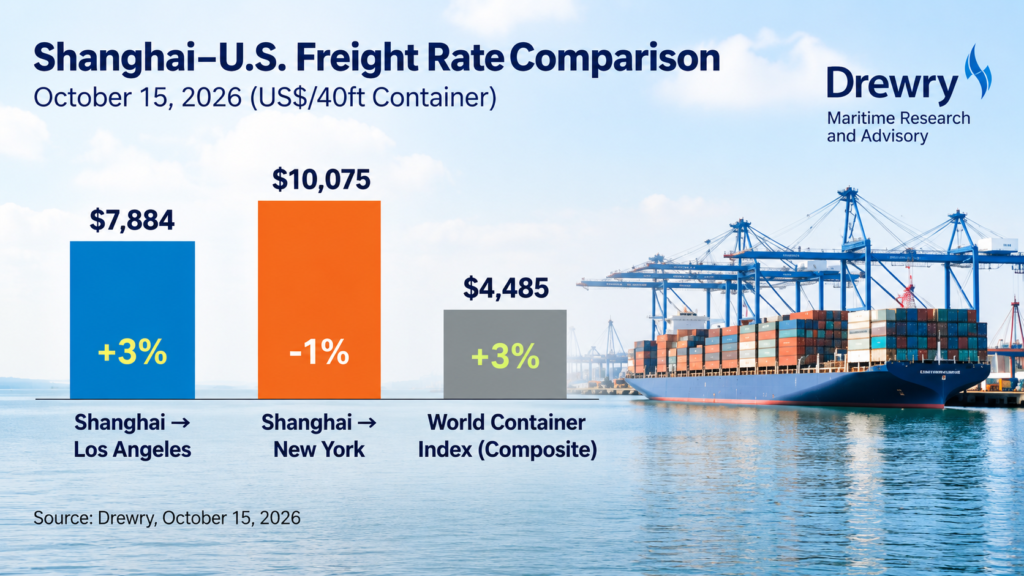
The composite index increased mainly because of higher Asia–Europe rates. It should therefore not be interpreted as evidence that every U.S.-bound lane increased by the same amount.
These figures are market benchmarks. They are not a substitute for a shipment-specific quotation and do not establish the complete cost of delivery to a buyer’s warehouse. Importers should confirm the services, charges, equipment, and validity period included in each actual quote. www.drewry.co.uk
Why a Global Index Is Not Enough for Apparel Costing
A global freight index helps explain the direction of the broader market. A garment costing sheet, however, needs a rate that matches the shipment.
A Shanghai–Los Angeles benchmark does not automatically represent a shipment leaving Vietnam, Bangladesh, or another production origin. Similarly, a New York port rate does not represent the complete cost of delivering goods to an inland warehouse.
Before updating a freight allowance, confirm:
- Port of loading and port of discharge
- Final delivery destination
- Container type and shipment size
- Direct service or transshipment routing
- Expected sailing date
- Quote expiry date
- Included and excluded surcharges
- Destination handling and inland delivery charges
For less-than-container-load shipments, obtain an LCL quotation. Dividing a full-container benchmark by the shipment’s volume will not reproduce the actual LCL charging structure.
A Lower Ocean Rate Does Not Automatically Mean a Better Route
West Coast and East Coast routing decisions should be made against the buyer’s delivery requirements.
A lower port-to-port ocean rate may be offset by higher inland transportation costs, additional handling, or a longer journey to the receiving warehouse.
Conversely, a higher ocean rate may still support a practical delivery plan when the destination port is closer to the buyer’s distribution network.
The appropriate comparison is:
Ocean freight + applicable surcharges + destination handling + inland transportation + expected delivery time.
For time-sensitive apparel, also assess the commercial consequences of missing the required delivery window. A freight saving offers limited value if the shipment arrives too late for the selling period.
Record Los Angeles Volumes Provide Context, Not Proof of Congestion
The Port of Los Angeles reported September throughput of approximately 1.043 million TEUs, its highest monthly total on record.
Loaded imports reached approximately 545,696 TEUs, about 19% above September of the previous year. The port also stated that its workforce and supply-chain partners kept cargo moving through the record volumes. portoflosangeles.org
These figures cover all containerized cargo, not apparel alone.
Higher throughput should not be presented as proof of congestion or an automatic delay for every shipment. For an individual apparel order, the more useful checks are terminal availability, customs release, container pickup arrangements, and the receiving warehouse’s appointment schedule.
Manage Delivery Through Warehouse Receipt
A vessel’s estimated arrival date is one milestone in the delivery process. It is not the warehouse delivery date.
After arrival, cargo may still require unloading, availability confirmation, customs clearance, terminal release, pickup, inland transportation, and a receiving appointment.
An apparel shipment tracker should distinguish at least the following dates:
- Cargo ready
- Confirmed vessel departure
- Latest estimated vessel arrival
- Actual arrival
- Cargo available for pickup
- Customs release
- Container pickup
- Warehouse appointment
- Actual warehouse receipt
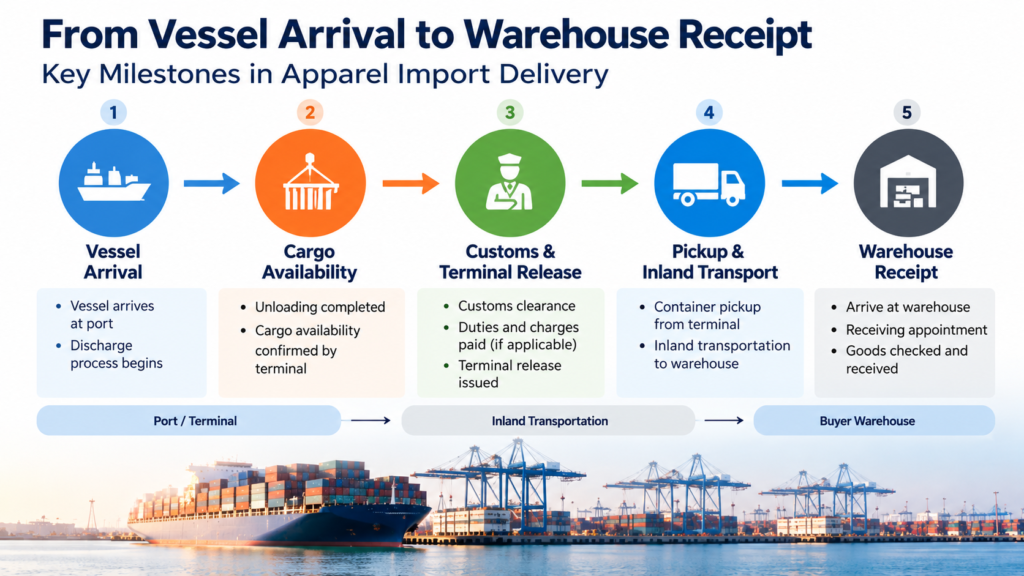
Keep planned, estimated, and actual dates separate. This makes it easier to identify which part of the delivery schedule has changed and who needs to take action.
Use our Apparel Production Delivery Date Calculator to build an initial production-to-warehouse schedule, then confirm its assumptions against the actual shipment.
Five Actions for Apparel Buyers and Production Teams
1. Refresh the Relevant Lane Quote
Request a current quotation for the actual production origin and delivery destination. Use market indices to check context, then confirm the commercial offer with the freight provider.
2. Record Freight Quote Validity
Add the quotation date and expiry date to the costing record. If production slips beyond the validity period, obtain a revised freight quote before treating the delivery cost as confirmed.
3. Compare Routes on the Same Basis
Use equivalent shipment quantities, container assumptions, delivery scope, and charge inclusions. A port-to-port quote and a warehouse-delivered quote are not directly comparable.
4. Connect Production Readiness with Booking
Confirm whether inspection, packing, documentation, and cargo handover can meet the booked service’s cutoffs. A production delay can change both the sailing and the applicable freight cost.
5. Update the Warehouse Delivery Plan
Review customs documentation, pickup responsibility, inland transport, free-time conditions, and receiving appointments before arrival. Reconfirm the plan when the vessel schedule changes.
What This Means for Landed-Cost Quotations
Freight assumptions should remain traceable within a landed-cost calculation.
Record the origin, destination, delivery scope, shipment quantity, rate source, quotation date, validity period, and excluded charges.
Where freight remains unconfirmed, label it as an estimate. Where the provider has issued a valid quote, record its conditions rather than treating the number as permanently fixed.
This is especially useful when a garment quotation includes delivery to the buyer’s warehouse. The factory price may remain unchanged while transportation assumptions change between the initial costing and the actual shipment.
The Practical Takeaway
This week’s freight update shows why apparel teams should avoid applying one global percentage change to every shipment.
For U.S.-bound apparel freight, accurate landed-cost planning requires lane-specific rates, confirmed delivery terms, and realistic warehouse arrival schedules.
Review the relevant lane, confirm the complete delivery scope, and connect freight validity with production readiness.
The sourcing decision is stronger when the costing sheet and delivery tracker describe the same shipment—from cargo handover through warehouse receipt.
Review Your Apparel Freight and Delivery Assumptions
Before confirming your next shipment, check whether your freight allowance reflects the actual route, shipment size, quote validity, and warehouse destination.
Explore Apparel Production Lab’s costing and production-planning resources, or contact us to discuss the assumptions behind your apparel sourcing and delivery plan.