
Garment finishing and packing may appear to be the final steps of apparel production, but they are much more than simply pressing, folding, and putting garments into cartons.
This is the stage where a garment begins to take its final commercial form.
A garment may have passed through sewing successfully, but problems with appearance, measurement, pressing, labeling, stains, packing, or carton information can still prevent it from being ready for final inspection and shipment.
In my experience, finishing control should begin by looking at the garment as a complete product—not by immediately checking individual measurements or isolated defects.
My basic approach is:
Appearance → Construction & Spec → Measurement → Labeling → Defects → Pressing → Re-Measurement → Packing Control → Final Inspection Readiness
The objective is simple:
Final inspection should confirm that the factory has controlled the product correctly—not become the first place where finishing and packing problems are discovered.
Start With the Overall Appearance
When I first inspect a finished garment, I do not begin with the measuring tape.
I begin with the garment itself.
The garment should be placed properly so that its overall appearance can be evaluated.
The first question is:
Does this garment look right as a complete product?
Before examining individual details, I look at the overall appearance, garment balance, and workmanship.
This first visual check can reveal problems that may not immediately appear on a measurement sheet.
For example:
- uneven overall shape
- left-to-right imbalance
- twisting or distortion
- uneven seams
- puckering
- poor garment shape
- visible workmanship problems
- inconsistent appearance between panels or components
A garment can sometimes meet individual measurements and still not look correct.
That is why appearance should not be treated as a secondary check.
Overall Garment Balance Matters
Apparel is not simply a collection of individual measurements.
The finished garment has to work as a complete shape.
The relationship between the front and back, left and right sides, sleeves, collar, neckline, hem, and other components contributes to the overall balance of the garment.
This becomes especially important after sewing because small differences from multiple operations can accumulate.
One operation may be only slightly off.
Another may also be slightly off.
Individually, each issue may appear minor. But together they can change the overall appearance of the garment.
Looking at the complete garment first helps identify these problems before moving into detailed inspection.
Check Workmanship at the Same Time
The first appearance review is also an opportunity to identify obvious workmanship problems.
Depending on the garment, these may include:
- uneven stitching
- skipped stitches
- open seams
- seam puckering
- poor edge finishing
- uneven topstitching
- incorrect stitch appearance
- twisting
- mismatched components
- visible repair marks
The objective at this stage is not necessarily to complete every detailed inspection.
It is to determine whether the garment appears to have been produced under proper control.
If the overall appearance already shows repeated workmanship problems, the factory should investigate them before allowing large quantities to continue through finishing and packing.
Check Construction Against the Approved Standard
After reviewing appearance and workmanship, I move into the garment details.
The next question is whether the garment has been constructed correctly.
Construction should be compared against the applicable approved references, including the approved sample and Tech Pack.
Depending on the style, this may include:
- seam construction
- stitch type
- collar construction
- pocket construction and placement
- sleeve construction
- waistband construction
- placket construction
- hem construction
- zipper or closure application
- reinforcement details
- trim application
A garment that looks acceptable at first glance may still contain a construction error.
This is why appearance and construction should be checked separately.
Appearance asks whether the garment looks right.
Construction asks whether the garment was made right.
Both matter.
Check the Specification and Measurements
After construction, measurements should be checked against the approved Measurement Sheet or applicable specification.
Important Points of Measure should be checked according to the garment type and customer requirements.
The objective is not only to identify individual off-measurement garments.
Repeated measurement variation may indicate a larger production issue involving sewing construction, fabric behavior, cutting, washing, or finishing.
Measurement results should therefore be considered together with what is happening in production—not simply recorded as isolated numbers.
Check Labeling Before the Garment Moves Further
Labeling is another critical part of finishing control.
A garment may be perfectly sewn and measured but still be commercially unacceptable if the wrong label is used or if the label is attached incorrectly.
Depending on the product and customer requirements, this may involve:
- main label
- size label
- care/content label
- country-of-origin label
- additional required labels
- customer-specific identification
The correct label must be used for the correct product.
But correct content alone is not enough.
Placement also matters.
The label should be attached in the specified location and orientation according to the approved requirement.
This is particularly important because labeling errors can affect large quantities very quickly if they are not detected early.
Check Spots, Stains, Dirt, and Fabric Defects
The garment should also be checked for visible defects that may have occurred during material handling, sewing, finishing, or production movement.
Typical examples include:
- spots
- stains
- dirt
- oil marks
- fabric defects
- holes
- snags
- surface damage
- shade differences
- handling marks
At this point, the question is not simply whether the defect can be cleaned or repaired.
The factory should also determine whether the problem is isolated or repeated.
If the same defect appears repeatedly, the source should be investigated before more garments are affected.
A finishing department should not become a place where recurring production problems are quietly hidden through cleaning and repair.
Pressing Is a Quality-Control Step
Pressing is sometimes viewed mainly as a cosmetic process.
I consider it more important than that.
Proper pressing helps establish the garment’s final appearance and shape before packing.
But pressing can also affect the way a garment measures and hangs.
For this reason, the garment should not simply be pressed and immediately sent to folding and packing.
After pressing, I check the garment again.
Re-Check Measurements After Pressing
One of the most important controls in this process is re-measuring the garment after pressing.
The purpose is to confirm that the pressing or ironing method has produced the correct result.
If the garment does not measure correctly after pressing, the factory needs to determine whether the problem comes from the garment itself or from the pressing method.
Pressing conditions and techniques can influence the final garment shape and dimensions, especially with fabrics or constructions that respond easily to heat, steam, pressure, or handling.
Therefore, the sequence should be:
Press → Check Appearance → Re-Measure → Evaluate Pressing Result
If the result is not correct, do not simply continue pressing the rest of the production in the same way.
Correct the Pressing Method Before Continuing
If pressing is creating an undesirable result, the method or setting should be corrected first.
Depending on the product, this may involve adjusting:
- heat
- steam
- pressure
- pressing time
- garment positioning
- ironing direction
- handling method
The correct pressing method should be established and verified before large quantities continue.
This is an important production principle:
Do not allow an incorrect finishing method to become a bulk-production problem.
Correct the setting, confirm the garment again, and then allow the process to continue.
Packing Control Begins Before the Carton Is Closed
Once the garment has passed the finishing checks, packing begins.
But packing control is not simply counting garments and closing cartons.
At this stage, incorrect tags, incorrect carton labels, wrong quantities, or packing mistakes can create serious problems even when the garment itself is acceptable.
For this reason, packing requirements should be confirmed with the factory before final inspection.
The final inspection should then verify that those requirements have actually been followed.
Confirm the Correct Tags and Their Placement
One of the first packing-related items I check is whether the correct tags are being used.
Depending on the order, this may include:
- hangtags
- price tickets
- barcode tags
- size identification
- promotional tags
- customer-specific tags or stickers
Again, there are two questions:
Is it the correct tag?
and
Is it in the correct placement?
A correct tag attached in the wrong place can still be a packing compliance problem.
The factory should therefore work from the approved packing instructions rather than relying on memory or assumptions from previous orders.
Verify Carton Labels and Their Placement
The same principle applies to carton labels.
The correct carton label needs to correspond to the actual merchandise inside the carton.
Depending on customer requirements, carton information may include:
- PO number
- style number
- color
- size
- assortment
- carton number
- quantity
- destination
- barcode or shipping information
But the label content is only part of the check.
Carton label placement should also follow the required specification.
This may seem like a small detail, but incorrect carton labeling can create receiving, warehouse, distribution, or compliance problems after the merchandise leaves the factory.
Check Carton Quantity
Carton quantity should be checked against the approved packing requirement.
The factory should confirm that the actual number of garments inside the carton matches the required quantity and assortment.
This is especially important for orders involving multiple colors, sizes, POs, or assortment ratios.
An incorrect carton quantity can affect the Packing List, shipment quantity, warehouse receiving, and ultimately customer inventory.
Therefore, carton quantity should never be assumed simply because the carton appears properly packed.
It needs to be verified.
Check Carton Weight
Carton weight is another useful control point.
The actual carton weight should be checked against the expected packing condition and applicable requirements.
An unusual carton weight can sometimes be an early warning that something is wrong.
For example, it may indicate:
- incorrect garment quantity
- incorrect assortment
- missing garments
- excess garments
- different packing materials
- an unexpected packing condition
Carton weight should therefore be viewed not only as shipping information but also as another practical verification point in packing control.
Verify Packing and Assortment Before Final Inspection
Before final inspection, the factory should already have confirmed that packing is being executed according to the approved requirements.
This includes the relationship between:
PO → Style → Color → Size → Assortment → Carton Quantity → Carton Label
The exact requirements will vary by customer and order.
The important principle is that the physical merchandise, tags, packing method, carton contents, carton labels, and packing records should all agree.
If they do not, the discrepancy should be corrected before final inspection.
Final Inspection Should Verify, Not Discover
This is one of the most important principles in finishing and packing control.
Final inspection should not be the first time the factory seriously checks these requirements.
Before final inspection, the factory should already have reviewed:
- garment appearance
- workmanship
- construction
- measurements
- labeling
- visible defects
- pressing quality
- post-pressing measurements
- tags and placement
- carton labels and placement
- carton quantity
- carton weight
- packing and assortment
Final inspection should then independently confirm that the production and packing meet the required standards.
For more on how inline, end-line, and final inspection work together to control production quality, see Apparel Quality Control: Inline, End-Line & Final Inspection.
When major finishing or packing problems are first discovered during final inspection, the factory has already lost valuable time.
The garments may already be folded.
They may already be polybagged.
They may already be packed into cartons.
Correcting a simple problem at that point can require opening cartons, unpacking garments, correcting the issue, re-inspecting, refolding, repacking, resealing, and updating records.
A problem that might have taken seconds to prevent earlier can become a major rework operation later.
Finishing Control Protects the Shipment Schedule
Finishing problems can easily become delivery problems.
If a large quantity needs to be re-pressed, re-measured, re-tagged, cleaned, sorted, or repacked shortly before final inspection, the finishing department can become a bottleneck.
That can delay:
- packing completion
- final inspection
- shipment documentation
- container loading
- cargo handover
- vessel or air booking schedules
For more on how production readiness connects to shipment execution and delivery, see Apparel Shipping & Logistics: Managing FOB, LDP/DDP, and Warehouse Delivery.
For this reason, finishing capacity and quality control should be monitored as part of the overall production schedule.
Sewing completion does not mean the order is finished.
The order is not truly production-ready until the garments have successfully passed through finishing, packing, and final quality verification.
Do Not Rush the Last 10% of Production
Factories often spend weeks developing materials, cutting fabric, and sewing garments.
Then, as the shipment date approaches, there can be pressure to move the final stages very quickly.
This is dangerous.
The last part of production is where many separate requirements come together:
Product quality + Appearance + Measurement + Labeling + Packing + Customer requirements + Shipping information
A mistake at this stage can affect merchandise that has already consumed almost all of its production cost.
The closer the product gets to shipment, the more expensive a mistake can become.
Finishing and packing therefore deserve the same production discipline as cutting and sewing.
A Practical Finishing and Packing Control Flow
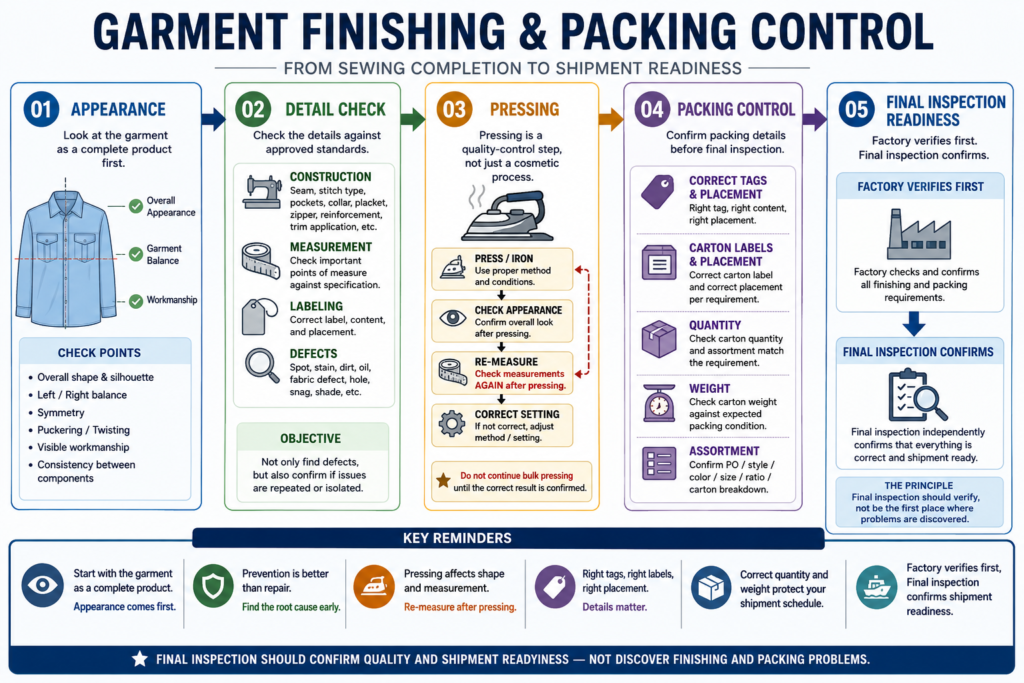
The overall process can be summarized as:
1. APPEARANCE
Check overall garment appearance, balance, and workmanship.
2. CONSTRUCTION
Confirm that the garment is built according to the approved standard.
3. SPEC & MEASUREMENT
Check important measurements against the approved specification.
4. LABELING & DEFECTS
Verify required labels and inspect spots, stains, dirt, fabric defects, and other visible problems.
5. PRESSING
Press the garment using the appropriate method and conditions.
6. RE-MEASUREMENT
Check measurements again after pressing and confirm that the garment maintains the correct shape and dimensions.
7. CORRECT PRESSING SETTING
If necessary, adjust the pressing method and verify the result before continuing bulk finishing.
8. TAG & PACKING CONTROL
Confirm correct tags, tag placement, folding, packing requirements, and assortment.
9. CARTON CONTROL
Verify carton labels and placement, carton quantity, and carton weight.
10. FINAL INSPECTION READINESS
Confirm with the factory that finishing and packing requirements have been properly executed before final inspection begins.
This sequence turns finishing from a simple end-of-line activity into a controlled production process.
Final Takeaway
Garment finishing and packing are not simply the last physical steps before shipment.
They are the final opportunity for the factory to make sure that the product has been produced, presented, identified, and packed correctly before final inspection.
I prefer to begin with the garment as a complete product:
Does it look right? Is the overall balance correct? Is the workmanship acceptable?
Then I move into construction, specifications, measurements, labeling, and defects.
After pressing, I check the measurement again and confirm that the pressing method and setting are producing the correct result.
Only then should the garment continue through tagging, packing, and carton control.
And before final inspection, the factory should already have confirmed the critical packing details—including correct tags and placement, correct carton labels and placement, carton quantities, carton weights, and assortment.
The central principle is:
Final inspection should confirm quality and shipment readiness—not become the first place where finishing and packing problems are discovered.
When finishing and packing are properly controlled before final inspection, the factory protects not only product quality but also rework cost, production efficiency, and the shipment schedule.
Need Help With Apparel Production & Finishing Control?
Apparel Production Lab provides practical support for apparel production management, quality control, finishing and packing execution, factory coordination, and shipment readiness.
If you need help improving finishing controls, reducing late-stage rework, managing packing requirements, or preparing production more effectively for final inspection and shipment, we can help evaluate the process around your actual product and production requirements.