
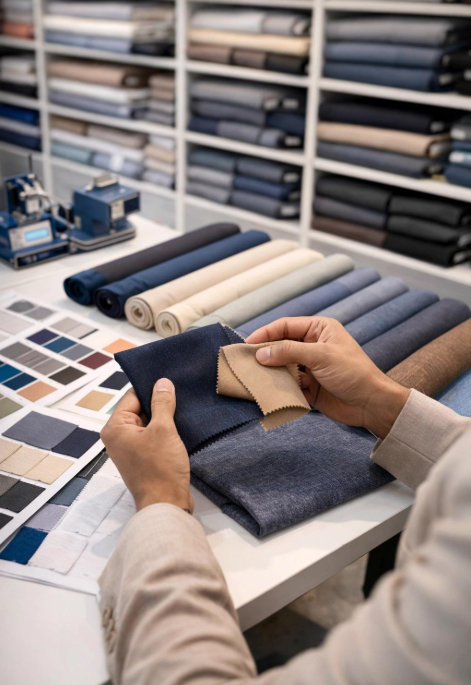
Fabric sourcing is not simply a matter of finding a mill that can produce a certain fabric at the lowest price.
The fabric affects the appearance, handfeel, performance, cost, production schedule, and ultimately the commercial success of the garment. A sourcing decision that looks acceptable on paper can create serious problems later if the material does not match the intended product or if the mill cannot deliver consistent bulk quality on time.
In my experience, effective fabric sourcing begins before contacting a mill.
It starts with understanding exactly what kind of fabric the product requires.
Start by Understanding the Fabric
When I receive an original fabric sample or specification from a customer, I do not immediately send it to mills and ask them to find something similar.
I first analyze as many details as possible.
The initial evaluation normally includes:
- Fabric type
- Weight
- Handfeel
- Color
- Overall appearance
- Current market trend
- Fiber content, when available
- Fabric construction
- Yarn count, when relevant
- Width
- Stretch characteristics
- Surface and finishing characteristics
The purpose is not simply to create a technical specification.
Fabric weight is one of these important considerations because it can directly affect garment performance, consumption, and cost.
It is to understand the character of the fabric and why that particular material works for the intended garment.
Fabric sourcing should not begin with a supplier list. It should begin with a clear understanding of the material the product actually needs.
The Original Sample Is the Most Important Reference
Once a mill submits a fabric development, my first priority is to compare it with the original sample.
Technical specifications such as GSM, yarn count, construction, and width are important, but I do not begin by looking only at numbers.
I first evaluate the fabric as a whole.
Does it have the right appearance?
Does the handfeel resemble the original?
Does the weight feel appropriate for the garment?
Does the surface character look right?
Does the fabric have the same overall balance and direction as the original sample?
And importantly, does it still make sense from a current product and market trend perspective?
This broader comparison should come before focusing on individual technical differences.
A fabric can match the specification and still miss the character of the original sample.
That is why the original sample remains one of the most important references throughout fabric development.
Select Mills by Reliability and Specialization Before Price
Once the fabric requirement is understood, the next step is selecting the right mills to approach.
My preference is to narrow the candidates in this order.
First, I identify mills that I consider reliable.
Reliability may come from previous experience, consistent quality, communication, production performance, and how the mill responds when problems occur.
Second, among those mills, I look for suppliers that regularly produce the same or similar type of fabric.
A mill may technically be capable of producing many fabrics, but that does not mean it produces every fabric equally well.
Experience with the particular fabric category matters.
Only after considering reliability and specialization do I compare factors such as price and lead time.
A mill should not be selected simply because it can produce the fabric. The more important question is whether it can produce that fabric well, consistently, and within the requirements of the order.
Evaluate the Development Against the Original Sample
When the first fabric development arrives, differences from the original sample are common.
The important question is not simply whether there is a difference.
The first question is whether the difference can realistically be corrected.
Different fabrics have different technical limitations. Depending on the construction, yarn, finishing process, weight, or other characteristics, some adjustments may be relatively easy while others may not be realistically achievable.
For example, a developed fabric may have an excellent overall appearance and handfeel but still differ from the required weight or another specification.
That does not automatically mean the fabric should be accepted or rejected.
The mill should first confirm whether the required correction is technically possible.
If it is possible:
Request Correction → Develop Again → Compare Again → Continue
If the required correction is not realistically achievable:
Present the Available Fabric to the Customer → Explain the Difference → Request Customer Direction → Proceed or Stop
This avoids wasting valuable development time repeatedly requesting a technical change that the fabric cannot realistically achieve.
Not Every Fabric Should Be Judged by the Same Tolerance
There is no single tolerance or development rule that works for every fabric.
Some materials allow significant adjustment during development. Others have much narrower technical limits.
Therefore, fabric development decisions should consider the characteristics of the particular material rather than applying the same rule to every fabric.
If the developed material cannot be brought closer to the original sample, the customer should be given a clear understanding of the difference.
The decision can then be made based on the actual available material rather than an unrealistic expectation.
Transparency at this stage is much better than discovering the limitation after bulk production begins.
After Quality Approval, T&A Becomes Critical
Once the customer approves the fabric quality, the next major priority is T&A — Time & Action.
There are still many technical items that must be completed, including:
- Lab dip and color approval
- Handfeel confirmation
- Shrinkage
- Colorfastness
- Width
- GSM
- Other required fabric testing and approvals
These are important, but I view them as individual tasks that must be completed within the overall development and production timeline.
A good fabric is not enough if the necessary approvals and bulk production cannot be completed on time.
This is where fabric sourcing becomes closely connected to production management.
Build the Fabric T&A Backward From the Garment ETA
For me, the final garment ETA should be the key reference point for the fabric schedule.
The fabric timeline should not be managed independently.
Instead, it should be built backward from the required garment delivery.
The general logic is:
Garment ETA
→ Garment Production Schedule
→ Required Bulk Fabric In-House Date
→ Fabric Production Schedule
→ Required Development, Color, Testing, and Technical Approvals
Every fabric activity should support the garment production schedule.
If one approval is late, fabric production may be delayed.
If bulk fabric is late, garment production may start late.
And if garment production starts late, the final garment ETA may be at risk.
The garment ETA is the destination. The fabric T&A should be built backward from that date.
When Lead Time Is at Risk, Work on Multiple Solutions at the Same Time
Sometimes the T&A shows that the selected mill’s normal lead time will not support the required garment ETA.
In that situation, waiting for one solution before considering another can waste valuable time.
I prefer to work on several options in parallel.
Discuss with the current mill whether the lead time can realistically be shortened.
At the same time, investigate alternative mills that may be able to produce the required fabric sooner.
And communicate with the customer regarding the available options and any potential impact on garment delivery.
The process becomes:
Lead Time Risk Identified
→ Negotiate With Current Mill
→ Check Alternative Mills
→ Evaluate Customer Options
→ Protect Garment ETA
These actions do not necessarily need to happen one after another.
They can—and often should—happen simultaneously.
Time lost deciding how to solve a fabric delay can become just as serious as the original delay itself.
There Is No Absolute Formula for Every Sourcing Decision
It is tempting to create a simple sourcing formula such as:
Quality first.
Then price.
Then lead time.
Real production decisions are rarely that simple.
I do not believe there is one absolute rule that should determine every fabric sourcing decision.
Each order should be evaluated according to its own circumstances.
The decision may depend on:
- Customer requirements
- Product characteristics
- Quality expectations
- Target price
- Order quantity
- Delivery requirements
- Mill capability
- Technical limitations
- Production risk
For one order, quality may dominate the decision.
For another, an extremely tight delivery schedule may change the available options.
In another situation, the cost difference between two technically acceptable fabrics may become the deciding factor.
The priority can change because the circumstances of the order change.
The best fabric sourcing decision is not always the same decision. It is the decision that best fits the requirements and risks of that particular order.
Bulk Production Creates Two Major Risks
Once bulk fabric production begins, two areas become especially important.
The first is quality consistency.
The bulk fabric must remain consistent with the quality that was approved during development.
Once bulk fabric arrives, proper fabric inspection becomes an important part of confirming that the material is suitable for production.
Changes in areas such as handfeel, weight, color or shade, finish, shrinkage, or overall appearance can affect the garment even when the original development was successful.
The second concern is the actual completion and delivery date of the bulk fabric.
A mill may have originally committed to a particular schedule, but what ultimately matters is whether the bulk fabric is actually completed and delivered when the garment factory needs it.
A fabric can meet the required quality and still create a serious production problem if it arrives too late.
For this reason, bulk fabric management should continuously monitor both:
Approved Quality vs. Actual Bulk Quality
and
Planned Fabric Delivery vs. Actual Fabric Completion
Both are necessary to protect garment production.
Fabric Sourcing Does Not End When the Fabric Is Selected
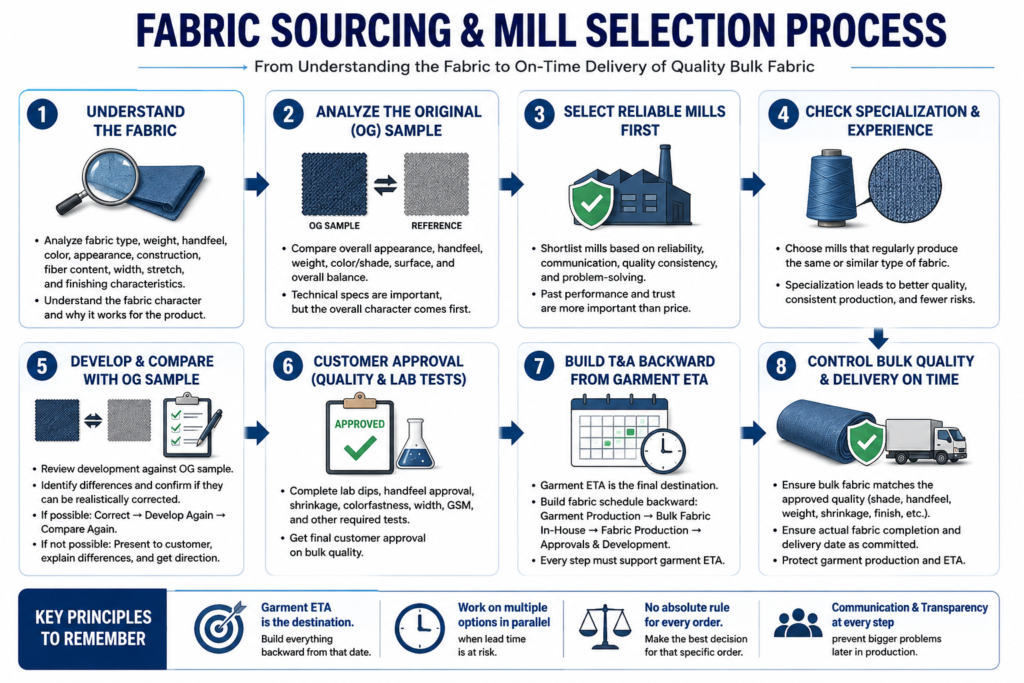
One of the biggest misunderstandings about fabric sourcing is that the job is finished once the right material and mill have been selected.
In reality, that is only the beginning.
The sourcing process continues through:
Fabric Analysis → Mill Selection → Development → Customer Approval → T&A → Technical Approvals → Bulk Production → Quality Consistency → Fabric Delivery → Garment Production
Each stage creates different risks.
A strong sourcing process connects all of them rather than treating fabric selection, fabric production, and garment production as separate activities.
Final Takeaway
Successful fabric sourcing is not simply about finding a fabric that matches a specification.
It begins with understanding the original material—its type, weight, handfeel, color, overall character, and market direction.
It requires selecting mills based on reliability and relevant manufacturing experience before looking only at price.
It requires understanding what can realistically be corrected during development and knowing when the customer must make the final decision.
And once the fabric is approved, sourcing becomes a matter of execution: managing T&A backward from the garment ETA, completing approvals, controlling bulk quality, and making sure the fabric actually arrives when production needs it.
Most importantly, there is no single formula that produces the right decision for every order.
Good fabric sourcing is the ability to understand the material, understand the mill, understand the schedule, and make the right decision for the specific order in front of you.
If you are developing an apparel product and need practical support with fabric sourcing, mill evaluation, production planning, or supplier management, Apparel Production Lab provides consulting based on real-world apparel manufacturing and sourcing experience.