
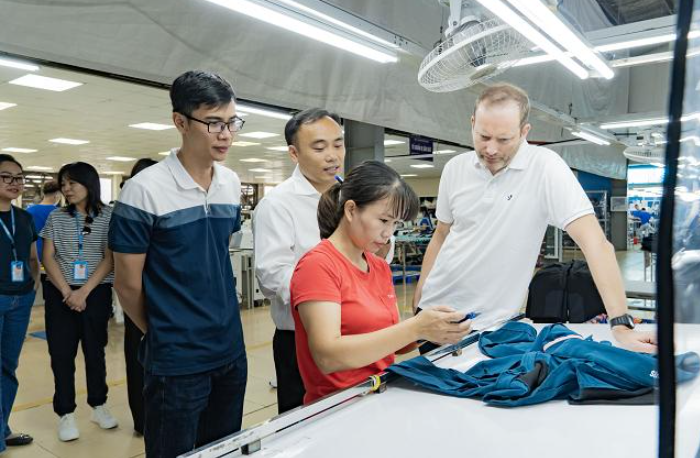
Choosing an apparel factory is not simply a matter of finding a supplier that says, “Yes, we can make it.”
In apparel production, there can be a significant difference between a factory that can produce a product and a factory that can produce it well.
That difference can affect quality, cost, production efficiency, delivery performance, and ultimately the profitability of the order.
When I evaluate a factory for a new order, I normally begin with a practical question:
What has this factory already produced successfully, and how similar is that production to the product I am planning to place?
From there, I evaluate the balance between price and quality, confirm whether the factory can realistically meet the required delivery schedule, and consider the factory’s previous performance if we have worked together before.
For a new factory, I take a more cautious approach.
The objective is not simply to find the cheapest factory or the factory with the most available capacity.
The objective is to find the right factory for the specific order.
Start With What the Factory Has Already Produced
One of the first things I want to see when evaluating a factory is the type of products it has already manufactured.
I compare those products with the order I am considering placing.
I look at areas such as:
- product category
- fabric type
- garment construction
- workmanship
- sewing complexity
- machinery requirements
- finishing requirements
- overall quality level
This gives me a much more practical understanding of the factory’s capability than a simple statement that the factory can make the product.
For a broader review of factory capability, production systems, and readiness before placing an order, see How to Evaluate an Apparel Factory Before Production.
A factory may technically be capable of producing many different garments.
That does not mean it is equally strong at producing all of them.
“Can Make It” and “Can Make It Well” Are Different
This distinction is extremely important.
A factory may say:
“We can produce this style.”
That may be true.
The factory may have the machines, workers, and basic technical capability required to manufacture it.
But my next question is:
“Can this factory produce this type of product well?”
That is a different question.
A factory that has repeatedly produced similar products usually understands the construction, fabric behavior, workmanship requirements, production difficulties, and quality risks much better than a factory encountering the product for the first time.
Past production experience therefore becomes an important part of factory selection.
A factory should not be selected simply because it says it can produce the style. The better question is whether it has demonstrated that it can produce similar products well.
Compare Product Suitability Before Comparing Price
Price is important.
But before making price the deciding factor, I want to know whether the factories being compared are equally suitable for the product.
For example, suppose three factories quote the same garment.
All three may technically be able to manufacture it.
But one factory may already have strong experience with similar garments, while another may have very little experience with that product category.
Their quotations should not automatically be treated as equivalent offers.
The production risk is different.
For this reason, I prefer to establish product suitability first and then evaluate the commercial differences between qualified factories.
Price vs. Quality Is Not a Simple Either-Or Decision
After confirming that a factory is capable of handling the product, price and quality become major considerations.
But I do not believe this decision should always be reduced to:
Cheap factory vs. expensive factory.
Suppose Factory A quotes:
$5.00 per piece
and Factory B quotes:
$5.30 per piece
Factory B may have stronger quality control and more stable production performance.
From a quality perspective, Factory B may clearly be the better choice.
But if the $0.30 difference has a significant impact on the profitability of the order, simply accepting the higher price may not be the best commercial decision either.
There may be another option.
Negotiate Before Making the Final Choice
If I believe the stronger factory is the better production partner but its price is too high, I would normally try to negotiate.
Using the previous example, rather than immediately choosing between $5.00 and $5.30, I might try to reach a commercially workable point somewhere in between—perhaps around $5.15 per piece, depending on the order and circumstances.
The exact number is not the important point.
The principle is.
Factory selection does not always have to be a binary decision between accepting the lowest price or paying the full premium for the stronger factory.
Sometimes the best result comes from recognizing the factory’s stronger capability while negotiating a price that allows both sides to make the order commercially workable.
The Lowest Factory Price Is Not Always the Lowest Production Cost
This is one of the most important lessons in sourcing.
A lower FOB or factory price does not necessarily mean that the total cost of managing the order will be lower.
If I choose the lower-priced factory knowing that its quality management is weaker, I also have to recognize what I may need to provide from my side.
That can include:
- more frequent QC inspections
- additional factory visits
- more time from my quality personnel
- closer production monitoring
- additional follow-up with factory management
- increased inspection before critical production stages
- greater risk of repair or rework
These activities have costs, even if they do not appear in the original garment quotation.
Therefore:
The lowest factory price is not always the lowest production cost.
The real comparison should consider both the quoted price and the resources required to manage the production risk.
Understand What You Are Giving Up for the Lower Price
Sometimes the lower-priced factory is still the right commercial decision.
But that decision should be made consciously.
If I choose a less expensive factory with weaker quality management, I should understand that I may need to compensate for that weakness from my side.
The price saving does not necessarily disappear.
But part of that saving may effectively be exchanged for additional management responsibility.
This is why I do not evaluate price independently from production control.
The question is not only:
“How much cheaper is this factory?”
It is also:
“What additional work and risk will I need to manage because I selected this factory?”
That creates a much more realistic price-versus-quality comparison.
Delivery Capability Is Part of Factory Selection
Even if a factory can make the product well and offers an acceptable price, there is still another critical question:
Can it meet the required delivery date?
A good factory that cannot support the order within the required production window may not be the right factory for that particular order.
This means reviewing more than the factory’s general monthly capacity.
I want to understand the capacity that can actually be allocated to my order.
That may include:
- available sewing lines
- expected line allocation dates
- manpower availability
- current production commitments
- finishing capacity
- packing capacity
- expected daily production
- production ramp-up
- required completion date
The objective is to determine whether the proposed delivery schedule is realistic—not simply whether the factory agrees to it.
For a practical approach to evaluating available lines, actual output, bottlenecks, and delivery requirements, see Apparel Production Capacity Planning: How to Match Orders, Lines, and Delivery Dates.
A Busy Good Factory Should Not Automatically Be Rejected
Capacity needs careful judgment.
If a factory has already demonstrated that it can produce my type of product very well, I would not necessarily reject it simply because its current capacity appears tight.
I would check again.
A factory with proven product experience, reliable quality, and good production performance may still be a better choice than a factory with plenty of open capacity but little relevant experience.
In this situation, I would look closely at:
What capacity can actually be allocated to my order, and can the delivery date still be protected?
If the answer is yes, the experienced factory may remain the better choice.
Available capacity is important, but it should be evaluated together with capability and past performance.
Previous Experience Changes How I Evaluate Delivery Risk
My approach also depends on whether I have worked with the factory before.
If I have already completed several orders with the factory, I have practical information that cannot be obtained from a quotation or factory presentation.
I know more about:
- whether production commitments were realistic
- whether the factory met previous delivery dates
- how quickly problems were communicated
- how management responded when production fell behind
- how quality issues were handled
- whether corrective actions were actually completed
- how dependable the factory was under pressure
That history becomes part of my decision.
Trust in apparel production should not come only from a relationship.
It should come from demonstrated performance over previous orders.
New Factories Require More Verification
A new factory is different.
There is no production history between us.
Therefore, I prefer to verify the production plan much more carefully before placing an important order.
This can include reviewing:
- relevant production experience
- factory organization
- machinery
- line allocation
- available capacity
- quality-control system
- production schedule
- finishing and packing capability
- delivery commitment
A new factory may look excellent during an initial evaluation.
But until actual production begins, much of that assessment is still based on information provided before the working relationship has been tested.
That is why additional verification is important.
Put Delivery Commitments Into the Agreement
For a new factory, I also believe the delivery requirement should be clearly documented in the manufacturing agreement or purchase terms.
The agreement should not leave the required delivery date open to interpretation.
It should clearly identify the factory’s commitment and, where commercially and legally appropriate, the agreed consequences or remedies if the factory fails to meet that commitment.
The exact contractual terms will depend on the buyer, supplier, jurisdiction, order, and commercial relationship.
But the management principle is straightforward:
Important delivery commitments should be documented, not left only as verbal promises.
This becomes especially important when the delivery date is tied to a buyer’s launch date, shipping schedule, seasonal program, promotion, or other time-sensitive requirement.
Do Not Start a New Factory With a Large Order
Even when a new factory appears strong in every initial evaluation, I prefer not to begin the relationship with a large production order whenever I have the option.
Instead, I normally prefer to start with a smaller production quantity.
And I do not consider one successful small order enough to fully understand the factory.
Whenever practical, I prefer to complete approximately two or three smaller production orders before committing a significantly larger volume.
This gives me an opportunity to evaluate the factory under actual production conditions.
Small Production Orders Reveal More Than Samples
Samples are essential, but they do not tell the whole story.
A good sample can demonstrate technical capability.
It can show whether the factory understands the construction, measurement, workmanship, and appearance requirements.
But production introduces additional challenges.
A small production order allows me to observe:
- production consistency
- line management
- actual daily output
- quality-control discipline
- communication
- material handling
- repair and rework control
- finishing and packing
- problem-solving
- delivery performance
These are difficult to evaluate from a few samples alone.
A principle I find useful is:
A sample can show whether a factory can make the product. A small production order begins to show whether the factory can manage the business.
Evaluate the First Two or Three Orders Carefully
The first few orders with a new factory should therefore be treated as an evaluation period.
I want to see whether the factory performs consistently.
One successful order is encouraging.
But the second and third orders can reveal whether that performance was repeatable.
During these initial orders, I pay attention not only to the finished garment but also to how the factory operates when something does not go according to plan.
Problems happen in production.
The important question is often:
How does the factory respond when they happen?
A factory that identifies problems early, communicates clearly, takes corrective action, and protects the delivery schedule can become a valuable long-term production partner.
Move to Larger Orders After Performance Is Proven
If the factory performs well through the initial smaller orders, then I become more comfortable allocating larger production volumes.
At that point, the decision is no longer based primarily on what the factory said during the initial evaluation.
It is based on evidence.
The factory has demonstrated:
Product Capability → Quality Performance → Production Control → Communication → Delivery Performance
That is a much stronger foundation for placing a large order.
Factory Selection Is Also Risk Allocation
Choosing a factory is ultimately a decision about where production risk will be managed.
A stronger factory may cost more but require less intervention.
A lower-priced factory may provide a commercial advantage but require more QC involvement from my side.
A highly experienced factory may have tighter capacity.
A new factory may have open capacity but no proven performance history with my organization.
There is rarely one number that makes the decision automatically.
The responsibility of sourcing and production management is to understand these trade-offs and decide which combination is most appropriate for the specific order.
A Practical Factory Selection Process
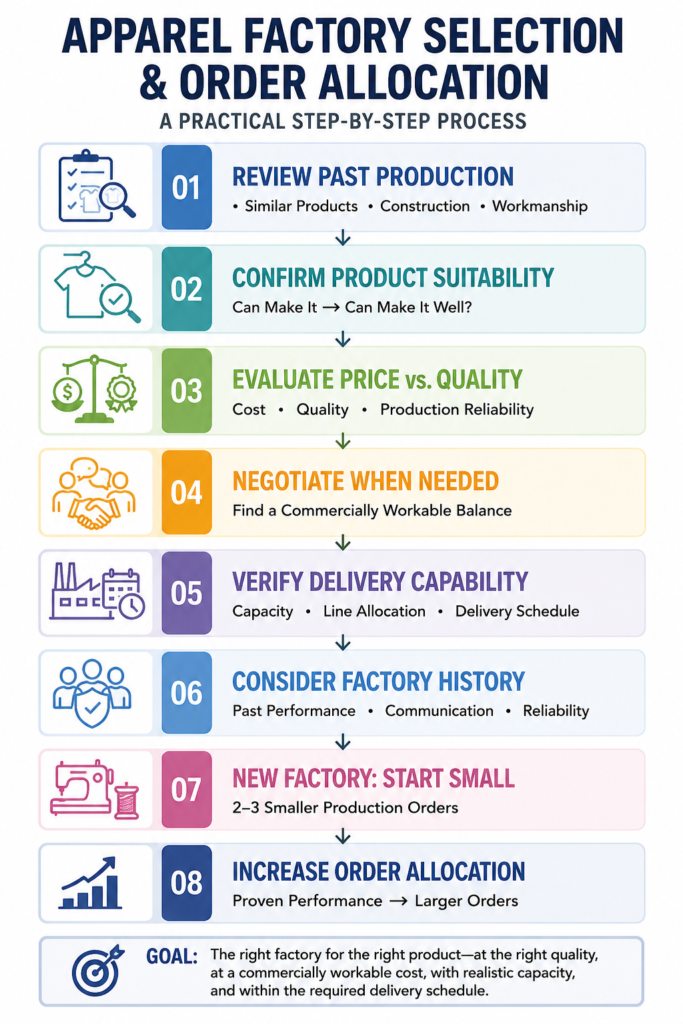
My practical approach can be summarized as:
1. Compare Previous Production
Review what the factory has actually produced and compare it with the product I intend to place.
2. Confirm Product Suitability
Determine whether the factory has demonstrated that it can produce this type of garment well.
3. Evaluate Price vs. Quality
Compare the quotation with the quality level and production reliability being offered.
4. Negotiate When Necessary
If the stronger factory’s price affects profitability too heavily, try to reach a commercially workable middle point.
5. Consider the Real Cost of the Lower Price
Estimate the additional QC, monitoring, inspection, and management resources that may be required.
6. Verify Delivery Capability
Confirm actual available capacity, production schedule, and whether the required delivery date is realistic.
7. Consider Previous Performance
For an established factory, use actual history as part of the decision.
8. Control the Risk of a New Factory
Verify more carefully and document important delivery commitments and responsibilities.
9. Start Small
Whenever possible, place two or three smaller production orders before committing major volume.
10. Increase Allocation After Proven Performance
Move toward larger orders when the factory demonstrates consistent quality, production control, communication, and delivery.
Final Takeaway
The right apparel factory is not necessarily the cheapest factory, the largest factory, or the factory with the most available production lines.
I first want to know what the factory has already produced and whether that experience is relevant to the product I plan to place.
Then I consider price and quality together.
If a stronger factory’s price is too high, I prefer to negotiate before automatically choosing the cheaper alternative.
And if I do choose the lower-priced factory, I recognize that some of the price advantage may need to be supported by additional QC attention and production management from my side.
Delivery capability is equally important.
With factories I know, previous performance helps me judge the risk. With a new factory, I verify more carefully, document the delivery commitment clearly, and whenever possible begin with two or three smaller production orders before allocating large volume.
The central principle is simple:
Do not choose a factory only because it says it can make the product. Choose a factory based on evidence that it can make the product well, at a commercially workable cost, with manageable production risk, and within the required delivery schedule.
That is the difference between simply finding a supplier and building a reliable production base.
Need Help With Factory Selection & Production Sourcing?
Apparel Production Lab provides practical support for factory evaluation, sourcing strategy, order allocation, price and quality assessment, production-capacity review, quality-control planning, and supplier development.
If you need help selecting the right apparel manufacturer, evaluating a new factory, comparing supplier options, or reducing production risk before placing a major order, we can help.