

Apparel production management is not simply asking a factory whether an order is “on schedule.”
Once bulk production begins, the production team needs to know what is actually happening on the factory floor and compare that information with the production plan.
Cutting may be behind schedule. Sewing input may be increasing while output remains low. Finished garments may be accumulating in repair. Packing may not be keeping pace with sewing.
Each of these conditions can affect the final delivery date.
Effective production management therefore depends on continuously comparing Plan vs. Actual, identifying gaps early, understanding their causes, taking corrective action, and confirming that the action actually worked.
A practical production management cycle can be summarized as:
PLAN → ACTUAL → GAP → CAUSE → ACTION → FOLLOW-UP
The objective is not to discover that an order is late.
The objective is to identify when production begins to fall behind the plan—while there is still time to correct it.
Production Control Starts Before Bulk Production
Production control should not begin on the first day of sewing.
When an order is confirmed, the factory should provide a realistic production plan showing how the order will move through manufacturing and how the required delivery date will be achieved.
This plan should be aligned with the overall Time and Action calendar, or T&A.
Before bulk production begins, important conditions should already be understood, including material availability, approvals, production capacity, line allocation, planned cutting, sewing start, expected production output, finishing, inspection, packing, and shipment.
For more information about building and managing the overall production calendar, read Apparel Production Planning & Lead Time: From PO to Warehouse Delivery.
Once production begins, that plan becomes the baseline against which actual factory performance can be measured.
1. Start With Cutting Status
One of the first areas to review is cutting.
But total cutting quantity alone does not provide enough information.
Cutting status should be reviewed according to the structure of the actual order, including:
PO → Color → Size → Quantity
For example, a factory may report that 80% of an order has been cut.
That sounds positive.
But if one important color or size range is significantly behind, the sewing line may not have the correct assortment available to maintain production flow.
This can later affect finished-goods ratios, packing, and shipment even though the overall cutting percentage appeared acceptable.
Production management therefore requires looking beyond the headline number.
The right quantity must be available in the right breakdown at the right time.
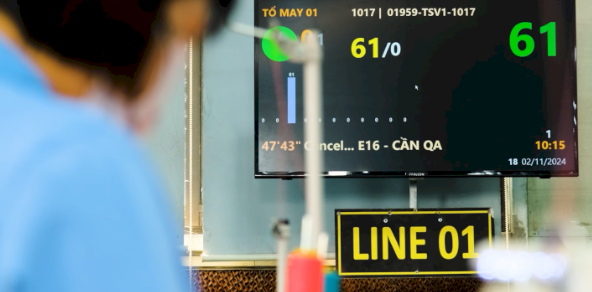
2. Monitor Sewing Input vs. Output
Once cut components enter the sewing floor, one of the most useful indicators is the relationship between sewing input and sewing output.
If input and output are reasonably balanced, production is generally flowing through the line.
But if input continues increasing while output does not keep pace, work-in-process—or WIP—begins accumulating somewhere inside the production line.
That difference is a signal.
It does not automatically explain the problem, but it tells the production manager that something needs to be investigated.
Simply reporting that “sewing is in progress” is therefore not enough.
The more useful questions are:
How much went in?
How much came out?
Where is the balance?
Why is it there?
3. WIP Can Show Where the Problem Is
When input and output begin to separate, the next step is to identify where unfinished work is accumulating.
Excessive WIP may indicate a bottleneck at a particular sewing operation.
For example, several operations may be producing faster than one difficult operation can process the work.
Pieces continue entering the line, but they cannot move through the bottleneck quickly enough.
This is why increasing input does not necessarily increase output.
In fact, pushing additional work into an unbalanced line may simply create more WIP.
Production management should therefore look at flow, not just activity.
4. Recheck the Production Setup
If output is below plan, review whether the production line has been configured appropriately for the garment.
Important questions include:
- Are the correct machines available?
- Are enough machines allocated to critical operations?
- Are operators with the required skills assigned appropriately?
- Is manpower balanced across operations?
- Is one operation creating a bottleneck?
- Does the actual garment construction require more time than originally planned?
- Are special machines or attachments needed?
- Is the production method working as expected?
A production plan may look reasonable on paper but perform differently once actual garments begin moving through the line.
When that happens, the solution may require rebalancing the production setup, rather than simply asking operators to work faster.
5. Look for Unexpected Material Problems
Material readiness does not end when fabric and trims arrive at the factory.
Some problems become visible only during actual manufacturing.
Fabric behavior, stretch, shrinkage, shade variation, feeding problems, puckering, trim attachment, component consistency, or other material characteristics may affect sewing speed and workmanship.
An unexpected material issue can therefore appear to be a production-efficiency problem when the real cause is somewhere else.
This is another reason production problems should be diagnosed before corrective action is selected.
Treating the symptom without identifying the cause can create a second problem instead of solving the first one.
6. Quality and Repair Must Be Part of Production Status
Sewing output does not automatically equal finished-goods output.
Suppose a factory reports that 10,000 garments have come off the sewing line.
If 1,500 garments are waiting for repair, those 10,000 pieces should not be treated as 10,000 completed garments.
Production status should therefore continue through:
Sewing Output → Inspection → Repair → Passed Goods → Packing
This distinction becomes particularly important as the shipment date approaches.
High sewing output may create the appearance that production is almost complete while a significant quantity remains trapped in inspection, repair, finishing, or packing.
A useful principle is:
Sewing output is not finished-goods output.
For more information about production quality systems, read Quality Control in Apparel Production: A Practical Guide for Brands.
7. Repair Quantity Is Also a Production Signal
Repair should not be treated only as a quality department issue.
A rising repair quantity can reduce actual production throughput and create additional work that was not included in the original production plan.
If repair begins accumulating, the production team should determine:
What defects are occurring?
Where are they being created?
Are the same defects repeating?
Has the cause been corrected?
Repairing finished garments without correcting the source of the defect allows the problem to continue.
Quality control and production management therefore need to work together.
8. Follow Production Through Inspection and Packing
Production management should continue beyond sewing.
Actual finished-goods status needs to include inspection and packing.
A useful daily or periodic view may include:
Cut Quantity → Sewing Input → Sewing Output → Inspection → Repair → Passed Quantity → Packed Quantity
Each number provides a different view of the order.
Together they show where the product actually is in the manufacturing process.
This becomes especially important when multiple POs, colors, sizes, or deliveries are being produced at the same time.
The objective is not simply to know how many garments exist somewhere inside the factory.
The objective is to know how many garments are actually ready for the next required step.
9. Compare Actual Production With the Plan
Production numbers become useful when they are compared with the agreed plan.
For each critical milestone, ask:
What was planned by today?
What has actually been completed?
What is the gap?
A small gap does not always mean the shipment is in danger.
But it should be understood.
The key is determining whether the factory has enough remaining capacity and time to recover without affecting later milestones.
This is why production management should be forward-looking.
The question is not only:
“Are we behind today?”
It is also:
“If we continue at the current rate, where will we be at the required completion date?”
10. Find the Cause Before Choosing the Action
When a gap appears, immediately demanding more production is not always the correct response.
First determine why the gap exists.
A practical diagnostic sequence might be:
Plan vs. Actual Gap
→ Input vs. Output
→ WIP Location
→ Machine & Manpower
→ Line Balance / Bottleneck
→ Material Issues
→ Quality & Repair
→ Root Cause
Only after understanding the cause should the corrective action be selected.
Different problems require different solutions.
A machine bottleneck may require additional equipment.
A skill bottleneck may require operator reassignment.
A line-balance problem may require changing manpower allocation.
A material problem may require technical adjustment or supplier action.
A recurring quality problem may require correcting the operation where the defect originates.
Corrective action should address the cause—not merely the number that looks wrong.
11. Corrective Action Must Be Measurable
Taking action is not the end of production management.
The next production report should show whether the action actually improved the situation.
If manpower was added to a bottleneck, did output increase?
If a machine was added, did WIP decrease?
If a quality issue was corrected, did repair quantity decline?
If the line was rebalanced, did input and output move closer together?
This creates the full management cycle:
PLAN → ACTUAL → GAP → CAUSE → ACTION → FOLLOW-UP
Without follow-up, corrective action is only an assumption.
With follow-up, it becomes measurable production management.
12. Do Not Wait Until the Shipment Is Late
One of the biggest advantages of detailed production monitoring is that it provides early warning.
If a production manager waits until final packing to discover that the order is short, many recovery options may already be gone.
But if cutting, sewing flow, WIP, quality, repair, and packing are monitored against the production plan, warning signs can appear much earlier.
That creates time to respond.
Depending on the problem, the response may involve adjusting line allocation, adding resources, changing production sequence, correcting quality issues, revising packing priorities, or—if necessary—communicating a revised delivery plan.
When a production problem affects suppliers, logistics, or customer decisions, the issue also becomes part of broader supply chain management.
For more information, read Apparel Supply Chain Management: From Material Sourcing to Final Delivery.
Production Management Is About Visibility and Control
A production manager cannot control every event inside a factory.
But good production management creates visibility.
It shows:
What was planned → What has happened → Where the product is → What is behind → Why it is behind → What needs to happen next
That visibility allows problems to be addressed while options still exist.
The most useful production report is therefore not necessarily the report with the most numbers.
It is the report that makes the difference between plan and reality clearly visible.
From Production Plan to Shipment
Successful apparel production management connects the entire factory flow:
Cutting → Sewing Input → Sewing Output → Inspection → Repair → Packing → Shipment
Each stage should be measured against the production plan and required delivery date.
Production management is therefore not simply production reporting.
Reporting tells you what happened.
Management determines what should happen next.
And that distinction can determine whether an order ships on time.
Need Help With Apparel Production Management?
Apparel Production Lab provides practical consulting for apparel production management, factory coordination, production planning, quality control, costing, and global sourcing.
Whether you need help monitoring factory performance, identifying production bottlenecks, managing delayed orders, improving production visibility, or building a more effective production-control process, we can help evaluate the situation and develop practical corrective actions.