
Testing is an important part of apparel production, but performing a test is not the final objective.
The real purpose of testing is to provide information that helps determine whether materials and finished products meet the required standards—and whether production should proceed.
Some tests need to be completed before materials are released for production. Others may be required after garments are manufactured, depending on customer, product, or market requirements.
The timing of testing matters.
If a material problem is discovered only after thousands of garments have already been produced, the available solutions may be expensive, time-consuming, or limited.
A practical testing process should therefore connect:
TEST → RESULT → ANALYZE → OPTIONS → IMPACT → APPROVAL → ACTION → VERIFY → RELEASE
Testing provides the information.
Production management determines what to do with it.
Testing Should Support a Production Decision
A test report should not simply be filed as another production document.
The result should answer a practical question:
Can this material or product safely move to the next stage?
If the result meets the required standard, the material or product may be released according to the applicable process.
If the result does not meet the requirement, the production team needs to determine:
Why did it fail?
What can be done?
What will the solution affect?
Does the customer need to approve the change?
How will the correction be verified?
This is why testing and production management should not operate separately.
1. Testing Before Production
Many important tests need to be completed before bulk materials are released for production.
Depending on the fabric, garment, customer, and product requirements, pre-production testing may include areas such as:
- Fabric weight / GSM
- Shrinkage
- Skew or twisting
- Colorfastness
- Fabric width
- Pilling
- Strength
- Stretch and recovery
- Other required performance characteristics
Not every fabric requires exactly the same test program.
The required tests should be determined by the material, intended product, customer requirements, production process, and applicable product requirements.
The important principle is:
Testing should happen early enough for the result to affect the production decision.
2. Test Materials Before They Are Shipped for Production
When bulk fabric or other materials are produced in a different location from the garment factory, required testing should normally be completed before those materials are released for shipment to the production factory.
A practical flow is:
Bulk Material Produced
→ Required Testing
→ Test Result Review
→ PASS / Approval
→ Release for Shipment
→ Ship / Drop-Ship
→ Garment Factory Receiving Inspection
→ Release for Production
This prevents known non-conforming materials from being transported to the garment factory and entering production unnecessarily.
The objective is simple:
Do not knowingly ship a material problem into the garment factory.
3. Testing and Factory Incoming Inspection Are Not the Same
Material testing and factory incoming inspection serve different purposes.
Testing determines whether a material meets defined performance or quality requirements.
Factory incoming inspection confirms that the actual bulk material received at the garment factory is correct, consistent, and suitable for production according to the required inspection process.
For example, fabric may have passed required testing before shipment, but the factory may still need to check areas such as:
- Received quantity
- Shade or lot variation
- Fabric defects
- Width
- Roll condition
- Identification
- Other production-related characteristics
Therefore:
TESTING → Confirms required material performance
INCOMING INSPECTION → Confirms the received bulk material is suitable for production
One does not automatically replace the other.
4. Fabric Weight / GSM
Fabric weight is one of the basic characteristics that can significantly affect the finished garment.
A fabric that is lighter or heavier than the approved requirement may affect:
- Appearance
- Hand feel
- Drape
- Performance
- Consumption
- Cost
- Finished product consistency
For this reason, actual bulk fabric weight should be compared with the required standard and applicable tolerance.
A numerical result alone is not enough.
If the result is outside the requirement, the team needs to determine whether the difference is acceptable, correctable, or requires another production decision.
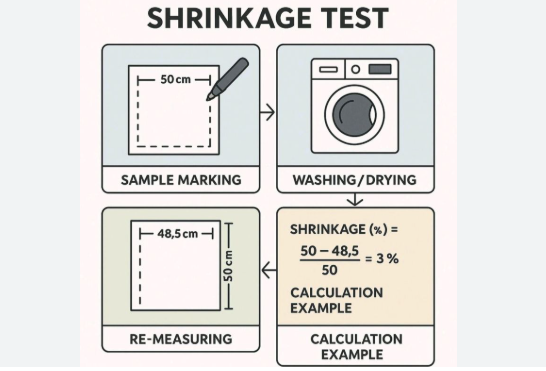
5. Shrinkage Testing
Shrinkage is particularly important because it can directly affect finished garment measurements and appearance.
However, a shrinkage result does not automatically lead to one corrective action.
Suppose bulk fabric shows more shrinkage than originally expected.
The correct response depends on several factors, including:
- Fabric construction
- Direction and amount of shrinkage
- Garment construction
- Finished measurement requirements
- Production process
- Washing requirements
- Customer expectations
Possible solutions may include pattern adjustment, fabric treatment, or another technically appropriate corrective action.
The correct decision should be based on the specific product and situation.
There is no single correction that should automatically be applied to every shrinkage problem.
6. A Technical Solution Can Create a Commercial Problem
Suppose fabric pre-washing or another treatment could reduce a shrinkage problem.
Technically, the solution may work.
But it may also affect:
- Cost
- Lead time
- Fabric hand feel
- Appearance
- Shade
- Width
- Yield or consumption
- Production process
This means the technically easiest solution may not necessarily be the best overall production solution.
If the proposed correction changes the approved material, process, appearance, cost, or delivery, its impact should be evaluated.
Customer approval should be obtained where required before implementing a change that affects the agreed product or commercial conditions.
This leads to an important principle:
A quality solution should not create an unmanaged cost, delivery, or product problem.
7. Skew and Twisting
Skew or twisting can affect the way a finished garment hangs and looks, particularly after laundering.
A fabric may appear acceptable before production but behave differently after washing or finishing.
This is why applicable skew or twisting tests should be reviewed before large-scale production when relevant to the material and product.
If the result is outside the required standard, the team should determine the likely effect on the finished garment before deciding whether the material can be released.
Again, the test result itself is only the beginning of the decision.
8. Colorfastness
Colorfastness testing evaluates how well a material retains or transfers color under specified conditions.
The required testing may depend on the product and customer requirements and can involve different exposures or processes.
A failure may have implications beyond appearance.
Depending on the situation, it may affect other components, garment combinations, customer requirements, or product performance.
Therefore, a failed colorfastness result should be evaluated before the affected material enters bulk production.
The key question remains:
What will this result mean when the material becomes a finished garment?
9. PASS Does Not Mean “Stop Monitoring”
A passing pre-production test is an important production gate.
But it does not mean that all material-related quality risk disappears.
Bulk production may involve multiple lots, rolls, colors, deliveries, or production dates.
The garment factory still needs appropriate receiving and production controls to confirm that the material actually being used remains consistent with the approved requirement.
Testing establishes a standard.
Production control verifies that the standard continues to be met.
For more information about production quality monitoring, read Apparel Quality Inspection: From Cut Pieces to Final AQL Inspection.
10. What Happens When a Test Fails?
A failed test should not automatically produce one standard response.
The first step is to understand the result and determine its cause and potential impact.
A practical decision process is:
FAIL
→ Identify Cause
→ Evaluate Options
→ Determine Quality Impact
→ Determine Cost Impact
→ Determine Lead-Time Impact
→ Customer Approval When Required
→ Corrective Action
→ Re-Test / Verify
→ Release or Reject
Possible decisions may include correction, treatment, pattern modification, material replacement, supplier action, customer-approved deviation, or rejection.
Which option is appropriate depends on the actual problem.
The important point is that the decision should be deliberate and documented—not improvised after production has already started.
11. Corrective Action Must Be Verified
If corrective action is taken, the next question is:
Did it work?
Changing a pattern does not automatically prove that finished measurements will be correct.
Treating fabric does not automatically prove that shrinkage or twisting is now acceptable.
Changing a process does not automatically prove that the original problem has disappeared.
The corrected condition should therefore be tested or otherwise verified as appropriate before release.
This follows the same production-management principle used throughout apparel manufacturing:
ACTION → VERIFY → RELEASE
For more information about corrective action and follow-up during production, read Apparel Production Management: How to Control Production from Cutting to Shipment.
Without verification, the team is assuming that the corrective action worked.
12. Finished Garment Testing After Production
Some testing is performed on finished garments after production, particularly when required by the customer or applicable product/market requirements.
The exact test program depends on the garment and its intended use.
Depending on the product, finished-garment testing may evaluate areas such as:
- Dimensional stability
- Appearance after laundering
- Color performance
- Seam or construction performance
- Functional performance
- Component performance
- Customer-specific requirements
- Product- or market-specific requirements
The important distinction is that post-production testing should not become a substitute for testing critical material characteristics at the appropriate earlier stage.
If a known material risk can reasonably be evaluated before production, waiting until finished garments are completed unnecessarily increases production exposure.
13. Buyer Requirements and Product Requirements Are Not Always the Same
Many finished-garment tests are performed because a customer requires them.
However, customer requirements are not the only consideration.
Depending on the product and market, additional regulatory, safety, labeling, chemical, or performance requirements may apply.
This is why the required testing program should be confirmed for each product and market rather than copied automatically from a previous order.
In practical terms:
Customer Requirement + Product Requirement + Market Requirement → Testing Program
This article does not attempt to cover every regulatory or compliance requirement, because those requirements can vary significantly by product and destination market.
The important production principle is to identify the applicable requirements early.
14. Do Not Discover a Known Risk at the End
One of the most expensive times to discover a material-related problem is after the garments have already been produced.
At that point, the material may have been:
Shipped → Received → Cut → Sewn → Finished → Packed
A problem that could have been addressed at the material stage may now affect thousands of finished garments.
For more information about identifying and minimizing production risks, read Apparel Production Delays: Common Causes, Risks, and How to Minimize Them.
This is why testing should be completed early enough for the result to influence the decision to release materials or production—not simply to document a problem after the product has already been made.
Early testing protects later production.
15. Testing Is a Gate, Not Just a Report
The most useful way to view testing is as a decision gate.
A report showing PASS or FAIL has limited value unless the result changes what happens next.
For example:
PASS → Release
or:
FAIL → Analyze → Correct → Verify → Release / Reject
This makes testing part of the production-control system rather than an isolated laboratory activity.
The same principle applies to other production checkpoints.
A PP meeting determines whether production is ready to begin.
Inline inspection determines whether production is following the approved standard.
Final inspection evaluates whether the completed lot meets the required acceptance criteria.
Testing determines whether the material or product meets the applicable requirement before the next decision is made.
For more information about production readiness, read Apparel Pre-Production Meeting: How to Prepare for Bulk Production.
Testing Provides Information. Management Makes the Decision.
Testing does not manage production by itself.
A test result provides evidence.
The production team then needs to interpret that evidence in the context of:
Quality → Product → Cost → Lead Time → Customer Requirement → Production Risk
That is especially important when the result is outside the original expectation.
The correct response may be technical.
It may be commercial.
It may require customer approval.
And sometimes the correct decision may be not to release the material at all.
The strongest testing process therefore connects laboratory or internal test results directly with production decision-making.
TEST → RESULT → ANALYZE → OPTIONS → IMPACT → APPROVAL → ACTION → VERIFY → RELEASE
That is how testing helps prevent a material problem from becoming a production problem.
Need Help With Apparel Testing & Production Decisions?
Apparel Production Lab provides practical consulting for material evaluation, product development, pre-production planning, quality control, sourcing, production management, and apparel manufacturing.
Whether you need help reviewing test results, evaluating corrective options, coordinating material approvals, or understanding how a testing issue may affect production, cost, quality, or delivery, we can help develop a practical approach based on the specific product and production situation.