
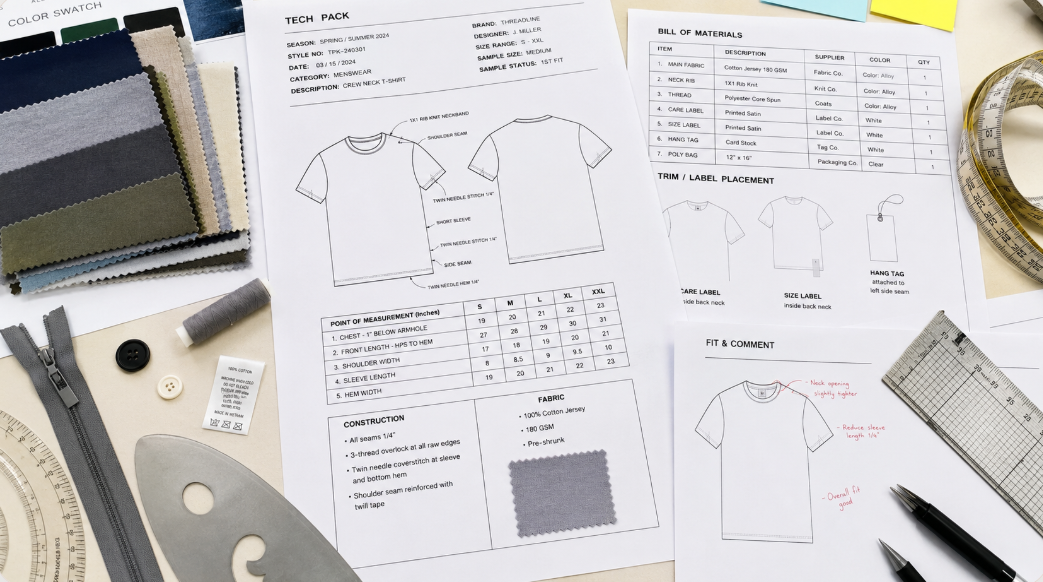
A tech pack is one of the most important communication tools between a brand and an apparel manufacturer.
It tells the factory what the product is expected to be.
But a complete-looking tech pack is not necessarily a production-ready tech pack.
A document may contain sketches, measurements, construction details, materials, artwork, and labeling information while still containing conflicting instructions, missing details, or outdated revisions.
The real purpose of a tech pack is not simply to provide information.
A good tech pack should reduce assumptions.
Before development or production proceeds, the factory should understand the garment, cross-check the information, clarify discrepancies, and confirm that everyone is working from the correct revision.
A practical process is:
UNDERSTAND → CROSS-CHECK → IDENTIFY DISCREPANCY → INVESTIGATE → CLARIFY → CONFIRM → UPDATE → CONTROL REVISION → DISTRIBUTE → VERIFY
Start by Understanding the Garment
When reviewing a new tech pack, it can be tempting to begin by checking individual measurements or BOM items.
But before reviewing the details, the production team should first understand:
What garment are we trying to make?
A practical review often begins with the design or sketch.
The sketch provides the overall visual direction of the product.
Next, review the construction.
How is the garment supposed to be assembled?
What seams, finishes, panels, openings, closures, or special operations are required?
Once the overall product and construction are understood, the remaining information becomes easier to evaluate in context.
1. Review the Design and Sketch
The design or technical sketch should communicate the overall appearance and important garment details.
Depending on the product, this may include:
- Front and back views
- Panels
- Seams
- Pockets
- Closures
- Collars
- Cuffs
- Waistbands
- Stitching details
- Placement details
- Other design features
The sketch should not be treated as decoration.
It is part of the technical communication.
If a feature shown in the sketch does not appear in the construction instructions or other specifications, that difference should be investigated.
2. Review the Construction
After understanding the design, review how the garment is intended to be made.
Construction information may cover areas such as:
- Seam type
- Stitch type
- Seam allowance
- Hem construction
- Edge finishing
- Reinforcement
- Binding
- Facing
- Lining
- Zipper or closure application
- Special sewing operations
The exact requirements depend on the garment.
This stage is important because a garment can look correct in a sketch but require very different production methods depending on the intended construction.
Construction also affects:
Quality → Appearance → CM/CMPT → Equipment → Production Efficiency → Lead Time
Therefore, unclear construction information should be resolved before it becomes a sample-room assumption.
3. Review Materials and BOM
Once the product and construction are understood, review the materials required to build it.
The Bill of Materials may include:
- Shell fabric
- Lining
- Interlining
- Rib
- Elastic
- Zippers
- Buttons
- Snaps
- Thread
- Labels
- Hangtags
- Packaging materials
- Other trims and components
The production team should confirm that the material descriptions, specifications, colors, sizes, placements, and other relevant requirements are consistent with the rest of the tech pack.
For more information about managing materials from approval through production, read Apparel Fabric & Trim Management: From Approval to Production.
4. Review Measurement Specifications
The measurement specification defines the dimensions the garment is expected to achieve.
Depending on the product and customer, it may include:
- Points of Measure
- Base-size measurements
- Size grading
- Tolerances
- Measurement methods
- Diagrams or reference points
But a measurement table should not be reviewed independently from the garment design.
For example, a measurement may technically be listed in the spec while conflicting with the sketch, construction, pattern intent, or another measurement.
This is why understanding the garment first is important.
Numbers should describe the garment—not contradict it.
5. Review Artwork, Placement, Labels, and Packing Requirements
Depending on the product, the tech pack may also contain instructions for:
- Embroidery
- Heat transfer
- Logo placement
- Artwork dimensions
- Color references
- Main labels
- Size labels
- Care labels
- Hangtags
- Folding
- Polybags
- Carton packing
- Other customer-specific requirements
These details may involve different suppliers or factory departments.
Therefore, unclear or outdated information can affect more than the sample room.
One incorrect instruction can travel through several parts of the supply chain.
6. Cross-Check the Entire Tech Pack
After reviewing each section, cross-check the information.
This is one of the most important steps.
Ask whether the different parts of the tech pack agree with each other.
For example:
Sketch ↔ Construction
Construction ↔ BOM
Sketch ↔ Measurement Spec
Artwork ↔ Placement Instruction
Trim Specification ↔ Garment Construction
Color Information ↔ BOM
The objective is not simply to ask:
“Is every page filled in?”
The better question is:
“Does all of this information describe the same garment?”
7. Do Not Guess When Information Conflicts
Suppose the sketch indicates one construction while another page indicates something different.
The factory should not simply choose whichever instruction appears more reasonable and continue.
First determine:
What is different?
Why might it be different?
Which direction appears technically consistent with the intended product?
What needs customer confirmation?
The production team may be able to identify the likely correct answer through the design, previous comments, approved references, construction logic, or other available information.
But there is an important distinction:
Finding the likely correct answer is not the same as receiving production confirmation.
If the information is customer-controlled, the discrepancy should be communicated and the correct direction confirmed before it becomes the production standard.
8. Investigate Before Sending the Question Back
When conflicting information is found, simply sending:
“Which one is correct?”
may not be the most effective communication.
The production team should first understand the issue as much as reasonably possible.
For example:
Tech Pack Page A indicates one construction.
Page B indicates another.
Based on the sketch and intended garment construction, A appears consistent.
Now the customer receives a specific issue and a proposed direction rather than an unexplained question.
This can reduce unnecessary communication cycles and speed up development.
A useful flow is:
IDENTIFY → INVESTIGATE → EXPLAIN → RECOMMEND → CONFIRM
9. Use a Mock-Up When Words Are Not Enough
Some construction issues are difficult to explain clearly through email, comments, or marked-up sketches.
In those situations, a mock-up sample can be extremely useful.
A mock-up may demonstrate:
- Two possible constructions
- Seam or finishing options
- Placement differences
- Shape or proportion
- Function
- Difficult technical details
The mock-up does not always need to be a complete garment.
Its purpose is to make the technical question easier to understand.
When written instructions are unclear, a mock-up can sometimes communicate the problem more accurately than another email.
The mock-up can then be submitted together with an explanation of the discrepancy and the proposed solution.
10. Request Correction or Confirmation
Once the correct direction has been confirmed, the documentation should also be corrected.
This is important.
If the customer confirms by email that one instruction is correct but the tech pack continues to show the old information, the same problem can return later.
The confirmed decision should therefore be incorporated into the working technical documentation.
The goal is:
One confirmed direction → One current production reference
Verbal or email clarification may solve today’s question.
Updated documentation helps prevent tomorrow’s mistake.
11. Tech Packs Change During Development
A tech pack is often revised several times before production.
Fit comments may change measurements.
Construction may be modified.
Materials may change.
Artwork placement may move.
Labels or packing requirements may be updated.
This is normal.
The risk is not that the tech pack changes.
The risk is that different parties begin working from different revisions.
For example:
Pattern Team → Latest Version
Sample Room → Previous Version
Trim Supplier → Earlier Version
Each party may believe it is following the correct instruction.
The result can still be wrong.
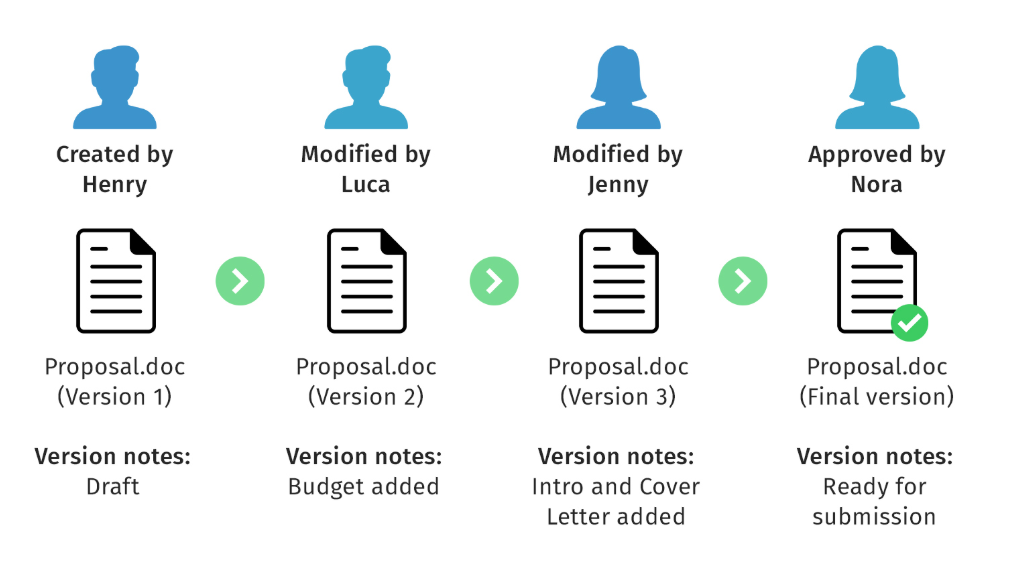
12. Revision Control Matters
Revision control should make two things possible:
Preserve what changed
and
Make the current instruction unmistakable
A practical system may retain the complete history of the tech pack while clearly identifying superseded information.
For example, each revision or page may show a date, and obsolete versions may be visibly marked with a large X or SUPERSEDED indication.
The latest working version should clearly show its most recent revision date.
Where practical, using both a revision number and date provides even clearer control:
Rev. 01 — Aug 10
Rev. 02 — Aug 14
Rev. 03 — Aug 18 — CURRENT
This can be especially useful when more than one revision occurs on the same day.
Revision control should preserve the history without creating confusion about which instruction is current.
13. Do Not Simply Delete the History
There is value in keeping previous revisions.
If a production issue appears later, the revision history can help answer:
What changed?
When did it change?
What instruction existed at that time?
Which version was distributed?
This can be useful when investigating the root cause of a development or production discrepancy.
The objective is therefore not to erase old information.
It is to make sure nobody accidentally uses it as the current production instruction.
Keep the history. Clearly cancel the obsolete instruction.
14. Distribute the Latest Revision to the Right Parties
Updating the master tech pack is not enough.
The correct revision needs to reach everyone whose work is affected.
Depending on the change, this may include:
- Merchandising
- Pattern team
- Sample room
- Material supplier
- Trim supplier
- Cutting
- Sewing
- Quality
- Packing
- Other relevant parties
Not every revision needs to be distributed to every supplier or department.
The important point is to identify who is affected by the change and make sure they receive the current information.
A revision that exists only in one person’s computer has not been fully controlled.
15. Connect the Final Tech Pack With the Approved Sample
A tech pack is a technical reference.
An approved sample is a physical reference.
Before bulk production, these two should agree.
The production team should confirm that the latest tech pack reflects the approved:
- Design
- Construction
- Measurements
- Materials
- Trims
- Artwork
- Labels
- Other applicable requirements
If the approved sample reflects a customer comment that was never incorporated into the final documentation, production risk remains.
Therefore:
APPROVED SAMPLE ↔ FINAL TECH PACK
should be part of production readiness.
16. The PP Meeting Is the Final Cross-Check Before Production
The pre-production meeting provides another opportunity to confirm that the latest technical information matches what the factory will actually produce.
The team can compare:
Final Tech Pack
↔ Approved Sample
↔ Approved Pattern
↔ Actual Bulk Fabric
↔ Actual Bulk Trims
↔ Production Method
This is where document control becomes production control.
The objective is not simply to say:
“We have the latest tech pack.”
The objective is to confirm:
“The factory is prepared to produce according to the latest approved information.”
17. A Complete Tech Pack Can Still Be Wrong
A tech pack can look extremely detailed and professional while still containing a contradiction.
Twenty pages of information do not eliminate risk if two important pages tell the factory to do different things.
This is why document completeness and document accuracy are different.
More information is not automatically better information.
The production team should understand, cross-check, and verify the technical information rather than treating the tech pack as unquestionable.
18. A Tech Pack Should Reduce Assumptions
Factories make hundreds of decisions during product development and production.
Some decisions properly belong to the factory.
Others belong to the customer.
A strong tech pack helps separate the two by clearly defining the approved product requirements.
When important information is missing or contradictory, the factory is forced to make assumptions.
Every unnecessary assumption creates another opportunity for:
Sample Rejection → Rework → Cost Increase → Approval Delay → Production Delay
For more information about how development and production issues can affect the overall schedule, read Apparel Production Delays: Common Causes, Risks, and How to Minimize Them.
The Tech Pack Is a Living Production Reference
A tech pack should not be viewed as a document that is received once at the beginning of development and then filed away.
It develops with the product.
Fit changes may affect measurements.
Construction changes may affect CM.
Material changes may affect quality and cost.
Artwork changes may affect suppliers.
Packing changes may affect shipping.
Each confirmed change should ultimately lead back to one controlled production reference.
A practical process is:
UNDERSTAND → CROSS-CHECK → IDENTIFY → INVESTIGATE → CLARIFY → CONFIRM → UPDATE → CONTROL REVISION → DISTRIBUTE → VERIFY
The best tech pack is not necessarily the one with the most pages.
It is the one that gives the people responsible for making the garment the clearest possible understanding of what has been approved.
A tech pack should reduce assumptions, not simply provide information.
Need Help With Apparel Tech Packs & Production Readiness?
Apparel Production Lab provides practical consulting for product development, tech pack review, sampling, sourcing, pre-production planning, quality control, and apparel manufacturing.
Whether you need help reviewing technical information, identifying development discrepancies, coordinating factory clarification, or preparing a style for bulk production, we can help develop a practical process based on the product and production requirements.