
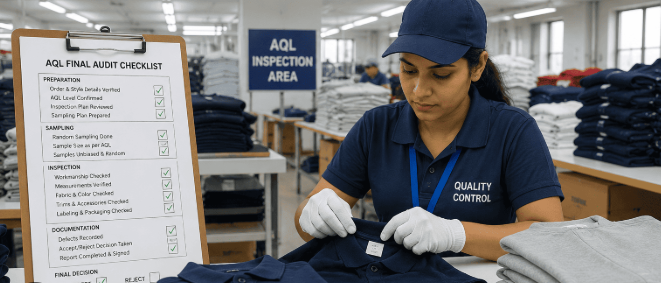
Apparel quality inspection should not begin when finished garments are packed and ready to ship.
By that point, thousands of garments may already have passed through cutting, sewing, finishing, and packing. If a systematic quality problem is discovered only at final inspection, correcting it may require extensive repair, repacking, additional inspection, production delays, or even remanufacturing.
A more effective approach is to inspect quality throughout production and use the results to improve the process while garments are still being made.
A practical inspection flow may include:
Cut Pieces Check → Early Inline Inspection → First Finished Garment Inspection → Factory End-Line QC → Compare & Analyze → Corrective Action → Re-Check → Packing → Final AQL Inspection
The objective is not simply to find defects.
The objective is to find problems early enough to prevent them from continuing through larger quantities.
Quality Inspection Is Part of Quality Control
Quality inspection and quality control are related, but they are not exactly the same thing.
Inspection identifies whether materials, components, workmanship, measurements, or finished garments meet the required standard.
Quality control is the broader system that uses those inspection results to prevent, correct, and verify quality throughout production.
A useful way to think about the relationship is:
Inspect → Identify → Correct → Verify
Finding a defect without correcting its cause is inspection.
Using that information to prevent the defect from continuing is quality control.
For a broader discussion, read Quality Control in Apparel Production: A Practical Guide for Brands.
1. Inspection Should Begin Before Sewing
Before sewing begins, cut components should be checked.
Once incorrect cut pieces enter the sewing line, a problem created in cutting can quickly become a sewing problem affecting many garments.
Depending on the product and material, cut-piece inspection may include:
- Cutting accuracy
- Fabric defects
- Shade variation
- Matching and alignment
- Notches and reference points
- Component identification
- Numbering and bundling
- Size identification
- Directional fabric or print requirements
The purpose is not necessarily to inspect every possible characteristic of every cut component.
The purpose is to confirm that the sewing line is receiving components that are suitable for production and consistent with the approved product requirements.
Quality problems should be stopped as close as possible to where they originate.
2. Do Not Wait for the First Finished Garment
Once the first bulk sewing line begins operating, an early inline inspection can provide valuable information before the first garments are completely finished.
This inspection takes place while the first garments are still moving through the sewing operations.
Partially assembled garments may reveal problems involving:
- Sewing method
- Seam construction
- Stitch quality
- Alignment
- Operation sequence
- Attachments
- Workmanship
- Fabric handling
- Machine setup
Some construction details may actually be easier to observe before later operations cover or enclose them.
This leads to an important principle:
Quality inspection should not begin with a finished garment. It should begin before defects become hidden inside the finished garment.
And:
Do not wait for the first finished garments to discover whether the sewing line is producing the garment correctly.
3. Early Inline Inspection Is Different From PP Sample Approval
The PP sample and early inline inspection serve different purposes.
A PP sample establishes the approved production standard before bulk manufacturing.
It helps confirm what the factory is expected to produce.
Early inline inspection asks a different question:
Is the actual bulk production line producing the garment according to that approved standard?
Even when the PP sample is correct, bulk production may introduce new variables involving operators, machines, production methods, fabric behavior, line balancing, or workmanship.
For more information about the approval sequence before bulk production, read Garment Sampling Process: From First Sample to Production Approval.
4. Inspect the First Finished Garments
When the first finished garments come off the sewing line, they should be reviewed again.
The early inline inspection shows what is happening during construction.
The first finished garments show how those operations come together as a complete product.
At this stage, inspection may include:
- Overall appearance
- Workmanship
- Measurements
- Construction
- Symmetry and alignment
- Stitching
- Trims and components
- Labels
- Functionality where applicable
- Comparison with the approved sample and specifications
This is an important checkpoint because production has started, but there is still an opportunity to correct systematic problems before they affect much larger quantities.
5. Compare Your Inspection With Factory End-Line QC
An independent production or quality inspection should not exist separately from the factory’s own QC system.
After reviewing the first finished garments, compare the findings with the factory’s end-line inspection results.
The purpose is not simply to determine who found more defects.
The more important question is:
Are both inspections identifying the same quality issues?
If your inspection repeatedly identifies a defect that factory QC does not report, investigate why.
Possible reasons may include:
- Different defect standards
- Different interpretation of specifications
- Different measurement methods
- Different tolerances
- Different inspection samples
- Inconsistent approved references
- Inspection technique
- A weakness in the factory QC process
Before concluding that one inspector is wrong, confirm that both sides are using the same approved standards and inspection criteria.
The objective should not be:
“Who is right?”
It should be:
“Why are the results different, and what needs to be corrected?”
6. Inspection Should Test the Quality System, Not Just the Garment
This comparison provides another important benefit.
It helps evaluate whether the factory’s own quality-control system is functioning effectively.
A production manager or outside inspector cannot personally inspect every garment throughout every order.
The factory must have a quality system capable of identifying and correcting problems during daily production.
This is why:
A good inspection does more than identify garment defects. It also verifies whether the factory’s own quality-control system is identifying the same problems.
If the same serious defect is repeatedly missed by factory QC, the problem is no longer limited to the garment.
It may indicate a weakness in the QC process itself.
7. Feed Inspection Results Back Into Production
Inspection findings should not remain only on an inspection report.
If a recurring defect is identified, the information needs to return to the point in production where the problem is being created.
For example, the response may involve:
- Correcting a sewing operation
- Adjusting machine settings
- Changing an attachment
- Rebalancing an operation
- Retraining or instructing an operator
- Clarifying workmanship requirements
- Correcting a measurement method
- Reviewing material behavior
- Revising an inspection standard
The purpose is not simply to repair the garments already affected.
It is to prevent the next garments from developing the same problem.
8. Corrective Action Must Be Verified
Giving a correction instruction does not mean the problem has been solved.
Production should be checked again after corrective action.
Did the defect disappear?
Did the frequency decrease?
Did the correction create another quality problem?
Are factory QC inspectors now identifying the issue correctly?
This creates the feedback loop that should drive effective production inspection:
DETECT → COMPARE → ANALYZE → CORRECT → VERIFY
Without verification, corrective action is only an instruction.
With verification, it becomes measurable quality control.
9. Continuous Inline QC Matters
The first inline and first finished-garment inspections are important, but quality monitoring should not stop there.
Production conditions can change.
Operators may change. Machines may be adjusted. Different colors or fabric lots may enter production. Production speed may increase. New problems may appear later in the order.
Factory inline QC should therefore continue monitoring production while garments are being manufactured.
The purpose is to identify changes before they become large-volume problems.
Quality control should move with production.
10. End-Line Inspection
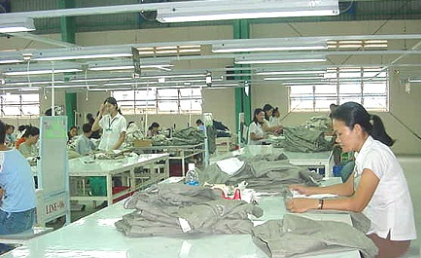
At the end of sewing, garments are generally inspected before moving further into finishing and packing.
End-line inspection provides an opportunity to identify workmanship and construction problems before garments are treated as completed goods.
Defective garments may be separated for repair while acceptable garments continue through the process.
However, repair quantity itself should also be monitored.
A large or increasing repair balance can indicate that production is continuing to create the same defects faster than they are being corrected.
At that point, the issue becomes both a quality problem and a production-management problem.
For more information, read Apparel Production Management: How to Control Production from Cutting to Shipment.
11. Finishing and Packing Are Part of Quality
A garment can be sewn correctly and still fail customer requirements during finishing or packing.
Inspection should therefore consider, where applicable:
- Pressing and finishing
- Measurements
- Appearance
- Cleanliness
- Labels
- Hangtags
- Size stickers
- Folding
- Polybags
- Assortments
- Barcodes
- Carton quantities
- Carton markings
Packing errors can create serious warehouse and retail problems even when garment workmanship is acceptable.
Quality does not stop when sewing stops.
12. Factory 100% Inspection and Final AQL Inspection Are Different
Factory inspection and final AQL inspection should not be treated as substitutes for one another.
During production, the factory may perform 100% inspection of garments according to the required quality system.
The purpose is to identify defective garments, correct them where appropriate, and prevent unacceptable goods from being packed.
Final AQL inspection serves a different purpose.
It uses a defined sampling plan to inspect selected units from the completed shipment lot and make an acceptance decision according to the applicable inspection standard and customer requirements.
Therefore:
Factory 100% Inspection → Controls individual production quality
while
Final AQL Inspection → Evaluates the completed lot through sampling
Both can be important parts of the overall quality process.
13. What Final AQL Inspection Should Confirm
A final inspection should be conducted when the order has reached the required level of completion and packing specified by the applicable inspection procedure.
Depending on customer requirements, the inspection may verify:
- Workmanship
- Measurements
- Appearance
- Color and shade
- Construction
- Functionality
- Labels
- Size and color assortment
- Packing
- Carton markings
- Quantity
- Buyer-specific requirements
Defects may be classified according to the applicable inspection standard and customer criteria, often using categories such as critical, major, and minor.
The exact AQL level, sample size, acceptance criteria, and inspection procedure should follow the customer’s requirements and the applicable sampling standard.
This is important because there is no single AQL setting that should automatically be assumed for every brand, product, and order.
AQL Does Not Mean “Acceptable Defects Are the Quality Goal”
AQL is sometimes misunderstood as meaning that a certain number of defective garments is considered desirable or automatically acceptable throughout production.
That is not the purpose.
AQL is used as part of a statistical sampling and lot-acceptance process.
The production goal should still be to manufacture goods according to the required quality standard.
Final sampling helps determine whether the completed lot meets the agreed acceptance criteria.
In other words:
AQL is an inspection decision tool—not a production quality target.
14. Final Inspection Should Confirm Quality, Not Create It
If a major systematic problem is discovered for the first time during final inspection, the problem may have been created much earlier.
By final inspection, garments may already have been:
Cut → Sewn → Finished → Inspected → Repaired → Packed
Correcting a large-volume issue at this stage can be expensive and time-consuming.
That is why final inspection should function as the last verification of an already operating quality system.
Final inspection should confirm quality—not create quality.
The later a quality problem is discovered, the more difficult and expensive it usually becomes to correct.
Inspection Is a Feedback System
The strongest inspection process is not a series of isolated checkpoints.
Each inspection should provide information to the next production decision.
Cut-piece inspection protects sewing.
Early inline inspection protects the developing production line.
First finished-garment inspection confirms how the garment is coming together.
Comparison with factory QC evaluates the effectiveness of the factory’s own inspection system.
Corrective action improves ongoing production.
Final AQL inspection evaluates the completed shipment lot.
Together, these activities create a continuous quality feedback system.
Detect → Compare → Analyze → Correct → Verify
That is when inspection becomes more than defect detection.
It becomes part of production management.
Need Help With Apparel Quality Inspection?
Apparel Production Lab provides practical consulting for quality control, factory evaluation, production management, product development, sourcing, and apparel manufacturing.
Whether you need help establishing inspection procedures, evaluating factory QC performance, identifying recurring defects, managing corrective actions, or preparing production for final inspection, we can help develop a practical quality-control approach for your product and production requirements.